Fenugreek Polysaccharide Identity
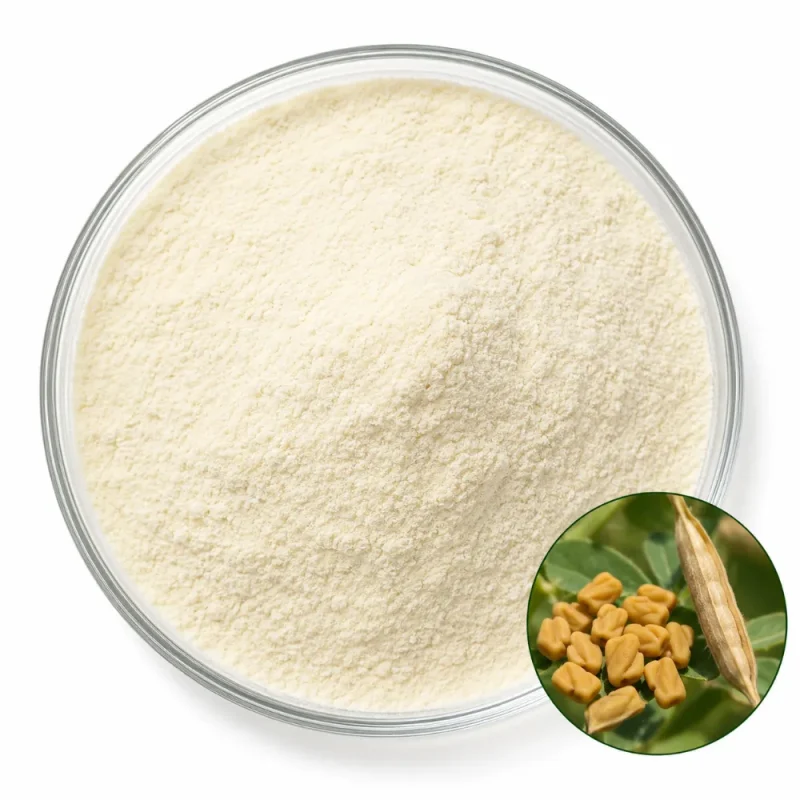
The source is the seed of Trigonella foenum-graecum L., fenugreek, an annual legume of the family Fabaceae. The seed is the only plant part used. Fenugreek leaf, sold as methi or kasuri methi, is a different raw material that does not carry a comparable amount of gum, and the whole seed spice and the fiber-rich husk are separate products. Fenugreek galactomannan is stored in the endosperm that surrounds the embryo, a thick reserve layer that swells strongly in water.
A galactomannan has a backbone of mannose units with single galactose units attached along the chain. Fenugreek galactomannan is unusual among the seed gums because it carries a high degree of galactose substitution, with roughly one galactose for each mannose. Guar has about one galactose for every two mannose units, and locust bean gum has about one for every four, so the fenugreek gum is the most heavily substituted and the most readily water-soluble of the three.
Seed extraction also brings out saponins, the alkaloid trigonelline, 4-hydroxyisoleucine and protein. Ethanol precipitation keeps the large gum molecules and leaves most of those small compounds in the supernatant. Fenugreek galactomannan therefore differs from the whole-seed extracts in composition and flavor, and the powder has little of the strong, maple-like aroma of the spice.
Related fenugreek materials serve other questions. Fenugreek Extract Powder is the whole water extract, Fenugreek Extract 50% Saponins is the saponin-standardized grade, and Trigonelline 98% is the isolated alkaloid.