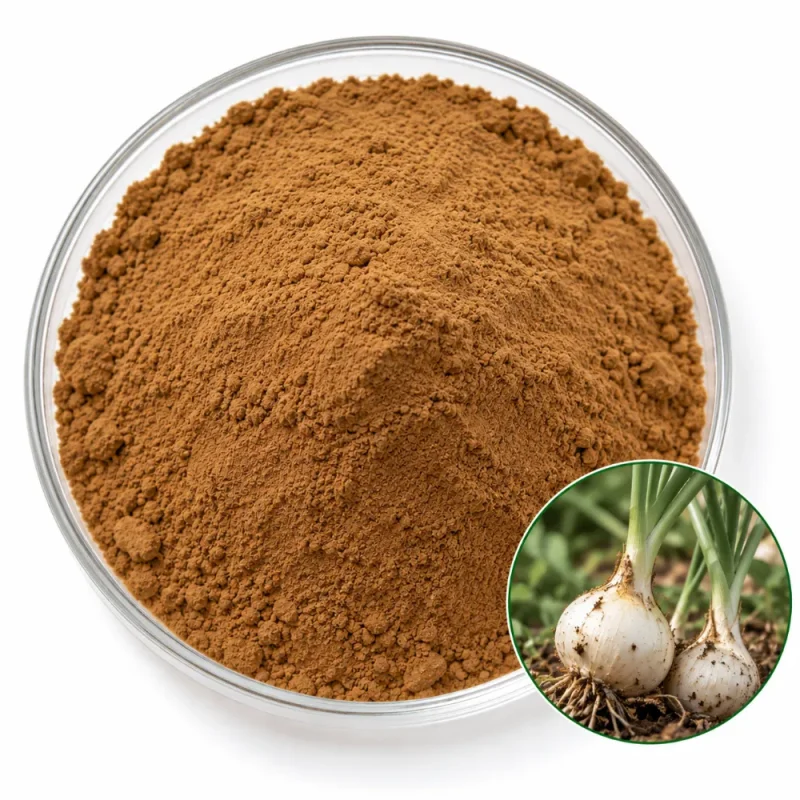
Allium Macrostemon Extract Powder

Allium macrostemon extract powder comes from the bulb of the long-stamen chive, a wild onion-family plant sold in Chinese trade as xie bai. The bulb is extracted with water, concentrated and dried to a light brown powder with a muted allium note.

The product is a 10:1 ratio extract with no marker percentage attached. It is water dispersible and milled to 80 mesh. The data for this botanical lists no powdered or standardized sibling, so the ratio extract is the only form described, and species and bulb define it.

Allium macrostemon Identity & Plant Part

The botanical entity is Allium macrostemon Bunge, family Amaryllidaceae, the onion family. The part used in this Allium macrostemon extract is the bulb; leaves, flower stalks and seeds are not part of the product. In Chinese trade the bulb is xie bai, also called long-stamen onion or Chinese chive bulb.

The pharmacopoeial source of xie bai also includes Allium chinense, the rakkyo, so the same trade name covers two species. The extract is also not garlic, Allium sativum, nor an onion extract, even though sulfur-containing compounds are characteristic across the genus. A buyer comparing offers should match the binomial and the bulb as plant part. Allium macrostemon extract should be read as a bulb ingredient only, because the leaves and flower stalks of the plant differ in composition and in use.

What 10:1 Means for Allium macrostemon

The 10:1 figure tells a buyer how much starting bulb went into one part of powder and nothing else. It is not a measure of sulfur compounds, saponins or any other marker. No standardized extract, powder or isolated compound of Allium macrostemon is listed among the siblings, so the ratio extract is the only profile described.

Choose it when the species and the bulb are the requirement. Because trade names and genus-level descriptions overlap with garlic and with rakkyo, the botanical name in the table is the reliable identifier. A formulator should treat this ingredient as a mild allium-type extract, with a smaller aroma than raw bulb.

Typical Specifications

Specification ItemProduct Information
Latin NameAllium macrostemon
Plant PartRoot & Rhizome
ProcessingWater Extraction
Common NameChinese Chive Bulb, Xie Bai
Ingredient TypeRatio Extract
Extract Ratio10:1
AppearanceLight Brown powder
Solubility / DispersibilityWater Dispersible
Quality Parameters
Moisture (LOD)≤5.0%
Total Ash≤5.0%
Particle Size80 mesh
Heavy MetalsLead ≤2 ppm · Arsenic ≤1 ppm · Cadmium ≤1 ppm · Mercury ≤0.1 ppm
MicrobiologyTPC ≤1,000 cfu/g · Yeast & Mold ≤100 cfu/g · E. coli Negative · Salmonella Negative/25 g
Shelf Life24 months in unopened original packaging, cool and dry storage

Application Areas

Light Capsule Fills

A plain capsule shell hides the powder’s color, so shell choice is not critical. Bulb extracts can be hygroscopic and cohesive, so run a flow check on the lot before filling and weigh capsules at intervals to catch drift across the run.

Spice-Led Drink Powders

The mild allium note of the extract needs masking in drink powders, and ginger or warm-spice flavors can carry it better than fruit. Taste a plain-water sample first, because sulfur-type aromas are more obvious in clear drinks.

Instant Tea-Style Sachets

Instant sachets can combine the extract with ginger or licorice-type extracts in a tea-style cup. Dissolve samples in hot and cold water to compare aroma and haze, and screen the powder into the premix so the tint spreads evenly.

Tablets with Bulb Extracts

Formulators press the extract with a dry binder and a disintegrant. Bulb extracts take up moisture before compression, so keep humidity low and test hardness and disintegration on finished tablets. A faint allium note may need a mint or ginger flavor to stay unobtrusive.

Bars with Mild Allium Extract

In nut or seed bars the extract adds a faint allium background. Stir it into the dry premix before the binder and sieve it, because wet lumps of bulb powder are hard to break up once the syrup has set.

Formulation Notes

The extract is a light brown powder with a muted onion-like aroma and a slightly sweet, bitter taste. Stirred into water, it forms a pale brown liquid with mild cloudiness. Most of the sharp volatile sulfur compounds of the raw bulb do not survive concentration, so the powder smells far milder than the fresh plant. Moisture is the main handling risk, so weigh the powder quickly and keep the lid on. Before the main batch, dilute the powder in part of the filler and sieve it. Allium macrostemon extract also handles very differently from the Allium macrostemon bulb itself, which is pungent and fibrous.

Packaging & Commercial Supply

Essencefield supports product evaluation, formulation trials, commercial orders, and ongoing ingredient supply. Packaging, storage, and shipping arrangements are determined by product characteristics, order quantity, stability requirements, and destination-market needs.

Supply ItemGeneral Information
SampleAvailable upon request for formulation, testing, and supplier evaluation
Order Quantities100 g · 1 kg · 5 kg · 25 kg · 100 kg · 500 kg · Bulk
Sample Lead TimeTypically 5–7 days after sample confirmation
Production Lead TimeTypically 15–30 days after order and specification confirmation
PackagingSuitable protective inner packaging with bags, cartons, drums, or other appropriate outer packaging
StorageStore in tightly sealed, suitable protective packaging in a cool, dry environment. Protect from moisture, heat, and direct sunlight. Specific storage conditions follow the approved product specification.
DocumentationCOA · Product Specification · TDS · SDS · Applicable declarations (as applicable)

Final order quantities, lead times, packaging, documentation, and shipping arrangements are confirmed according to the selected product and commercial requirements.

Request Ingredient Specifications & Quote

Share your target specification, application, quantity, and documentation needs. We’ll help confirm suitable options, samples, and commercial supply details.