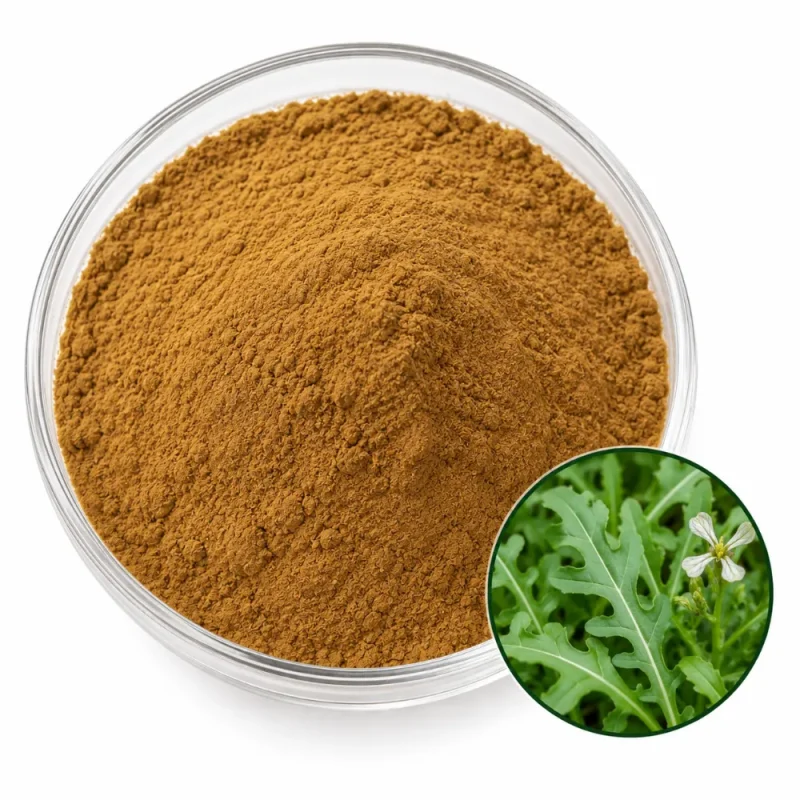
Arugula Extract Powder

Arugula leaf, the peppery salad green Eruca vesicaria known in Britain and Australia as rocket, supplies this arugula extract, and the seed that is pressed for taramira oil is not used. Water extraction concentrates the soluble leaf fraction, and the liquor is dried into a light brown powder that disperses in water.

Concentration is set by a 10:1 ratio, the mesh is 80, and no marker percentage applies. No standardized extract, powder or isolated compound of this species is listed alongside it, so this ratio extract is the single arugula ingredient, with no declared glucosinolate figure.

Eruca vesicaria Identity & Plant Part

The botanical entity is Eruca vesicaria (L.) Cav., an annual leafy plant of the Brassicaceae family, also written Eruca sativa in older sources and in many catalogs. The part used is the leaf. Seed, flowers, stems and roots are not part of this ingredient.

Two naming problems appear in the trade. Salad rocket, Eruca, is often confused with wild rocket, Diplotaxis tenuifolia, a different genus with narrower leaves and a stronger flavor. And arugula leaf is not arugula seed, which is the source of a pungent oil and is a separate material.

The leaf stores glucosinolates, such as glucoerucin, that give the peppery bite once the plant enzyme myrosinase acts on them when the tissue is damaged.

What 10:1 Means for Arugula

A 10:1 ratio records how much arugula leaf went into the extract. It is not a content figure for glucosinolates, isothiocyanates, chlorophyll or flavonoids, and no such figure is attached to this product. The ratio describes concentration of the starting material only.

Hot water acts on the leaf enzymes as well, and the fresh peppery character depends on myrosinase working on glucosinolates in damaged tissue. A water extract that is heated and dried therefore sits well below the pungency of fresh leaf, which is why the powder is mild and the color is a brown-green tone instead of bright green.

Arugula leaf is also sold dried and cut as a herb. That is a coarse leaf material and not a concentrate, so it wets, settles and flavors a blend differently from a dispersible arugula extract.

Typical Specifications

Specification ItemProduct Information
Latin NameEruca vesicaria
Plant PartLeaf & Herb
ProcessingWater Extraction
Common NameArugula (Rocket)
Ingredient TypeRatio Extract
Extract Ratio10:1
AppearanceLight Brown powder
Solubility / DispersibilityWater Dispersible
Quality Parameters
Moisture (LOD)≤5.0%
Total Ash≤5.0%
Particle Size80 mesh
Heavy MetalsLead ≤2 ppm · Arsenic ≤1 ppm · Cadmium ≤1 ppm · Mercury ≤0.1 ppm
MicrobiologyTPC ≤1,000 cfu/g · Yeast & Mold ≤100 cfu/g · E. coli Negative · Salmonella Negative/25 g
Shelf Life24 months in unopened original packaging, cool and dry storage

Application Areas

Greens-Style Drink Mixes

Arugula extract adds a mild leafy note and a muted color to dry drink mixes. Because the peppery bite of fresh leaf is largely gone, citrus and green-apple flavors carry the cup, and the hazy light brown tone suits opaque drinks better than clear ones.

Brassica Leaf Capsule Fills

Arugula extract fills hard capsules when a flow aid is blended through it. It disperses without dissolving, so disintegration on the finished fill is worth testing, and a dense leaf extract packs unevenly enough to make fill weight an early check.

Leafy Stick Pack Blends

Stick packs pair arugula extract with other vegetable and fruit powders. Matching particle size across the blend stops the dense extract from sifting out of a lighter base, and a dry filling room avoids early lumping at the seal.

Dry Tablet Blends

As carriers for tableting, arugula extract takes microcrystalline cellulose and a disintegrant. Sulfur-containing leaf material gives a faint cabbage-family smell if the tablet is stored damp, so a coating and desiccated pack are common, and arugula extract tablets are best stored sealed.

Formulation Notes

The powder is light brown with a faint leafy-sulfurous aroma and a mildly bitter, slightly pungent taste. In water it disperses to a hazy tan-green liquid, and a little fine material settles on standing.

Cabbage-family extracts release a stronger odor as they take up humidity, so weigh and blend this one in a dry room. Premixing arugula extract with a flow carrier avoids hopper bridging. After opening, reseal the liner after each draw and use the contents in order, because a damp pack cakes and its aroma sharpens. Arugula extract also takes on neighboring odors, so keep it away from strong-smelling ingredients.

Packaging & Commercial Supply

Essencefield supports product evaluation, formulation trials, commercial orders, and ongoing ingredient supply. Packaging, storage, and shipping arrangements are determined by product characteristics, order quantity, stability requirements, and destination-market needs.

Supply ItemGeneral Information
SampleAvailable upon request for formulation, testing, and supplier evaluation
Order Quantities100 g · 1 kg · 5 kg · 25 kg · 100 kg · 500 kg · Bulk
Sample Lead TimeTypically 5–7 days after sample confirmation
Production Lead TimeTypically 15–30 days after order and specification confirmation
PackagingSuitable protective inner packaging with bags, cartons, drums, or other appropriate outer packaging
StorageStore in tightly sealed, suitable protective packaging in a cool, dry environment. Protect from moisture, heat, and direct sunlight. Specific storage conditions follow the approved product specification.
DocumentationCOA · Product Specification · TDS · SDS · Applicable declarations (as applicable)

Final order quantities, lead times, packaging, documentation, and shipping arrangements are confirmed according to the selected product and commercial requirements.

Request Ingredient Specifications & Quote

Share your target specification, application, quantity, and documentation needs. We’ll help confirm suitable options, samples, and commercial supply details.