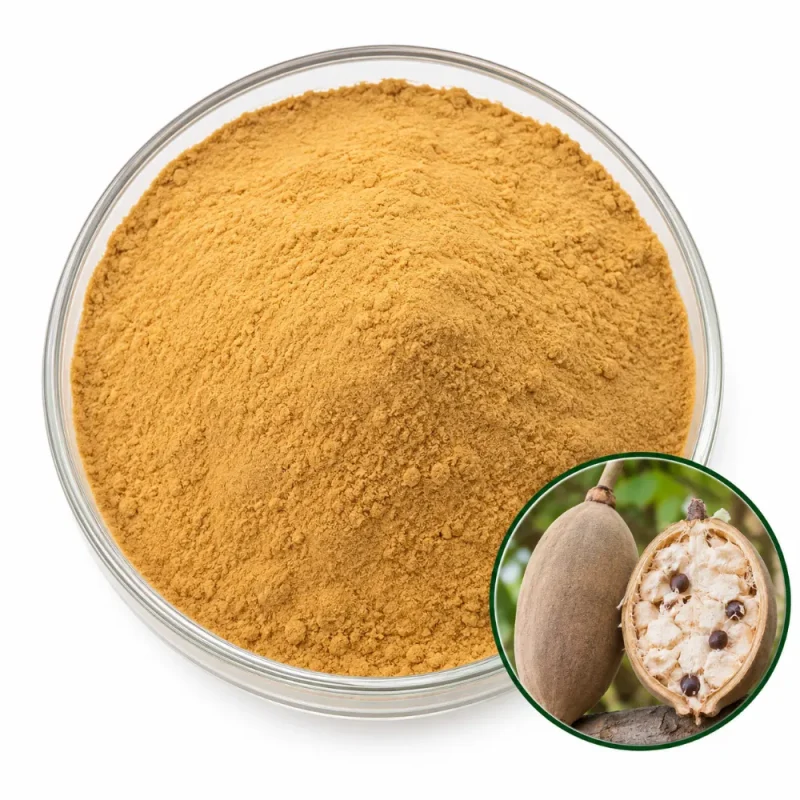
Baobab Extract Powder

Baobab, the African tree Adansonia digitata with its swollen trunk, supplies the fruit for this extract. The fruit is extracted in water, concentrated and dried to a light brown powder. Leaves, seeds, seed oil and bark of the tree are not used in the material.

This baobab extract is a 10:1 ratio extract with no marker assay. The powder is milled to 80 mesh and disperses in water. No vitamin, acid or fibre percentage is stated, so the product is defined by species, part and ratio, and a plain fruit powder of the same tree is listed as a separate product.

Adansonia digitata Fruit Source & Identity

The botanical entity is Adansonia digitata L., the African baobab of the mallow family, Malvaceae, a massive deciduous tree of the savannas of sub-Saharan Africa. The part used is the fruit, an oblong pod with a hard shell enclosing dry, powdery pulp and seeds. Leaves, seeds, seed oil and bark are not part of this baobab extract.

Other baobabs exist. Adansonia grandidieri and A. za are Madagascan species that are separate raw materials. Baobab seed oil and baobab leaf powder are also traded and are unrelated to the fruit extract.

The fruit pulp is characterised by soluble fibre such as pectin, organic acids with tartaric acid prominent, and a polyphenol fraction.

Baobab Extract vs Fruit Powder

FormWhat It IsChoose It When
10:1 Baobab Fruit ExtractWater extract of baobab fruit, ratio-definedA dispersible extract without fibre bulk is needed
Baobab PowderDried baobab fruit powder with no extractionWhole-fruit material with soluble fibre is wanted

The 10:1 ratio measures fruit going into the baobab extract. It is not an acid or vitamin assay. The extract concentrates the water-soluble parts of the fruit, while the fruit powder keeps the pulp as a whole with its fibre and its natural tartness.

For a buyer, the question is whether a concentrated, dispersible extract or a bulk fruit powder fits the product. The extract disperses with less grittiness and takes up less volume per dose.

Typical Specifications

Specification ItemProduct Information
Latin NameAdansonia digitata
Plant PartFruit & Berry
ProcessingWater Extraction
Common NameAfrican Baobab, Monkey Bread
Ingredient TypeRatio Extract
Extract Ratio10:1
AppearanceLight Brown powder
Solubility / DispersibilityWater Dispersible
Quality Parameters
Moisture (LOD)≤5.0%
Total Ash≤5.0%
Particle Size80 mesh
Heavy MetalsLead ≤2 ppm · Arsenic ≤1 ppm · Cadmium ≤1 ppm · Mercury ≤0.1 ppm
MicrobiologyTPC ≤1,000 cfu/g · Yeast & Mold ≤100 cfu/g · E. coli Negative · Salmonella Negative/25 g
Shelf Life24 months in unopened original packaging, cool and dry storage

Application Areas

Capsules for an Acidic Fruit Extract

Baobab extract is naturally tart, so a capsule shell masks the taste. The pectin and acid content makes the dried powder attract moisture, which means a controlled-humidity filling room and a covered hopper. Flow additives are needed only when the powder hangs up above the filling station.

Tablets with Acid-Tolerant Excipients

The organic acids of the fruit can react with carbonate or alkaline excipients. Choose neutral fillers and a dry binder, then compare tablet hardness and colour at pressing and after a week in the final pack. A film coat gives a moisture barrier.

Fruit-Style Drink Powders

The tart, fruity profile suits drink powders and sticks. Baobab extract disperses to a tan, lightly hazy liquid, and a sugar or sweetener balance is needed to offset the acidity. Test taste and viscosity at the planned dose.

Powder Sachets

Sachets pair the extract with a carrier such as maltodextrin or fibre. Sieve baobab extract into the carrier before filling to keep it from clumping at the surface, and check dose uniformity at the start, middle and end of the filling run. Acidic fruit extracts are sticky when warm, so keep the filling area cool.

Gummy Premixes

For gummies, the acid and pectin content of the extract can shift gel set and flavour. Trial the gummy with a small portion of the extract and check texture again after a week, because pectin-bearing powders can change how the gel sets and how firm it stays on storage.

Formulation Notes

Baobab extract is a light brown powder with a fruity, slightly sour smell and a tart taste. In water it forms a tan dispersion, and its acid content gives the liquid a low pH that can affect other ingredients such as proteins or colours. The pectin fraction adds mild body to the liquid.

Use a moving liquid or a pre-wetted slurry when dispersing, since dry clumps are slow to break up. Dry blends need the extract dispersed in a carrier portion first, which a sieve does quickly. For baobab, after opening, press out the air, close the liner tightly and keep the drum off damp floors, away from steam and heat.

Sweet, fruity flavours such as pineapple, mango or citrus fit the natural tartness, while chocolate or dairy bases clash with it. Judge taste and pH in the finished product, not in plain water, before the dose is fixed.

Packaging & Commercial Supply

Essencefield supports product evaluation, formulation trials, commercial orders, and ongoing ingredient supply. Packaging, storage, and shipping arrangements are determined by product characteristics, order quantity, stability requirements, and destination-market needs.

Supply ItemGeneral Information
SampleAvailable upon request for formulation, testing, and supplier evaluation
Order Quantities100 g · 1 kg · 5 kg · 25 kg · 100 kg · 500 kg · Bulk
Sample Lead TimeTypically 5–7 days after sample confirmation
Production Lead TimeTypically 15–30 days after order and specification confirmation
PackagingSuitable protective inner packaging with bags, cartons, drums, or other appropriate outer packaging
StorageStore in tightly sealed, suitable protective packaging in a cool, dry environment. Protect from moisture, heat, and direct sunlight. Specific storage conditions follow the approved product specification.
DocumentationCOA · Product Specification · TDS · SDS · Applicable declarations (as applicable)

Final order quantities, lead times, packaging, documentation, and shipping arrangements are confirmed according to the selected product and commercial requirements.

Request Ingredient Specifications & Quote

Share your target specification, application, quantity, and documentation needs. We’ll help confirm suitable options, samples, and commercial supply details.