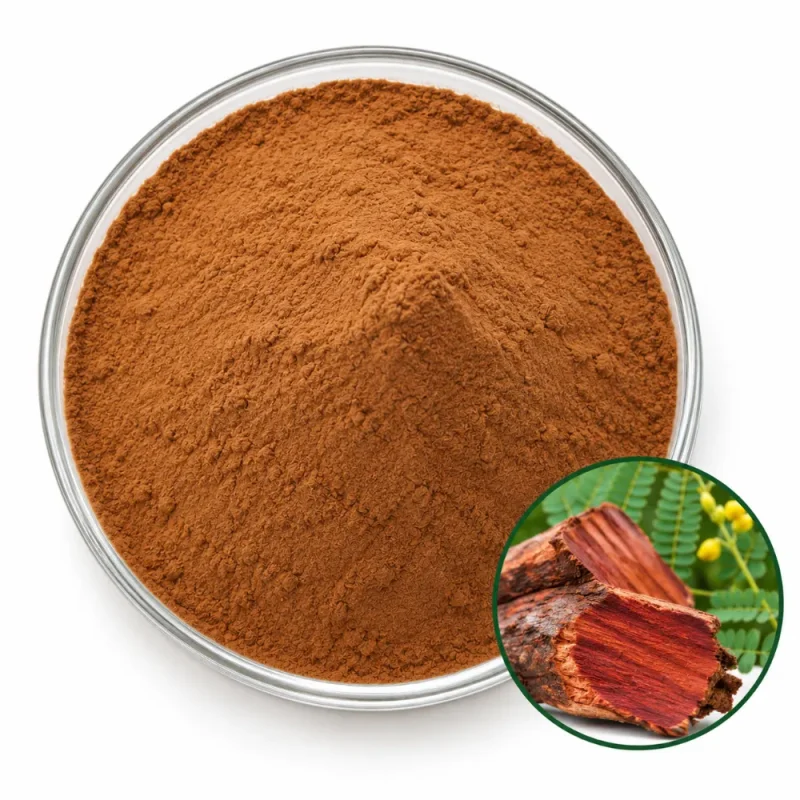
Caesalpinia Sappan Extract Powder

Dense red-orange heartwood of Caesalpinia sappan, the sappanwood tree of South and Southeast Asia, supplies this sappanwood extract, and the leaves, pods and seed are not used. Water extraction concentrates the soluble heartwood fraction, and the liquor is dried into a red-brown powder that disperses in water.

The grade is a 10:1 ratio extract at 80 mesh, with no marker percentage. A tannin-defined sappanwood extract is a separate standardized product on its own page. This ratio extract carries no declared brazilin, tannin or polyphenol figure.

Caesalpinia sappan Identity & Plant Part

The botanical entity is Caesalpinia sappan L., a small thorny tree of the Fabaceae family that databases now place under Biancaea sappan. The part used is the heartwood, the dense inner wood that is cut into chips. Sapwood, bark, leaves, pods and seed are not part of this ingredient.

Sappanwood has been a dye wood for centuries. Its characteristic constituent is brazilin, a homoisoflavonoid that is nearly colorless to yellow when fresh and oxidizes in air to brazilein, which is red. The wood also holds tannins and chalcones, and this chemistry is why its water extracts range from orange through red to purple-brown.

Caesalpinia sappan is a relative of brazilwood, Paubrasilia echinata, the dye wood that gave Brazil its name, but the two are different trees.

Sappanwood Extract vs Standardized Grade

FormWhat It IsChoose It When
10:1 Heartwood ExtractWater-extracted, concentrated and dried sappanwoodA dispersible whole-heartwood extract is wanted without a marker
Sappanwood Extract 15% TanninsStandardized sappanwood extract defined by tanninsThe specification names a tannin figure

The 10:1 ratio records how much Caesalpinia sappan heartwood went into the Caesalpinia sappan extract. It gives no figure for brazilin, tannins or any other constituent, and none is attached to this product. Brazilin dissolves in hot water and oxidizes as the liquor stands, so a water extract of the wood shifts in color from yellow-orange toward red while it dries.

The standardized sibling changes the basis of the specification by adding a tannin figure with its method. A formula that must declare a tannin value starts there, and one that wants a plain dispersible sappanwood ingredient with a natural red-brown tone starts here.

Sappanwood chips are also traded for decoctions, and that coarse wood material is not a dispersible extract.

Typical Specifications

Specification ItemProduct Information
Latin NameCaesalpinia sappan
Plant PartBark & Stem
ProcessingWater Extraction
Common NameSappanwood
Ingredient TypeRatio Extract
Extract Ratio10:1
AppearanceRed-Brown powder
Solubility / DispersibilityWater Dispersible
Quality Parameters
Moisture (LOD)≤5.0%
Total Ash≤5.0%
Particle Size80 mesh
Heavy MetalsLead ≤2 ppm · Arsenic ≤1 ppm · Cadmium ≤1 ppm · Mercury ≤0.1 ppm
MicrobiologyTPC ≤1,000 cfu/g · Yeast & Mold ≤100 cfu/g · E. coli Negative · Salmonella Negative/25 g
Shelf Life24 months in unopened original packaging, cool and dry storage

Application Areas

Natural Red-Brown Color Systems

Caesalpinia sappan extract carries a warm red-brown tone that can tint dry drink and dessert mixes. Its color turns more yellow at low pH and more red toward neutral, so finished products are checked at their final acidity.

Two-Piece Capsule Lots

The extract fills two-piece capsules after a flow aid is blended in. The dark red-brown powder shows through clear shells, so opaque capsules are normal, and disintegration is worth testing since the powder disperses without dissolving.

Film-Coated Tablet Cores

Sappanwood extract is bound into tablets by microcrystalline cellulose with a disintegrant. Tannins and brazilin both stain, so dedicated tooling and a film coat are common, and iron contact surfaces are avoided because iron darkens sappanwood to purple-black.

Herbal Infusion Mixes

Wood infusions are a recognized herbal format, so instant mixes suit Caesalpinia sappan extract. It disperses to a hazy red-brown cup with a mild woody, slightly astringent taste that spice or caramel flavors cover. Because acid shifts the shade toward yellow, lemon-flavored infusions look more orange than neutral ones.

Formulation Notes

The powder is red-brown with a faint woody aroma and a mild, astringent, slightly sweet taste. In water it disperses to a hazy orange-red liquid, and the color deepens toward brown on standing in air.

Brazilin forms colored complexes with metal ions, giving red with aluminum and dark purple with iron, so avoid metal contact surfaces. Handle the powder as a dye, weighing it in a separate area and wiping surfaces after each lot. A short premix with a flowing carrier stops bridging at the hopper, and the liner should be resealed at each draw. Sappanwood extract is an old textile dye, and the same behavior carries over to food contact surfaces such as sieves and scoops. Stainless steel is tolerated, whereas iron-based tools discolor the powder.

Packaging & Commercial Supply

Essencefield supports product evaluation, formulation trials, commercial orders, and ongoing ingredient supply. Packaging, storage, and shipping arrangements are determined by product characteristics, order quantity, stability requirements, and destination-market needs.

Supply ItemGeneral Information
SampleAvailable upon request for formulation, testing, and supplier evaluation
Order Quantities100 g · 1 kg · 5 kg · 25 kg · 100 kg · 500 kg · Bulk
Sample Lead TimeTypically 5–7 days after sample confirmation
Production Lead TimeTypically 15–30 days after order and specification confirmation
PackagingSuitable protective inner packaging with bags, cartons, drums, or other appropriate outer packaging
StorageStore in tightly sealed, suitable protective packaging in a cool, dry environment. Protect from moisture, heat, and direct sunlight. Specific storage conditions follow the approved product specification.
DocumentationCOA · Product Specification · TDS · SDS · Applicable declarations (as applicable)

Final order quantities, lead times, packaging, documentation, and shipping arrangements are confirmed according to the selected product and commercial requirements.

Request Ingredient Specifications & Quote

Share your target specification, application, quantity, and documentation needs. We’ll help confirm suitable options, samples, and commercial supply details.