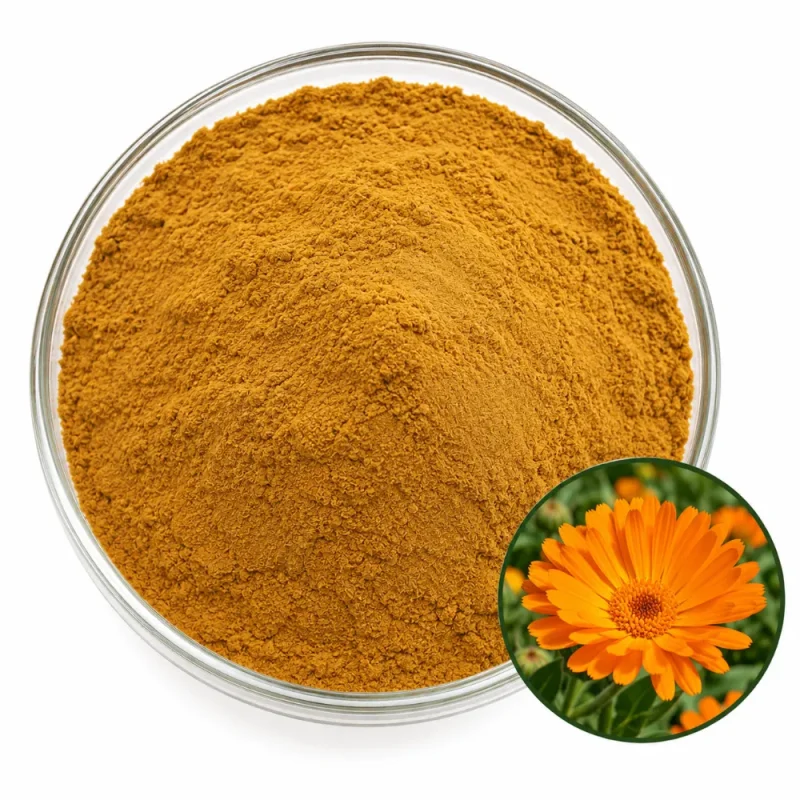
Calendula Flower Extract Powder

Dried flower heads of Calendula officinalis, the pot marigold, supply this calendula flower extract, with the leaves and stems left out. Water extraction concentrates the soluble flower fraction, and the liquor is dried into a yellow-orange powder that disperses in water.

Concentration is set by a 10:1 ratio, the mesh is 80, and no marker percentage applies. A flavonoid-defined calendula extract is a separate standardized product, and the plain dried flower is offered as a milled powder. This ratio extract carries no declared flavonoid or carotenoid figure.

Calendula officinalis Identity & Plant Part

The botanical entity is Calendula officinalis L., the pot or English marigold, an annual of the Asteraceae family. The part used is the flower head, the golden to orange florets gathered when fully open. Leaves, stems, roots and seed are not part of this ingredient.

The common name marigold is the main source of error. Calendula is not the African or French marigold, Tagetes erecta and Tagetes patula, which are a different genus and the main commercial source of lutein. A calendula flower extract and a tagetes extract share a color range and little else.

Calendula flowers hold carotenoids, flavonoid glycosides based on quercetin and isorhamnetin, triterpenoid saponins and fatty esters of triterpene alcohols.

Calendula Extract vs Powder & Standardized Grades

FormWhat It IsChoose It When
10:1 Flower ExtractWater-extracted, concentrated and dried calendula flowersA dispersible whole-flower extract is wanted without a marker
Calendula Extract 1–20% Total FlavonoidsStandardized flower extract with a defined total flavonoid rangeThe specification names a flavonoid figure
Calendula Flower PowderDried, milled calendula flower with no extractionWhole flower with fiber is wanted at higher inclusion

The 10:1 ratio records how much calendula flower went into the extract. It states no flavonoid or carotenoid figure, so a labelled content belongs to the standardized grade and cannot be read from the ratio. The two pigment families behave differently in water: flavonoid glycosides dissolve, while carotenoids, which carry most of the orange, are fat soluble and are only partly carried into a water extract.

The two siblings change the basis of the specification. The standardized extract adds a flavonoid figure with its method, and the milled flower adds back the insoluble fiber and the full carotenoid load. Buyers who need a declared flavonoid value go to the standardized extract, and those who need only a dispersible calendula flower ingredient choose this one.

Typical Specifications

Specification ItemProduct Information
Latin NameCalendula officinalis
Plant PartFlower
ProcessingWater Extraction
Common NamePot Marigold
Ingredient TypeRatio Extract
Extract Ratio10:1
AppearanceYellow-Orange powder
Solubility / DispersibilityWater Dispersible
Quality Parameters
Moisture (LOD)≤5.0%
Total Ash≤5.0%
Particle Size80 mesh
Heavy MetalsLead ≤2 ppm · Arsenic ≤1 ppm · Cadmium ≤1 ppm · Mercury ≤0.1 ppm
MicrobiologyTPC ≤1,000 cfu/g · Yeast & Mold ≤100 cfu/g · E. coli Negative · Salmonella Negative/25 g
Shelf Life24 months in unopened original packaging, cool and dry storage

Application Areas

Floral Tea-Style Instant Mixes

Calendula flowers have a long place in herbal infusions, so tea-style instant mixes suit the extract. It disperses to a hazy golden cup with a mild floral-resinous character, and chamomile, orange blossom or honey flavors match it well.

Two-Piece Capsule Lots

Calendula extract goes into two-piece capsules after a flow aid is blended through it. The yellow-orange powder is easy to place beside other botanical extracts, and disintegration is worth testing on the finished fill since it disperses without dissolving.

Chewable Gummy Matrices

Pectin gummies can carry calendula extract at low inclusion for a warm golden tint. Add it after the cooked mass has cooled below the setting temperature, and pair it with citrus or mango flavors that echo the color.

Powder Sachet Fills

Sachets combine the extract with a dispersible carrier or fruit powders. Matched particle size avoids sifting of the dense golden powder, and a dry filling room avoids lumping at the seal. Resinous flower solids can stick to forming collars, so a flow aid in the blend keeps filling smooth.

Formulation Notes

The powder is yellow-orange with a faint dried-flower, slightly resinous aroma and a mildly bitter, herbal taste. In water it disperses to a hazy golden liquid, and the color pales on dilution.

Carotenoid pigments fade in light and oxygen, so keep the powder in sealed opaque packs and add it late in warm processing. A premix with a flowing carrier stops calendula extract from arching in the hopper. Resin-bearing flower extracts turn tacky when humid, so weigh in a dry room and close the liner at every draw. Pale cream bases make the golden color of calendula extract easy to read, whereas a brown base hides it. Color is therefore judged on the base that the product will actually use.

Packaging & Commercial Supply

Essencefield supports product evaluation, formulation trials, commercial orders, and ongoing ingredient supply. Packaging, storage, and shipping arrangements are determined by product characteristics, order quantity, stability requirements, and destination-market needs.

Supply ItemGeneral Information
SampleAvailable upon request for formulation, testing, and supplier evaluation
Order Quantities100 g · 1 kg · 5 kg · 25 kg · 100 kg · 500 kg · Bulk
Sample Lead TimeTypically 5–7 days after sample confirmation
Production Lead TimeTypically 15–30 days after order and specification confirmation
PackagingSuitable protective inner packaging with bags, cartons, drums, or other appropriate outer packaging
StorageStore in tightly sealed, suitable protective packaging in a cool, dry environment. Protect from moisture, heat, and direct sunlight. Specific storage conditions follow the approved product specification.
DocumentationCOA · Product Specification · TDS · SDS · Applicable declarations (as applicable)

Final order quantities, lead times, packaging, documentation, and shipping arrangements are confirmed according to the selected product and commercial requirements.

Request Ingredient Specifications & Quote

Share your target specification, application, quantity, and documentation needs. We’ll help confirm suitable options, samples, and commercial supply details.