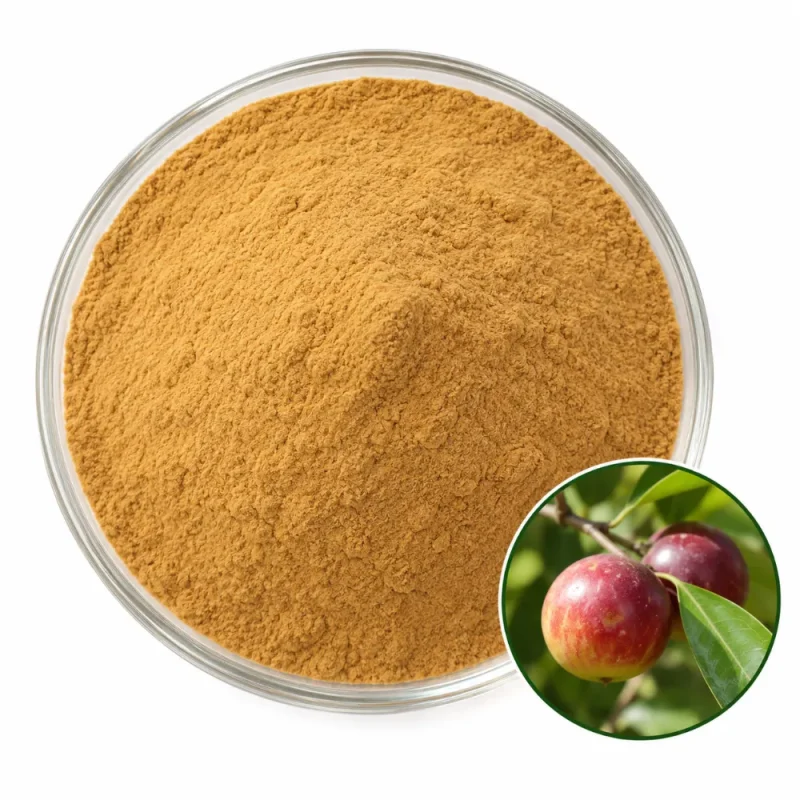
Camu Camu Extract Powder

Small, cherry-sized fruit of Myrciaria dubia, the camu camu shrub of Amazonian river floodplains, supplies this camu camu extract, and the leaves, bark and seed are not used. Water extraction concentrates the soluble fruit fraction, and the liquor is dried into a light brown powder that disperses in water.

This is a 10:1 ratio extract milled to 80 mesh, and it carries no marker percentage. A vitamin C-defined camu camu extract is a separate standardized product, and camu camu fruit powder and a freeze-dried powder have their own pages. This ratio extract carries no declared ascorbic acid figure.

Myrciaria dubia Identity & Plant Part

The botanical entity is Myrciaria dubia (Kunth) McVaugh, a shrub of the Myrtaceae family that grows along the flooded margins of Amazonian rivers and lakes, partly submerged for months of the year. The part used is the fruit, a round, glossy, red-purple berry. Leaves, bark and the large seeds are not part of this ingredient.

Camu camu is often grouped with other vitamin C fruits, which creates two confusions. Acerola is Malpighia emarginata, a different family from the Caribbean, and rosehip is the fruit of Rosa species. All three are acidic, but their botany, flavor and pigments differ.

Camu camu fruit is very tart. It holds ascorbic acid and other organic acids, ellagitannins and phenolic acids, and anthocyanins in the skin, which is the source of the red-purple color.

Camu Camu Extract vs Powder & Grades

FormWhat It IsChoose It When
10:1 Fruit ExtractWater-extracted, concentrated and dried camu camu fruitA dispersible concentrated fruit extract is wanted without a marker
Camu Camu Extract 10–25% Natural Vitamin CStandardized fruit extract defined by natural vitamin CThe specification names a vitamin C figure
Camu Camu PowderSpray-dried camu camu fruit powder with a carrierA juice-based fruit powder is wanted
Freeze-Dried Camu Camu PowderFreeze-dried camu camu fruit, milledA gently dried fruit powder is wanted, with the fruit intact

The 10:1 notation shows how strongly camu camu fruit was concentrated, and it carries no other information. It gives no figure for ascorbic acid, anthocyanins or ellagitannins, and none is attached to this product. Ascorbic acid is water soluble but loses stability with heat, light and oxygen, which is why a vitamin C figure belongs to a standardized grade with a defined method and cannot be inferred from the ratio.

The three siblings change the basis of the specification. The standardized extract names a vitamin C range, the spray-dried powder is built from juice with a carrier, and the freeze-dried powder keeps the whole fruit. A formula that wants a tart, dispersible camu camu ingredient with no declared figure starts here.

Typical Specifications

Specification ItemProduct Information
Latin NameMyrciaria dubia
Plant PartFruit & Berry
ProcessingWater Extraction
Common NameCamu Camu
Ingredient TypeRatio Extract
Extract Ratio10:1
AppearanceLight Brown powder
Solubility / DispersibilityWater Dispersible
Quality Parameters
Moisture (LOD)≤5.0%
Total Ash≤5.0%
Particle Size80 mesh
Heavy MetalsLead ≤2 ppm · Arsenic ≤1 ppm · Cadmium ≤1 ppm · Mercury ≤0.1 ppm
MicrobiologyTPC ≤1,000 cfu/g · Yeast & Mold ≤100 cfu/g · E. coli Negative · Salmonella Negative/25 g
Shelf Life24 months in unopened original packaging, cool and dry storage

Application Areas

Tart Fruit Drink Mixes

Camu camu extract gives dry drink mixes a sharp, citrus-like acidity and a faint pink-brown tone. It suits tropical, lemon and berry flavors where tartness is welcome, and the acid content means sweeteners are usually needed to balance the cup.

Effervescent Tablet Blends

The extract works in effervescent tablets, where its own acidity reduces the amount of added acid. Dry granulation protects the humidity-sensitive powder, and moisture-proof tubes keep the tablets free of early fizzing. Because the powder is already acidic, the balance of added acid and bicarbonate is tuned on small batches first.

Chewable Gummy Matrices

Pectin gummies can carry camu camu extract at low inclusion for tartness and a light pink-brown tint. The extract goes in after the cooked mass has cooled below the setting temperature, and sour sanding sugar pairs with its acidity.

Dry Sachet Fills

Sachets combine the extract with sweeteners and a dispersible carrier. Matched particle size avoids sifting, and a dry filling room matters, because acid-rich fruit extracts take up humidity quickly and turn sticky in the sealing zone.

Formulation Notes

The powder is light brown with a sour, fruity aroma and a very tart taste. In water it disperses to a hazy pink-brown liquid with a low pH.

Because the powder is acidic, it lowers the pH of any blend it joins, which affects color in pigmented systems and stability of acid-sensitive ingredients. Ascorbic acid and anthocyanins fade with heat and light, so add the extract late in warm processes and use opaque packs. Acid- and sugar-rich extracts absorb humidity and set hard, so weigh in a dry room and close the liner at every draw. Camu camu extract is sensitive to its own acidity: bicarbonate, carbonate and other alkaline components react with it on contact with moisture, so such ingredients are kept apart in dry mixes.

Packaging & Commercial Supply

Essencefield supports product evaluation, formulation trials, commercial orders, and ongoing ingredient supply. Packaging, storage, and shipping arrangements are determined by product characteristics, order quantity, stability requirements, and destination-market needs.

Supply ItemGeneral Information
SampleAvailable upon request for formulation, testing, and supplier evaluation
Order Quantities100 g · 1 kg · 5 kg · 25 kg · 100 kg · 500 kg · Bulk
Sample Lead TimeTypically 5–7 days after sample confirmation
Production Lead TimeTypically 15–30 days after order and specification confirmation
PackagingSuitable protective inner packaging with bags, cartons, drums, or other appropriate outer packaging
StorageStore in tightly sealed, suitable protective packaging in a cool, dry environment. Protect from moisture, heat, and direct sunlight. Specific storage conditions follow the approved product specification.
DocumentationCOA · Product Specification · TDS · SDS · Applicable declarations (as applicable)

Final order quantities, lead times, packaging, documentation, and shipping arrangements are confirmed according to the selected product and commercial requirements.

Request Ingredient Specifications & Quote

Share your target specification, application, quantity, and documentation needs. We’ll help confirm suitable options, samples, and commercial supply details.