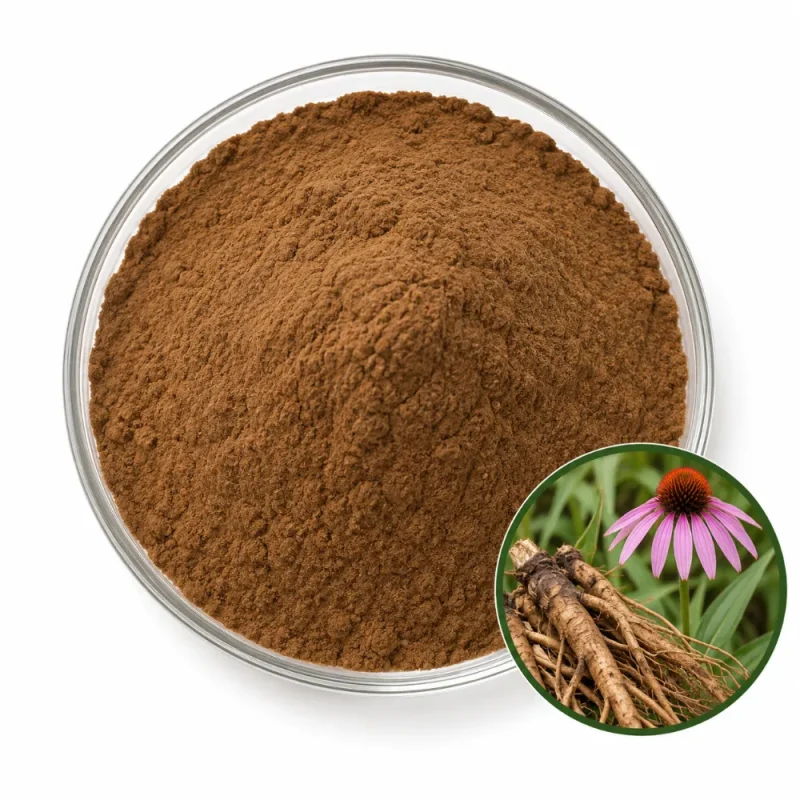
Echinacea Angustifolia Extract Powder

Narrow-leaved purple coneflower, Echinacea angustifolia, is a prairie native, and its root is the part used for this echinacea angustifolia extract. Water extraction concentrates the soluble root fraction of Echinacea angustifolia, and the liquor is dried to a light brown powder.

At 10:1 this root extract states a concentration and no phenolic or cichoric acid figure; it is water dispersible and milled to 80 mesh. The root extract standardized to cichoric acid is a separate product, and so is the aerial-part extract of the sister species E. purpurea.

Echinacea angustifolia Root Identity & Plant Part

The botanical entity is Echinacea angustifolia DC., a perennial of the daisy family (Asteraceae) native to the Great Plains of North America, recognized by narrow leaves and pale pink to purple ray florets around a spiny central cone. The part used is the root, dug from established plants, washed and dried. Leaves, flowers and seeds are not included in this echinacea angustifolia extract.

Species, part and solvent separate one echinacea ingredient from another. E. angustifolia, E. purpurea and E. pallida are all sold as “echinacea”, roots and aerial parts carry different profiles, and alcoholic extracts hold lipophilic compounds that a water extract leaves behind. A document that says only “echinacea extract” answers none of these.

Echinacea Angustifolia Extract vs Standardized Root Grade

FormWhat It IsChoose It When
10:1 Root ExtractWater-extracted, concentrated and dried E. angustifolia rootA dispersible root extract without a marker is wanted
Echinacea Root Extract 2–4% Cichoric AcidStandardized root extract with a defined cichoric acid rangeThe specification names a cichoric acid figure

At 10:1 this echinacea angustifolia extract states how far the root was concentrated. It is not a measure of echinacoside, other caffeic acid derivatives or alkylamides, and two lots at the same ratio can differ in all three.

The standardized root extract in the table is the one to use if a cichoric acid figure must appear on a label. E. purpurea is offered here only as an aerial-parts extract, a different species and part that cannot stand in for this root.

Root age adds its own spread to echinacea angustifolia extract. E. angustifolia roots are generally lifted after a few years of growth, and older roots are larger and denser, a difference that shows in color and taste before it shows in any figure.

Typical Specifications

Specification ItemProduct Information
Latin NameEchinacea angustifolia
Plant PartRoot & Rhizome
ProcessingWater Extraction
Common NameEchinacea, Narrow-Leaved Purple Coneflower
Ingredient TypeRatio Extract
Extract Ratio10:1
AppearanceLight Brown powder
Solubility / DispersibilityWater Dispersible
Quality Parameters
Moisture (LOD)≤5.0%
Total Ash≤5.0%
Particle Size80 mesh
Heavy MetalsLead ≤2 ppm · Arsenic ≤1 ppm · Cadmium ≤1 ppm · Mercury ≤0.1 ppm
MicrobiologyTPC ≤1,000 cfu/g · Yeast & Mold ≤100 cfu/g · E. coli Negative · Salmonella Negative/25 g
Shelf Life24 months in unopened original packaging, cool and dry storage

Application Areas

Root Extract Capsule Fills

A 10:1 echinacea angustifolia extract is a concentrated solid, so a capsule holds the root’s soluble fraction in much less volume than milled root would need, which leaves room for other ingredients in the same shell. Opaque shells hide the light brown tint, and a quick flow test shows whether the powder needs a glidant.

Film-Coated Root Extract Tablets

Tablets of echinacea angustifolia extract take a film coat to cover a mildly bitter, earthy taste and to guard against moisture. Disintegration and hardness are retested after a few weeks, since the polar solids of a water extract pull moisture into the compact.

Citrus and Honey Flavored Sachets

Sachets pair echinacea angustifolia extract with citrus, honey or ginger flavors that cover its earthy character. The pale tan color suits amber or warm drinks, and the powder disperses in water with a faint haze that fades into the flavor.

Instant Herbal Tea-Style Mixes

Tea-style mixes combine the extract with elderflower, lemon balm or rosehip. It dissolves in hot water without leaving root fiber behind, and its earthy-sweet note sits well alongside floral and fruity herbs, while the light amber infusion shows only a faint haze.

Formulation Notes

The powder is light brown with a faint earthy aroma and a mildly bitter, slightly sweet taste. In water it gives a pale tan, lightly hazy liquid. Caffeic acid derivatives such as echinacoside and cynarin are sensitive to heat, light and alkaline conditions, so keep beverages mildly acidic to neutral and out of long bright-light exposure.

Strongly alkaline ingredients darken the color and degrade the caffeic acid derivatives, so keep them apart from the extract in a blend. If the powder bridges at a hopper outlet, a pinch of glidant restores flow; fold the extract into a portion of the filler first and screen out soft lumps before filling.

Once a container of echinacea angustifolia extract is opened, press the liner flat and reseal it. The polar root solids draw moisture from room air, and the powder first turns sticky and then gradually darkens.

Packaging & Commercial Supply

Essencefield supports product evaluation, formulation trials, commercial orders, and ongoing ingredient supply. Packaging, storage, and shipping arrangements are determined by product characteristics, order quantity, stability requirements, and destination-market needs.

Supply ItemGeneral Information
SampleAvailable upon request for formulation, testing, and supplier evaluation
Order Quantities100 g · 1 kg · 5 kg · 25 kg · 100 kg · 500 kg · Bulk
Sample Lead TimeTypically 5–7 days after sample confirmation
Production Lead TimeTypically 15–30 days after order and specification confirmation
PackagingSuitable protective inner packaging with bags, cartons, drums, or other appropriate outer packaging
StorageStore in tightly sealed, suitable protective packaging in a cool, dry environment. Protect from moisture, heat, and direct sunlight. Specific storage conditions follow the approved product specification.
DocumentationCOA · Product Specification · TDS · SDS · Applicable declarations (as applicable)

Final order quantities, lead times, packaging, documentation, and shipping arrangements are confirmed according to the selected product and commercial requirements.

Request Ingredient Specifications & Quote

Share your target specification, application, quantity, and documentation needs. We’ll help confirm suitable options, samples, and commercial supply details.