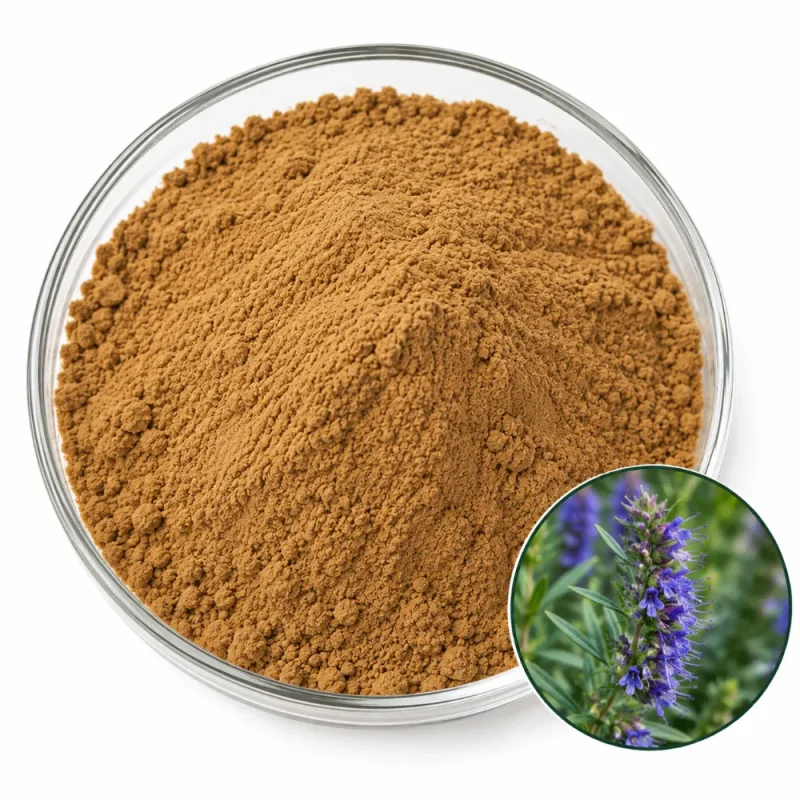
Hyssop Extract Powder

Hyssop extract is made from the aerial parts of Hyssopus officinalis, meaning the leaves and flowering tops of the herb, with the root excluded. Water extraction concentrates the soluble herb fraction, and the liquor is dried into a light brown powder that disperses in water.

The extract is supplied at a 10:1 ratio and milled to 80 mesh, with no marker percentage declared. It is a plain herb extract, and the volatile oil that gives the fresh herb its camphor-like scent is largely absent from a water extract.

Hyssopus officinalis Identity & Plant Part

The botanical entity is Hyssopus officinalis L., hyssop, a semi-evergreen subshrub of the Lamiaceae with square stems, narrow leaves and spikes of blue-violet flowers. The part used is the aerial part, meaning leaf and flowering top. The root is not part of this ingredient. The hyssop of the Bible is generally identified with a different plant, Origanum syriacum, and giant hyssop, Agastache, is another genus altogether. Phenolic acids, flavonoids and tannins are the main constituent families of the extract, named here without figures.

What 10:1 Means for Hyssop

A 10:1 figure on a hyssop extract describes concentration against the starting herb and carries no information about the volatile oil. Because the oil leaves with steam during drying, the powder is defined by its phenolic acids and flavonoids instead, and neither is quantified by the ratio. A buyer who wants a stated constituent level has to use a marker-based product. A buyer who names the species, the aerial part and the ratio can use this hyssop extract as it is. No powder or marker grade is listed beside it.

Typical Specifications

Specification ItemProduct Information
Latin NameHyssopus officinalis
Plant PartLeaf & Herb
ProcessingWater Extraction
Common NameHyssop Herb
Ingredient TypeRatio Extract
Extract Ratio10:1
AppearanceLight brown powder
Solubility / DispersibilityWater Dispersible
Quality Parameters
Moisture (LOD)≤5.0%
Total Ash≤5.0%
Particle Size80 mesh
Heavy MetalsLead ≤2 ppm · Arsenic ≤1 ppm · Cadmium ≤1 ppm · Mercury ≤0.1 ppm
MicrobiologyTPC ≤1,000 cfu/g · Yeast & Mold ≤100 cfu/g · E. coli Negative · Salmonella Negative/25 g
Shelf Life24 months in unopened original packaging, cool and dry storage

Application Areas

Herb Extract Capsules

Hyssop extract fills two-piece capsules as a light brown powder with a mild herbal note and a faint bitterness. Leaf extracts can pack unevenly, so a flow aid in the premix and early checks of fill weight keep capsule weight steady across the run.

Herbal Tea-Style Mixes

In tea-style mixes the extract gives a hazy amber-brown liquid with a mild herbal, slightly minty taste. It pairs with peppermint, lemon balm or honey flavors, and a carrier such as maltodextrin keeps the dose consistent in each sachet.

Lozenge Compressions

Lozenges carry the extract with isomalt or sorbitol, and honey or anise flavors match its herbal note. Granulate before compression, because the fine powder takes up moisture and can stick to the punches in humid rooms. Check tablet hardness again after storage, because herb extracts gain moisture slowly.

Gummy Premix Powders

In gummies the extract is added to the cooked base late to limit heat exposure. Its amber-brown tint blends into honey, lemon and herbal liqueur flavors, and phenolic acids can darken at higher pH, so test the color across shelf life.

Dry Drink Stick Blends

Sticks combine the extract with citric acid and sweetener, giving a repeatable dose. Because phenolic acids are sensitive to light, opaque stick film protects the amber-brown tone of the finished drink during storage. Single-serve sticks also limit the exposure of the opened bulk pack to damp air.

Formulation Notes

Hyssop extract is a light brown powder with a mild herbal aroma and a faintly bitter, slightly astringent taste. Wetted with water, it turns into a hazy amber-brown liquid, and a little fine material settles on standing. The camphor-like scent of the fresh herb is largely absent after water extraction.

A water extract of a leafy herb takes up moisture quickly, so weigh the hyssop extract in a dry room and reseal the pack after each draw. Surface clumping and darkening are the first signs of uptake. For capsule work, blend the powder with a free-flowing carrier, and for drinks add it to the dry base first.

Phenolic acids such as the rosmarinic type can bind iron and darken in its presence. Use stainless steel or plastic scoops and mixing equipment with hyssop extract, and avoid carbon-steel tooling in tablet rooms, because dark specks appear on the tablet face when iron contacts the powder.

Packaging & Commercial Supply

Essencefield supports product evaluation, formulation trials, commercial orders, and ongoing ingredient supply. Packaging, storage, and shipping arrangements are determined by product characteristics, order quantity, stability requirements, and destination-market needs.

Supply ItemGeneral Information
SampleAvailable upon request for formulation, testing, and supplier evaluation
Order Quantities100 g · 1 kg · 5 kg · 25 kg · 100 kg · 500 kg · Bulk
Sample Lead TimeTypically 5–7 days after sample confirmation
Production Lead TimeTypically 15–30 days after order and specification confirmation
PackagingSuitable protective inner packaging with bags, cartons, drums, or other appropriate outer packaging
StorageStore in tightly sealed, suitable protective packaging in a cool, dry environment. Protect from moisture, heat, and direct sunlight. Specific storage conditions follow the approved product specification.
DocumentationCOA · Product Specification · TDS · SDS · Applicable declarations (as applicable)

Final order quantities, lead times, packaging, documentation, and shipping arrangements are confirmed according to the selected product and commercial requirements.

Request Ingredient Specifications & Quote

Share your target specification, application, quantity, and documentation needs. We’ll help confirm suitable options, samples, and commercial supply details.