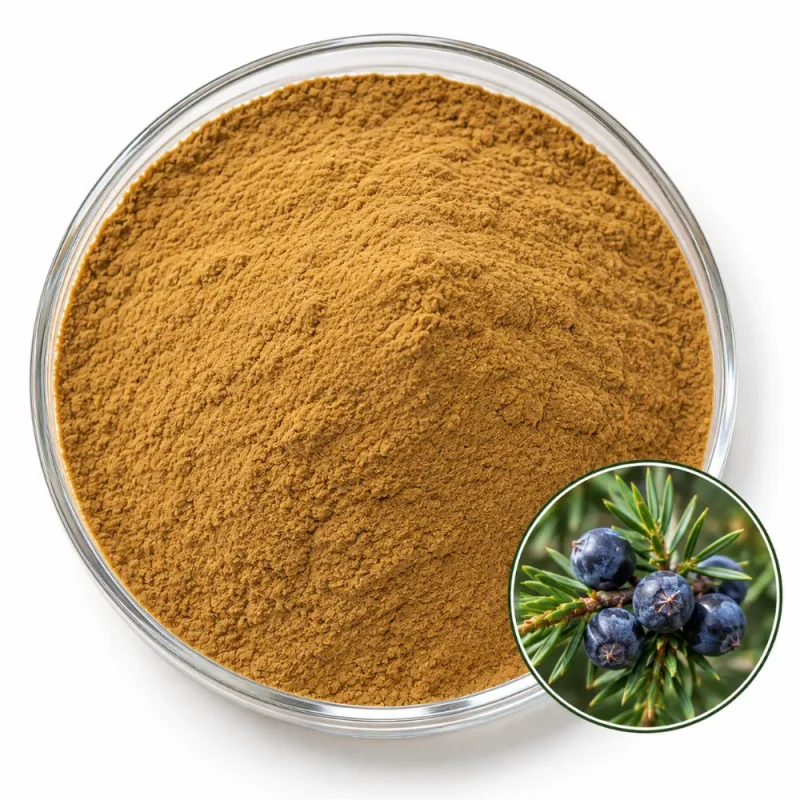
Juniper Berry Extract Powder

Juniper berry extract is made from the ripe female cones of Juniperus communis, commonly called berries, and not from the needles or wood. Water extraction concentrates the soluble berry fraction, and the liquor is dried into a brown powder that disperses in water.

The extract is supplied at a 10:1 ratio and milled to 80 mesh, with no marker percentage declared. It is a plain berry extract of a single named species, and the volatile oil that gives the whole berry its piney scent is largely absent from a water extract.

Juniperus communis Identity & Plant Part

The botanical entity is Juniperus communis L., common juniper, a conifer of the Cupressaceae found across the northern hemisphere. The part used is the berry, which is botanically a fleshy seed cone that ripens to blue-black over two to three years. Needles, wood and unripe green cones are not included. Several other junipers exist, and some of them, such as savin, Juniperus sabina, are toxic and are different species, so the Latin name matters. Flavonoids including biflavones, sugars, resin and tannins are the main constituent families of the extract, named here without figures.

What 10:1 Means for Juniper Berry

A 10:1 figure on a juniper berry extract describes concentration against the starting berries. It carries no information about the volatile oil, which is the part of the berry most people associate with gin and cooking. Because the oil leaves with steam, a water extract is defined by its sugars, flavonoids and tannins, and none of these is quantified by the ratio. A buyer who wants the oil has to look at a different product. No powder or marker grade of juniper is listed beside this extract.

Typical Specifications

Specification ItemProduct Information
Latin NameJuniperus communis
Plant PartFruit & Berry
ProcessingWater Extraction
Common NameJuniper Berries
Ingredient TypeRatio Extract
Extract Ratio10:1
AppearanceBrown powder
Solubility / DispersibilityWater Dispersible
Quality Parameters
Moisture (LOD)≤5.0%
Total Ash≤5.0%
Particle Size80 mesh
Heavy MetalsLead ≤2 ppm · Arsenic ≤1 ppm · Cadmium ≤1 ppm · Mercury ≤0.1 ppm
MicrobiologyTPC ≤1,000 cfu/g · Yeast & Mold ≤100 cfu/g · E. coli Negative · Salmonella Negative/25 g
Shelf Life24 months in unopened original packaging, cool and dry storage

Application Areas

Berry Extract Capsules

Juniper berry extract goes into two-piece capsules as a brown powder with a mild resinous note. Because the berries are sweet before extraction, the powder is slightly sticky, so a flow aid in the premix keeps it moving through the dosing disc.

Spiced Tea-Style Sachets

In instant mixes the extract gives a hazy, amber-brown liquid with a mild, resinous sweetness. Cinnamon, orange peel and ginger flavors suit it, and a soluble carrier keeps the small dose even from sachet to sachet.

Resin-Note Gummy Bases

Gummies pair the extract with dark berry or spiced flavors, which cover its brown tint. Add it to the cooked base late, and test the texture, because sugar-bearing berry extracts can soften the set slightly.

Compressed Berry Tablets

In tablets the extract sits at moderate inclusion with microcrystalline cellulose as the filler. The sugar fraction attracts moisture, so granulate first and keep the press room dry, to prevent sticking and capping at higher speed. A film coat then protects the compressed berry extract from moisture on the shelf.

Drink Powder Sticks

Sticks combine the extract with acid and a sweetener. The mild resinous note blends well with citrus and herbal flavors, and a laminate stick film limits moisture entry during shelf life. Pack in an opaque laminate so the amber tone of the dry blend does not fade.

Formulation Notes

Juniper berry extract is a brown powder with a mild, resinous, slightly sweet aroma and a bittersweet, faintly piney taste. The powder wets in water to give a hazy amber-brown liquid, and fine particles settle slowly on standing. The characteristic juniper scent is much weaker than that of the whole berry.

Sugar-bearing powders pick up moisture quickly, so weigh the juniper berry extract in a dry room and reseal the pack after every draw. Caking at the surface is the first sign of uptake. Blend with a free-flowing carrier before capsule filling and add the powder to the dry base of drink mixes.

Fruit-derived powders with residual sugars brown on warm storage. Keep juniper berry extract in sealed liners below room-warm stores, rotate packs by date, and treat a darker, harder cake at the surface of an opened pack as a sign that moisture has entered.

Packaging & Commercial Supply

Essencefield supports product evaluation, formulation trials, commercial orders, and ongoing ingredient supply. Packaging, storage, and shipping arrangements are determined by product characteristics, order quantity, stability requirements, and destination-market needs.

Supply ItemGeneral Information
SampleAvailable upon request for formulation, testing, and supplier evaluation
Order Quantities100 g · 1 kg · 5 kg · 25 kg · 100 kg · 500 kg · Bulk
Sample Lead TimeTypically 5–7 days after sample confirmation
Production Lead TimeTypically 15–30 days after order and specification confirmation
PackagingSuitable protective inner packaging with bags, cartons, drums, or other appropriate outer packaging
StorageStore in tightly sealed, suitable protective packaging in a cool, dry environment. Protect from moisture, heat, and direct sunlight. Specific storage conditions follow the approved product specification.
DocumentationCOA · Product Specification · TDS · SDS · Applicable declarations (as applicable)

Final order quantities, lead times, packaging, documentation, and shipping arrangements are confirmed according to the selected product and commercial requirements.

Request Ingredient Specifications & Quote

Share your target specification, application, quantity, and documentation needs. We’ll help confirm suitable options, samples, and commercial supply details.