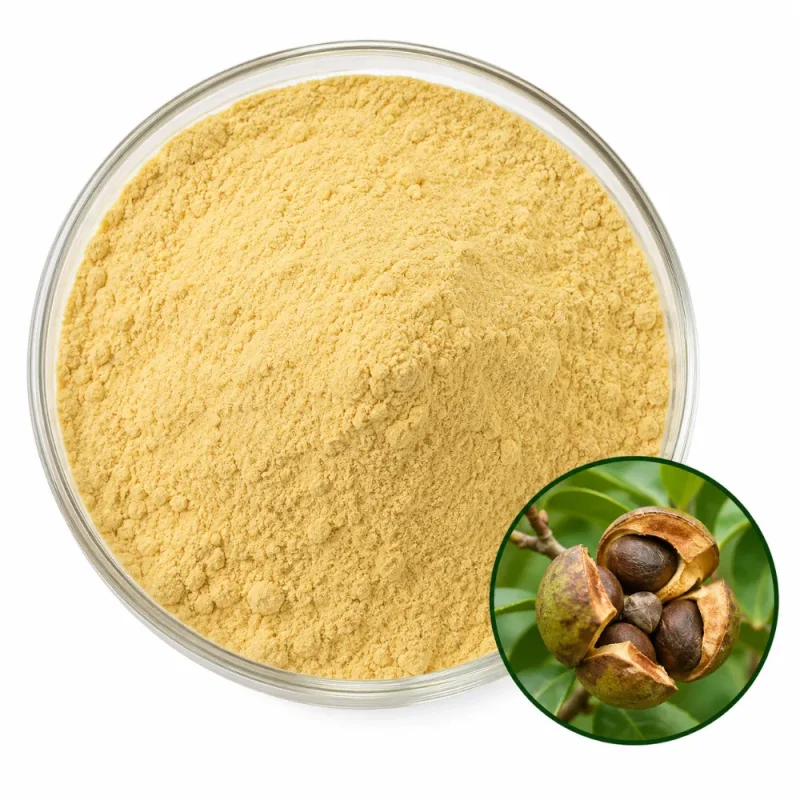
Tea Seed Extract Powder

Seeds of Camellia oleifera, the oil-tea camellia grown in southern China for its seed oil, supply this tea seed extract, and the leaves that make drinking tea are not used. Water extraction concentrates the soluble seed fraction, and the liquor is dried into a light brown powder that disperses in water.

This is a 10:1 ratio extract milled to 80 mesh, and it carries no marker percentage. No standardized extract, powder or isolated compound of this species is listed alongside it, so this ratio extract is the single tea seed ingredient, with no declared saponin or polyphenol figure.

Camellia oleifera Identity & Plant Part

The botanical entity is Camellia oleifera Abel., an evergreen shrub or small tree of the Theaceae family, cultivated across southern China for camellia seed oil. The part used is the seed. Leaves, flowers, wood and the oil itself are not part of this ingredient, and the extract is made from the seed material and not from pressed oil.

The name tea seed needs a clear reading. The drinking tea plant is the related species Camellia sinensis, grown for its leaf, and its seed is a different material again. Camellia oleifera seed is valued for oil and, after pressing, for the defatted seed cake that remains, which concentrates the polar constituents, notably triterpenoid saponins known as camellia or tea saponin, along with polyphenols and polysaccharides.

Because tea seed is not tea leaf, a listing for tea seed extract does not describe a caffeine or catechin profile.

What 10:1 Means for Tea Seed

A 10:1 ratio records how much tea seed went into the extract. It is not a content figure for saponins, polyphenols or any other constituent, and no such figure is attached to this product. The ratio describes concentration of the starting material only, so it is read together with the plant part and the extraction medium.

Saponins dissolve readily in water and foam on shaking, so a tea seed extract made with water carries them into the powder. That foaming is a property of the material that formulators plan around, and it is one reason tea seed extract is judged first by identity and handling and not by a single marker.

Typical Specifications

Specification ItemProduct Information
Latin NameCamellia oleifera
Plant PartSeed & Grain
ProcessingWater Extraction
Common NameCamellia Oleifera Seed
Ingredient TypeRatio Extract
Extract Ratio10:1
AppearanceLight Brown powder
Solubility / DispersibilityWater Dispersible
Quality Parameters
Moisture (LOD)≤5.0%
Total Ash≤5.0%
Particle Size80 mesh
Heavy MetalsLead ≤2 ppm · Arsenic ≤1 ppm · Cadmium ≤1 ppm · Mercury ≤0.1 ppm
MicrobiologyTPC ≤1,000 cfu/g · Yeast & Mold ≤100 cfu/g · E. coli Negative · Salmonella Negative/25 g
Shelf Life24 months in unopened original packaging, cool and dry storage

Application Areas

Foam-Aware Stick Packs

Tea seed extract works in stick packs beside fruit powders and a dispersible base. Saponin foaming means the powder is stirred in gently and not shaken, and a light brown tint blends into caramel, coffee-style and warm fruit flavors without making them muddy.

Saponin-Rich Capsule Fills

The extract is filled into hard capsules after a flow aid is blended in. Because it disperses without dissolving, disintegration on the finished fill is worth testing, and a fine seed extract packs densely enough to make fill weight an early check.

Tablet Compression Blends

Granulation of tea seed extract with microcrystalline cellulose and a disintegrant precedes compression. Saponins foam on contact with water, so wet granulation steps use short mixing and low shear, and a coating keeps the brown core clean. Dry granulation or direct compression keeps contact with water short, which limits saponin foaming in the blend.

Instant Drink Powders

In dry drink mixes, the extract suits opaque, flavored drinks. A foamy head forms when the cup is stirred hard, which some formats want, and a hazy light brown liquid hides well in cocoa or chai-style bases.

Formulation Notes

The powder is light brown with a faint woody-nutty aroma and a mildly bitter taste with a slight lingering tingle that comes from saponins. In water it disperses to a hazy tan liquid, and shaking raises a persistent foam.

To limit foaming, wet the powder into a small volume of liquid and add the rest slowly, and mix beverages with low shear. Tea seed extract flows better after a quick premix with a carrier. Once a pack is open, reseal the liner after each draw, since a damp pack cakes and the saponins make the surface turn tacky.

Packaging & Commercial Supply

Essencefield supports product evaluation, formulation trials, commercial orders, and ongoing ingredient supply. Packaging, storage, and shipping arrangements are determined by product characteristics, order quantity, stability requirements, and destination-market needs.

Supply ItemGeneral Information
SampleAvailable upon request for formulation, testing, and supplier evaluation
Order Quantities100 g · 1 kg · 5 kg · 25 kg · 100 kg · 500 kg · Bulk
Sample Lead TimeTypically 5–7 days after sample confirmation
Production Lead TimeTypically 15–30 days after order and specification confirmation
PackagingSuitable protective inner packaging with bags, cartons, drums, or other appropriate outer packaging
StorageStore in tightly sealed, suitable protective packaging in a cool, dry environment. Protect from moisture, heat, and direct sunlight. Specific storage conditions follow the approved product specification.
DocumentationCOA · Product Specification · TDS · SDS · Applicable declarations (as applicable)

Final order quantities, lead times, packaging, documentation, and shipping arrangements are confirmed according to the selected product and commercial requirements.

Request Ingredient Specifications & Quote

Share your target specification, application, quantity, and documentation needs. We’ll help confirm suitable options, samples, and commercial supply details.