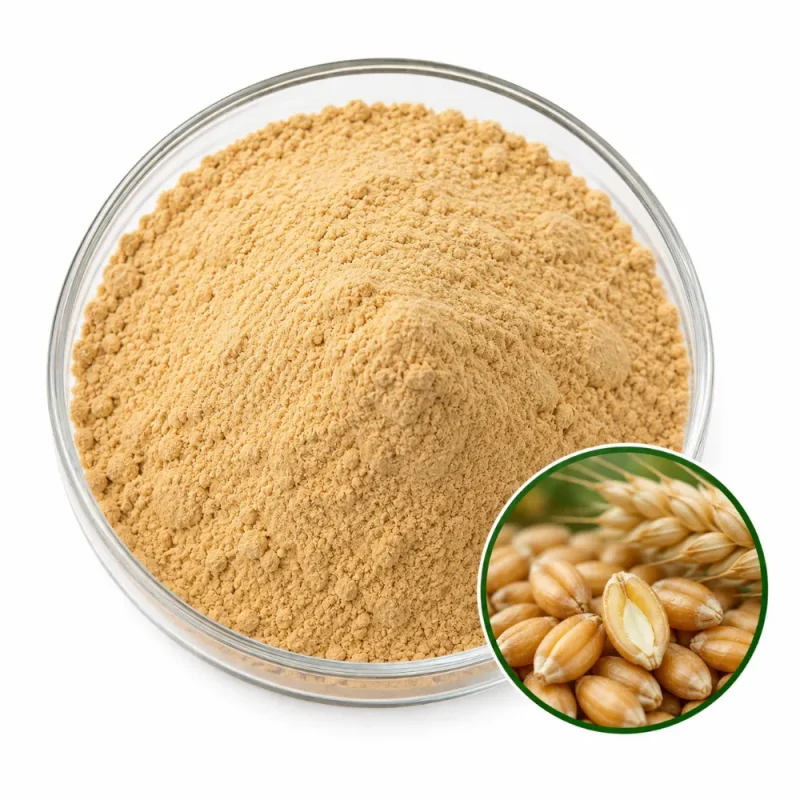
Wheat Germ Extract 0.1–1% Spermidine

Wheat germ extract is prepared from the germ of the wheat kernel, Triticum aestivum L., the embryo that is separated from the grain in milling, and the grass belongs to the family Poaceae. Ethanol extraction concentrates the polyamine fraction of the germ, and the concentrate is dried to a light yellow powder that dissolves in water.

Spermidine is measured by HPLC, with a primary grade of 1% and a lower grade of 0.1%. The powder is 80 mesh. The 1% grade suits capsules and tablets, while the 0.1% grade suits drink powders and blends.

Spermidine Standardization & Grades

Spermidine is an aliphatic polyamine, a small molecule with three nitrogen atoms spaced along a flexible chain. It occurs in all living cells and is concentrated in the germ of cereals, where it sits beside spermine and putrescine. Wheat germ is among the richest common food sources. The free base is hygroscopic and air sensitive, and it is often handled as a salt, with the trihydrochloride the usual commercial form. Wheat germ extract is standardized to spermidine because the compound is the defining polyamine of the germ and can be quantified against a reference standard.

The botanical entity is Triticum aestivum L., and the part is the germ, not the whole kernel and not the young green plant. Wheat germ, wheat bran and milled wheat are three different fractions of the grain, and wheat grass is another material altogether. The same germ is supplied as a 10:1 ratio extract with no marker figure, Wheat Germ Extract Powder, as a hydrolyzed protein fraction, Wheat Germ Peptide Powder, and as the single compound Spermidine.

GradeAssay & MethodWhere It Fits
0.1% SpermidineHPLCDrink powders, bulk blends
1% SpermidineHPLCCapsules and tablets, lower fill

The 1% grade carries ten times the spermidine per gram, so a capsule or tablet reaches its target with a smaller charge. The 0.1% grade is bulky and behaves like a concentrated germ extract in blends. The extract is made from stabilized germ, which is heat treated to inactivate lipase, defatted, extracted and concentrated.

Spermidine Analysis & Purity Risks

Polyamines have no strong chromophore, so HPLC analysis uses a derivatization step. The sample is reacted with a reagent such as benzoyl chloride or dansyl chloride, which attaches a light-absorbing or fluorescent group, and the derivatives are separated and read against a reference standard. The result is a specific compound, not a class equivalent. It is stated on a dry basis and as the free base unless the salt is named.

The basis needs attention. A spermidine figure can refer to the free base or to the trihydrochloride, and the salt weighs about 1.7 times the base per mole. Two certificates compare only when they state the same form. A spermidine HPLC figure also cannot be converted into a total polyamine figure that includes spermine and putrescine.

A second point is origin. Commercial spermidine at a very high figure is usually the synthetic trihydrochloride, which is a chemical and not a plant extract. The extract described here is a plant-derived material at a low percentage, with the sugars, amino acids and lipids of the germ present, and its fingerprint reflects that. A near-pure spermidine powder is a different product from a germ extract.

Purity risks follow from the material class. The germ is the defined part, and bran or endosperm in the starting material dilutes the polyamines. Raw germ spoils quickly, since its lipase and lipoxygenase make it turn rancid within days, which is why stabilized germ is the starting material.

Freshness of the starting germ is the main process variable. Polyamine levels fall and biogenic amines rise when germ is stored warm and damp, so the germ is stabilized by heat shortly after milling and used within a short window. A wheat germ extract from stabilized material has a clean malty scent, and one from spoiled germ smells sour and shows a lower spermidine peak.

Typical Specifications

Specification ItemProduct Information
Latin NameTriticum aestivum
Plant PartSeed & Grain
ProcessingEthanol Extraction
Common NameWheat Germ
Ingredient TypeStandardized Extract
Marker Compound(s)Spermidine
Primary Grade1% Spermidine (HPLC)
Available Grades0.1% · 1% Spermidine (HPLC)
AppearanceLight Yellow powder
Solubility / DispersibilityWater Soluble
Quality Parameters
Moisture (LOD)≤5.0%
Total Ash≤5.0%
Particle Size80 mesh
Heavy MetalsLead ≤2 ppm · Arsenic ≤1 ppm · Cadmium ≤1 ppm · Mercury ≤0.1 ppm
MicrobiologyTPC ≤1,000 cfu/g · Yeast & Mold ≤100 cfu/g · E. coli Negative · Salmonella Negative/25 g
Shelf Life24 months in unopened original packaging, cool and dry storage

Applications by Grade

1% Grade for Capsule Fills

The 1% grade of wheat germ extract reaches its spermidine target in a moderate capsule fill. The pale yellow powder is hygroscopic and sticky when damp, so a dry filling room and a flow agent keep the hopper from bridging, and a check weight at the start of each run confirms the fill.

0.1% Grade in Drink Powders

The 0.1% grade dissolves in cold water to a clear to slightly hazy pale yellow drink with a mild, malty note. Cereal, honey and nutty flavor bases suit it, and the finished pH is held mildly acidic to keep the polyamine in its salt form.

1% Grade in Tablet Blends

Tablets of the 1% grade need a dry binder and a lubricant. A film coat limits moisture pickup, which otherwise softens the sugar- and amine-rich compact, and hardness and disintegration are rechecked after storage at warm and cool temperatures.

0.1% Grade for Bar and Cereal Bases

Bars and cereal bases take the 0.1% grade in the dry fraction before the syrup is added. The malty flavor fits cereal systems, and the pale color is hidden by cocoa, nut or oat bases. Syrup temperature is kept moderate, since heat browns the amines.

1% Grade for Stick-Pack Mixes

Stick-pack mixes use the 1% grade with a bulking carrier. The powder dissolves, but it attracts moisture, so the packing room is kept dry and the sachet film is chosen for its moisture barrier. The seal area is checked for sticky residue.

0.1% Grade for Powder Premixes

Premixes carry the 0.1% grade in a larger dry blend. Mix it with part of the carrier before the main charge, and the batch stays uniform even though the grade carries only a small share of marker.

Technical & Quality Considerations

Wheat germ extract is a light yellow powder with a mild, malty, slightly nutty scent. It is water soluble, and the solution is pale yellow, with a clear to faintly hazy look. Polyamines are stable in acidic to neutral solution at moderate temperature, but they react with reducing sugars and aldehydes in a Maillard-type browning during long hot-holding, and the color of a heated drink deepens.

Free amines also react with some flavor aldehydes and with oxidizing agents. They absorb carbon dioxide from the air as carbamates in open containers, so sealed liners are used. The germ lipids that remain in small amounts oxidize slowly, and a rancid note is the first sign of aging.

Humid air is taken up strongly, and the powder cakes. Keep it in tightly closed liners with desiccant, away from heat. Compare each lot with a retained sample for color and scent, and take a new check weight when the filling line is restarted with the other grade, since the two powders differ widely in bulk.

Packaging & Commercial Supply

Essencefield supports product evaluation, formulation trials, commercial orders, and ongoing ingredient supply. Packaging, storage, and shipping arrangements are determined by product characteristics, order quantity, stability requirements, and destination-market needs.

Supply ItemGeneral Information
SampleAvailable upon request for formulation, testing, and supplier evaluation
Order Quantities100 g · 1 kg · 5 kg · 25 kg · 100 kg · 500 kg · Bulk
Sample Lead TimeTypically 5–7 days after sample confirmation
Production Lead TimeTypically 15–30 days after order and specification confirmation
PackagingSuitable protective inner packaging with bags, cartons, drums, or other appropriate outer packaging
StorageStore in tightly sealed, suitable protective packaging in a cool, dry environment. Protect from moisture, heat, and direct sunlight. Specific storage conditions follow the approved product specification.
DocumentationCOA · Product Specification · TDS · SDS · Applicable declarations (as applicable)

Final order quantities, lead times, packaging, documentation, and shipping arrangements are confirmed according to the selected product and commercial requirements.

Request Ingredient Specifications & Quote

Share your target specification, application, quantity, and documentation needs. We’ll help confirm suitable options, samples, and commercial supply details.