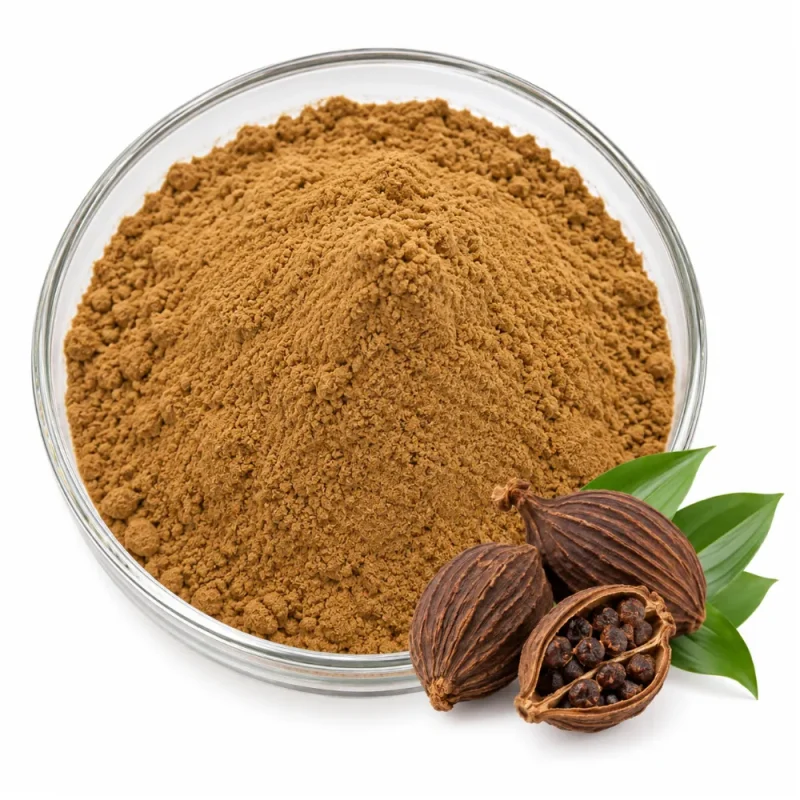
Amomum Fruit Extract Powder

Amomum fruit extract powder comes from the dried fruit of Amomum villosum, the ginger-family spice sold in Chinese trade as sha ren. The fruit is extracted with water, concentrated and dried to a light brown powder with a faint, warm aromatic note.

The product is a 10:1 ratio extract with no marker percentage attached. It is water dispersible and milled to 80 mesh. The data for this botanical lists no powdered or standardized sibling, so the ratio extract is the only form described.

Amomum villosum Identity & Plant Part

The botanical entity is Amomum villosum Lour., family Zingiberaceae. Databases now place it in Wurfbainia as Wurfbainia villosa, while trade and the master data keep the Amomum name. The part used in this Amomum fruit extract is the fruit; leaves, rhizomes and flowers are not part of the product.

The Amomum name covers several spices. Black cardamom, Amomum subulatum, is a smoky Himalayan spice of the same genus and a different plant, and true cardamom belongs to Elettaria. In Chinese trade, sha ren is also separated from Alpinia oxyphylla, whose fruit is sold as yi zhi and has its own page. Amomum fruit extract from Amomum villosum is a fruit ingredient, so its specification names both the fruit and the binomial, whichever spice name a supplier uses.

What 10:1 Means for Amomum villosum

For this botanical the 10:1 ratio means ten parts of fruit per part of powder and nothing else. It makes no claim about volatile oil, bornyl acetate or any other compound, so it is a concentration statement and not a marker. No standardized, powdered or isolated sibling of Amomum villosum is listed, so the ratio extract is the only form described.

Choose it when species identity and the fruit as plant part are the requirement. The aromatic oil that characterizes the whole spice is largely lost in water extraction, so the powder is a mild, dispersible material and not a flavor substitute for the spice.

Typical Specifications

Specification ItemProduct Information
Latin NameAmomum villosum
Plant PartFruit & Berry
ProcessingWater Extraction
Common NameAmomum Fruit, Sha Ren
Ingredient TypeRatio Extract
Extract Ratio10:1
AppearanceLight Brown powder
Solubility / DispersibilityWater Dispersible
Quality Parameters
Moisture (LOD)≤5.0%
Total Ash≤5.0%
Particle Size80 mesh
Heavy MetalsLead ≤2 ppm · Arsenic ≤1 ppm · Cadmium ≤1 ppm · Mercury ≤0.1 ppm
MicrobiologyTPC ≤1,000 cfu/g · Yeast & Mold ≤100 cfu/g · E. coli Negative · Salmonella Negative/25 g
Shelf Life24 months in unopened original packaging, cool and dry storage

Application Areas

Spice-Tinted Capsule Fills

Regular capsule shells cover the powder’s light brown tint without trouble. Fruit extracts can bridge in the hopper and absorb moisture, so run a flow check on the lot before filling and weigh capsules at intervals to catch fill variation.

Cardamom-Style Drink Powders

In drink powders the extract adds a faint, warm aromatic note that suits chai, ginger and cocoa flavors. Taste a plain-water sample first, because the aroma is quiet after extraction and strong spices can overpower it completely.

Instant Tea Sachets with Spice

Instant tea-style sachets can combine the extract with ginger, cinnamon or tangerine-peel extracts for a warm spice blend. Dissolve test sachets in hot and cold water to compare haze, and screen the powder into the premix.

Tablet Blends for Fruit Extracts

A dry binder plus a disintegrant gives a tablet that holds and then breaks up. Moisture pickup softens compacts, so keep humidity low during compression and test hardness and disintegration on finished tablets. Residual sugars in fruit extracts can make a tablet sticky, so control humidity in the press room.

Spiced Gummy Bases

In gummies the extract provides a pale brown tint and a faint spice note that suits orange, ginger and honey flavors. Add the powder after cooking and cooling slightly, then test gel set on a finished gummy.

Formulation Notes

The extract is a light brown powder with a faint warm, camphor-like aroma and a slightly bitter taste. A glass of water with the powder shows a pale brown liquid with mild cloudiness. Most of the volatile aroma of the fruit is lost during extraction and concentration, so the powder smells much milder than the spice. Because the powder is hygroscopic, weigh it promptly and reseal the container after each use. Before the main batch, blend it first with part of the filler, then screen. Compare an opened lot with a retained sample before it goes into a pale blend, as brown shades darken with air.

Packaging & Commercial Supply

Essencefield supports product evaluation, formulation trials, commercial orders, and ongoing ingredient supply. Packaging, storage, and shipping arrangements are determined by product characteristics, order quantity, stability requirements, and destination-market needs.

Supply ItemGeneral Information
SampleAvailable upon request for formulation, testing, and supplier evaluation
Order Quantities100 g · 1 kg · 5 kg · 25 kg · 100 kg · 500 kg · Bulk
Sample Lead TimeTypically 5–7 days after sample confirmation
Production Lead TimeTypically 15–30 days after order and specification confirmation
PackagingSuitable protective inner packaging with bags, cartons, drums, or other appropriate outer packaging
StorageStore in tightly sealed, suitable protective packaging in a cool, dry environment. Protect from moisture, heat, and direct sunlight. Specific storage conditions follow the approved product specification.
DocumentationCOA · Product Specification · TDS · SDS · Applicable declarations (as applicable)

Final order quantities, lead times, packaging, documentation, and shipping arrangements are confirmed according to the selected product and commercial requirements.

Request Ingredient Specifications & Quote

Share your target specification, application, quantity, and documentation needs. We’ll help confirm suitable options, samples, and commercial supply details.