Celery Powder

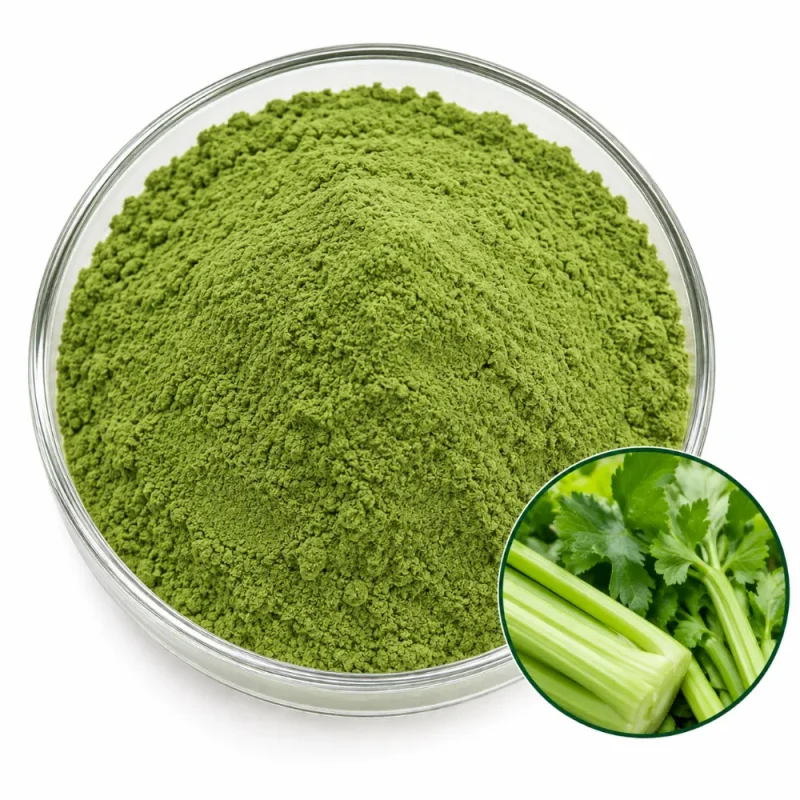
Stalks of Apium graveolens are washed, cut, dried in warm air and milled to 80 mesh to give celery powder. The powder is green and tastes of celery: herbal, salty-sweet and faintly bitter, with a clear aromatic note. Roots, seeds and leaves of the plant are separate materials.

The stalk is the swollen leaf stem, or petiole, of the plant. The powder keeps its fiber, chlorophyll, sugars and aroma compounds in the proportions of the vegetable, with no carrier and no juice separation, and it is one of the best-known savory vegetable powders in processed food.

Dehydrated Celery Processing

The species is Apium graveolens L., a biennial of the carrot family (Apiaceae) grown in three main forms. Stalk celery, the type used here, is bred for crisp petioles. Celeriac, Apium graveolens var. rapaceum, is grown for its swollen root, and leaf celery, or smallage, is grown for its aromatic leaves and seeds. Celery seed is a spice, and celery seed powder is a different material from stalk powder.

The raw material is fresh celery stalk. Stalks are washed, trimmed, sliced and dried in warm air, then ground into powder. Drying concentrates the savory-sweet base and drives off much of the water, which makes up the majority of the fresh stalk. Hot-air dehydration gives a deeper, more cooked flavor than freeze-drying, with less of the raw crispness in the aroma.

Celery is a cool-season crop that needs steady water and is often blanched or grown for tender, pale stalks. Darker green stalks are more strongly flavored and a little more bitter than pale ones, and they give a greener powder. The powder is described by shade and flavor, and the cultivar and stalk color are not stated.

The aroma of celery comes from phthalides such as sedanolide and 3-n-butylphthalide, which are present in the stalk and survive drying in part. These volatile compounds are what separate celery from other green vegetables and make a small inclusion recognizable in a blend.

Celery Color, Flavor & Composition

Celery powder is green, softer and paler than spinach or kale powder, and it forms a pale green suspension in water. The flavor is herbal and salty-sweet, with a clean, slightly bitter aromatic finish. Natural sodium in the stalk is higher than in most vegetables, which adds a mild savory sense without added salt.

Characteristic constituents are fiber, phthalide aroma compounds, flavonoids such as apigenin glycosides, nitrate and minerals. No figure is given for any of them. Celery is a nitrate-bearing vegetable, and in cured-meat systems it is used together with a nitrate-reducing culture so that its nitrate can be converted during processing.

Celery powder sits between a vegetable and a spice. It is used at low levels like a seasoning, but its fiber and mineral content behave like a vegetable, so it adds a little body to soups and rubs as well as aroma.

FormWhat It IsChoose It When
Dehydrated Celery PowderHot-air dried and milled stalkWhole-stalk fiber and a cooked flavor are wanted
Celery Juice PowderSpray-dried juice on a carrierA fine, fiber-light, dispersible green is wanted
Freeze-Dried Celery PowderStalk dried under vacuumA fresher aroma matters most
Celery Seed PowderGround seed of the plantThe seed spice, not the stalk, is specified

Typical Specifications

Specification ItemProduct Information
Latin NameApium graveolens
Plant PartBark & Stem
ProcessingDehydrated
Common NameCelery
Raw MaterialFresh celery stalk
Ingredient TypeDehydrated Vegetable Powder
AppearanceGreen powder (natural color of the dried material)
FlavorHerbal, salty-sweet, aromatic
Solubility / DispersibilityWater Dispersible
Quality Parameters
Moisture (LOD)≤8.0%
Particle Size80 mesh
Heavy MetalsLead ≤2 ppm · Arsenic ≤1 ppm · Cadmium ≤1 ppm · Mercury ≤0.1 ppm
MicrobiologyTPC ≤10,000 cfu/g · Yeast & Mold ≤1,000 cfu/g · E. coli Negative · Salmonella Negative/25 g
Shelf Life24 months in unopened original packaging, cool and dry storage

Application Areas

Soup, Broth and Bouillon Bases

Dry soup, bouillon and broth bases use celery powder for the herbal-savory backbone that fresh celery gives in a mirepoix. It dissolves into hot liquid with a pale green cloud, and the phthalide aroma identifies the product as celery at low inclusion.

Curing and Cooked-Meat Blends

Processed-meat producers use celery powder as a vegetable-based curing ingredient together with a nitrate-reducing culture. The culture is part of the system and is a decision for the producer, and the powder’s mild flavor suits ham, sausage and poultry applications.

Seasoning Salt and Rub Blends

Seasoning blends use celery powder with salt, pepper and paprika, as in celery salt and savory rubs. It blends evenly as a fine powder, and its herbal note rounds the sharp edges of salt and spice.

Snack and Dip Seasonings

Snack and dip seasonings include celery powder for a fresh vegetable note against dairy, onion and garlic. The green tint is faint, so it shows little on a seasoned snack, and the aroma is the main contribution.

Plant-Based and Savory Premixes

Plant-based sausages, nuggets and vegetable burgers take celery powder to add savory background and vegetable depth. It supports onion and garlic, and its fiber holds some moisture in the cooked product, which suits sausages and nuggets that otherwise dry out on reheating.

Handling Notes

Celery powder is hygroscopic and takes on moisture from humid air. It cakes into soft, pale green lumps that grow into a hard mass, and an open drum can form a crust within a shift. Weigh in a dry room and reseal the liner after each draw.

The phthalide aroma is volatile. Warm storage and long exposure to air flatten the fresh celery note, and a stale, hay-like background replaces it. The scent also travels to neighboring ingredients in a shared store, so keep the drum tightly closed and apart from delicate flavors.

Color fades from green toward tan under light, heat and acid. Sealed, light-proof packs stored cool hold the green, and acidic dry mixes speed the fade. The powder is dusty and light, so use closed transfer where possible to keep pale green residue off adjacent lines.

Celery stalks carry a lot of potassium and sodium salts, which stay in the powder and draw water. That is a second reason, beyond fiber, why celery powder cakes quickly, and why a barrier liner matters more for this powder than for starch-based vegetable powders.

Packaging & Commercial Supply

Essencefield supports product evaluation, formulation trials, commercial orders, and ongoing ingredient supply. Packaging, storage, and shipping arrangements are determined by product characteristics, order quantity, stability requirements, and destination-market needs.

Supply ItemGeneral Information
SampleAvailable upon request for formulation, testing, and supplier evaluation
Order Quantities100 g · 1 kg · 5 kg · 25 kg · 100 kg · 500 kg · Bulk
Sample Lead TimeTypically 5–7 days after sample confirmation
Production Lead TimeTypically 15–30 days after order and specification confirmation
PackagingSuitable protective inner packaging with bags, cartons, drums, or other appropriate outer packaging
StorageStore in tightly sealed, suitable protective packaging in a cool, dry environment. Protect from moisture, heat, and direct sunlight. Specific storage conditions follow the approved product specification.
DocumentationCOA · Product Specification · TDS · SDS · Applicable declarations (as applicable)

Final order quantities, lead times, packaging, documentation, and shipping arrangements are confirmed according to the selected product and commercial requirements.

Request Ingredient Specifications & Quote

Share your target specification, application, quantity, and documentation needs. We’ll help confirm suitable options, samples, and commercial supply details.