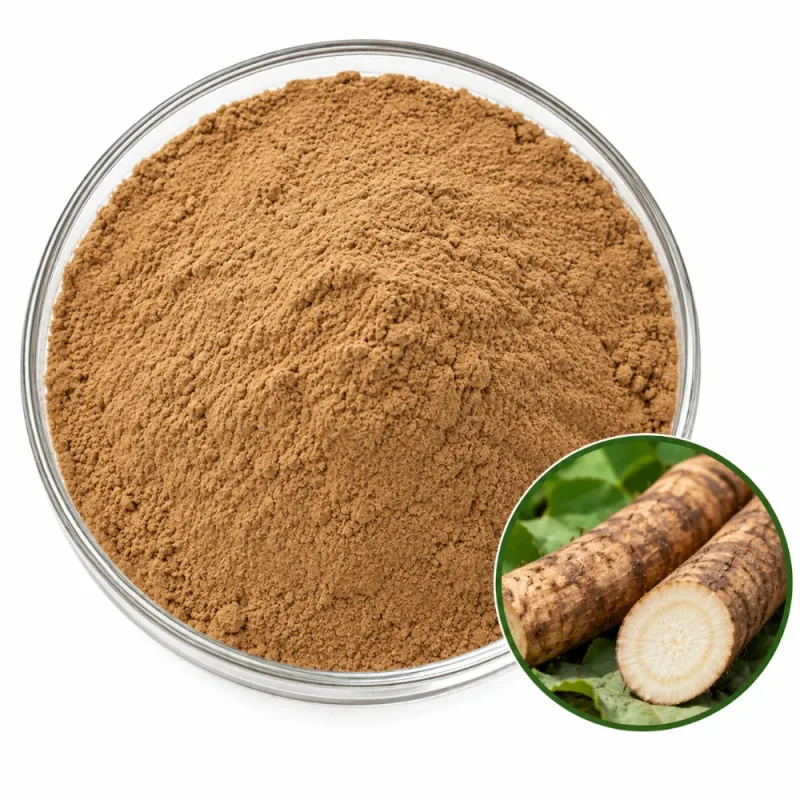
Burdock Root Powder

Roots of Arctium lappa are washed, sliced, dried in warm air and milled to 80 mesh to give burdock root powder. The powder is light yellow and tastes sweet, earthy and faintly nutty, with a mild, slightly bitter finish. Seeds, leaves and the spiny burs of the plant are separate materials.

The long taproot is the vegetable known in Japan as gobo. The powder keeps its fiber, inulin-type storage carbohydrates and phenolic compounds, with no carrier and no juice separation.

Dehydrated Burdock Root Processing

The species is Arctium lappa L., greater burdock, a biennial of the daisy family (Asteraceae) native to Europe and Asia. Related species such as Arctium minus and Arctium tomentosum grow as roadside weeds with similar burs, and the cocklebur, Xanthium, is another plant with spiny fruit that is often confused with burdock in traditional medicine. The part used here is the root, and burdock seed, which is sold as a separate spice and extract, has a different chemistry.

The raw material is fresh burdock root. Roots are washed, scrubbed or peeled, sliced thinly, dried in warm air and ground to powder. Fresh root browns rapidly when cut because its phenolic compounds oxidize, and processors move cut pieces to drying quickly or hold them in water. Hot-air drying fixes that tan color into the powder, giving it a warmer tone than the pale flesh suggests.

Burdock is harvested in autumn of the first year, before the plant flowers and the root turns woody. Young, tender roots are sweet and crisp, while older roots are fibrous and bitter. The cultivar and root age are not stated, so the powder is described by character.

The main storage carbohydrate of burdock is inulin, a chain of fructose units, in place of the starch of potato or sweet potato. That is why the root tastes mildly sweet without being starchy, and why the powder behaves differently from starch-based vegetable powders in doughs and drinks.

Burdock Root Color, Flavor & Composition

Burdock root powder is light yellow to tan, and it gives a pale brown suspension in water. The flavor is sweet, earthy and slightly woody, with a gentle bitterness and a mushroom-like depth. The taste is milder than that of dandelion root or chicory root, which share some of its character.

Characteristic constituents are inulin-type fructans, caffeoylquinic acids and other phenolics, dietary fiber and trace polyacetylenes. No figure is given for any of them. Burdock root is a fiber-rich vegetable material, and the powder is a whole-root product and not a concentrate.

Burdock root is often paired with carrot and sesame in Japanese kinpira, and the powder suits the same flavor family. Its sweet-earthy note works with soy, mirin and toasted sesame, while citrus and mint would clash with the woody character.

FormWhat It IsChoose It When
Dehydrated Burdock Root PowderHot-air dried and milled rootA whole-root, fiber-containing base is wanted
Burdock Root Extract PowderRatio extract of the rootA concentrated extract is specified
Burdock Seed PowderGround seed of the plantThe seed, not the root, is specified
Burdock Seed Extract PowderWater extract of the burdock seedThe seed, not the root, is the requirement

Typical Specifications

Specification ItemProduct Information
Latin NameArctium lappa
Plant PartRoot & Rhizome
ProcessingDehydrated
Common NameBurdock root
Raw MaterialFresh burdock root
Ingredient TypeDehydrated Vegetable Powder
AppearanceLight Yellow powder (natural color of the dried material)
FlavorSweet, earthy, mildly bitter
Solubility / DispersibilityWater Dispersible
Quality Parameters
Moisture (LOD)≤8.0%
Particle Size80 mesh
Heavy MetalsLead ≤2 ppm · Arsenic ≤1 ppm · Cadmium ≤1 ppm · Mercury ≤0.1 ppm
MicrobiologyTPC ≤10,000 cfu/g · Yeast & Mold ≤1,000 cfu/g · E. coli Negative · Salmonella Negative/25 g
Shelf Life24 months in unopened original packaging, cool and dry storage

Application Areas

Roasted Root Teas and Instant Infusions

Burdock root teas are popular in Japan and Korea, and the powder reproduces the sweet, earthy cup in instant sticks. It blends with roasted barley, corn silk or ginger, and a short steep in hot water gives a tan, slightly cloudy drink.

Miso, Soup and Broth Bases

Dry miso soup, broth and noodle bases use burdock root powder to deliver the sweet-earthy backbone of gobo cooked in soup. It pairs with soy, mushroom and sesame flavors, and it adds mild body without the water content of fresh root.

Rice, Grain and Seasoning Mixes

Seasoning mixes for rice, porridge and stir-fried vegetables include burdock root powder to carry the woody sweetness of kinpira-style dishes. It blends easily with soy powder, sesame and chili flakes, and the fine texture sticks to grain.

Bakery and Cracker Doughs

Bakers add burdock root powder to savory crackers, breads and rice-flour snacks for earthy flavor and a warm tan color. Its fiber holds water, so dough hydration is adjusted, and baking deepens both color and flavor.

Plant-Based Patty and Dumpling Mixes

Plant-based patties and dumpling fillings take burdock root powder for fiber, binding and a woody-sweet note that echoes mushroom and root vegetable flavors. It absorbs moisture and keeps the cooked patty cohesive, and the earthy sweetness reads as a mushroom-like background in vegetable burgers.

Handling Notes

Burdock root powder is hygroscopic and takes up water from humid air. It clumps into soft lumps that harden into a crust, and its inulin content makes it especially water-attracting. Weigh in a dry area and close the liner after each use.

The tan color darkens with warmth because of phenolic oxidation and sugar browning. Opaque, sealed packaging in a cool store holds the shade, and iron and copper contact speeds darkening, so stainless steel tools are the right choice. Aged powder smells flat and slightly musty.

Dust from root powders is fine and light. Closed transfer, a covered hopper and regular cleaning keep brown residue off adjacent lines. Keep opened bags sealed, and use them within a short window to hold the fresh, sweet-earthy note.

Inulin-type carbohydrates make the powder soft and sticky in damp air. A humid store turns it into a rubbery lump that does not break apart under a scoop, so smaller pack sizes and a desiccant-free but well-sealed liner are the practical protection.

Packaging & Commercial Supply

Essencefield supports product evaluation, formulation trials, commercial orders, and ongoing ingredient supply. Packaging, storage, and shipping arrangements are determined by product characteristics, order quantity, stability requirements, and destination-market needs.

Supply ItemGeneral Information
SampleAvailable upon request for formulation, testing, and supplier evaluation
Order Quantities100 g · 1 kg · 5 kg · 25 kg · 100 kg · 500 kg · Bulk
Sample Lead TimeTypically 5–7 days after sample confirmation
Production Lead TimeTypically 15–30 days after order and specification confirmation
PackagingSuitable protective inner packaging with bags, cartons, drums, or other appropriate outer packaging
StorageStore in tightly sealed, suitable protective packaging in a cool, dry environment. Protect from moisture, heat, and direct sunlight. Specific storage conditions follow the approved product specification.
DocumentationCOA · Product Specification · TDS · SDS · Applicable declarations (as applicable)

Final order quantities, lead times, packaging, documentation, and shipping arrangements are confirmed according to the selected product and commercial requirements.

Request Ingredient Specifications & Quote

Share your target specification, application, quantity, and documentation needs. We’ll help confirm suitable options, samples, and commercial supply details.