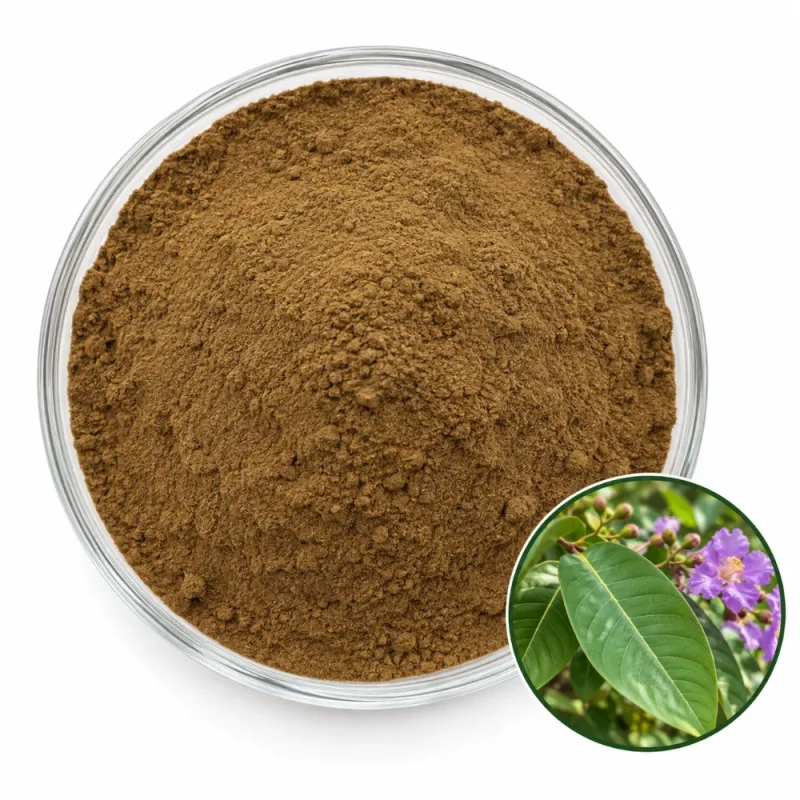
Banaba Leaf Extract Powder

Leaves of Lagerstroemia speciosa, a tropical flowering tree of South and Southeast Asia known in the Philippines as banaba, are the starting material for this banaba leaf extract. Water extraction concentrates the soluble leaf fraction, and the liquor is dried into a green powder that wets and disperses in water.

The extract is supplied at a 10:1 ratio with no marker percentage and is milled to 80 mesh. Corosolic acid-defined extracts of the same leaf are a separate standardized product, and pure corosolic acid is a distinct compound grade. Water dispersibility, not full solution, is the physical behavior to plan around.

Lagerstroemia speciosa Identity & Plant Part

The botanical entity is Lagerstroemia speciosa (L.) Pers., a deciduous tree in the Lythraceae family, the same family as the ornamental crape myrtle. The part used is the leaf. Flowers, bark and fruit are not part of this ingredient, and the tree’s other common names, giant crape myrtle and queen’s crape myrtle, describe the whole plant and say nothing about the part.

The leaf carries triterpenoid acids, corosolic acid among them, together with ellagitannins. Those two constituent families explain why banaba leaf is traded under both corosolic acid and tannin descriptions. Lagerstroemia indica, the common garden crape myrtle, is a different species and is not the source here.

In the Philippines the name banaba is also used for the dried leaf sold as a tea-style cut. That cut is a different physical form from a spray-dried banaba extract, and the two are not interchangeable in a formula.

Banaba Extract vs Powder & Standardized Grades

FormWhat It IsChoose It When
10:1 Leaf ExtractWater-extracted, concentrated and dried banaba leafA dispersible whole-leaf extract is wanted without a marker
Banaba Leaf Extract 1–10% Corosolic AcidStandardized extract with a defined corosolic acid rangeThe specification names a corosolic acid figure
Corosolic Acid 98%Isolated triterpenoid acid compoundA single pure compound is required

The 10:1 ratio records how much banaba leaf went into the extract. It states nothing about corosolic acid or tannin content, which is why a labelled corosolic acid figure belongs to the standardized grade and not to this one. Because the leaf holds both triterpenoid acids and ellagitannins, two extracts of equal ratio can still carry different proportions of each in the dried powder.

The two siblings change the basis of the specification. The standardized extract adds a corosolic acid range, while pure corosolic acid removes the leaf matrix and leaves a single compound. A formula that must declare a marker starts at the standardized extract, and one that wants a plain dispersible banaba leaf ingredient starts here.

Powder color follows extraction time and temperature, shifting between olive green and brown, so it describes the batch physically and does not rank banaba extract quality.

Typical Specifications

Specification ItemProduct Information
Latin NameLagerstroemia speciosa
Plant PartLeaf & Herb
ProcessingWater Extraction
Common NameBanaba
Ingredient TypeRatio Extract
Extract Ratio10:1
AppearanceGreen powder
Solubility / DispersibilityWater Dispersible
Quality Parameters
Moisture (LOD)≤5.0%
Total Ash≤5.0%
Particle Size80 mesh
Heavy MetalsLead ≤2 ppm · Arsenic ≤1 ppm · Cadmium ≤1 ppm · Mercury ≤0.1 ppm
MicrobiologyTPC ≤1,000 cfu/g · Yeast & Mold ≤100 cfu/g · E. coli Negative · Salmonella Negative/25 g
Shelf Life24 months in unopened original packaging, cool and dry storage

Application Areas

Tablet Granulation Blends

Banaba extract is a green powder that tints white tablet cores, so blends are often film-coated. Tannin-rich leaf extracts can darken on contact with iron, which makes metal contact surfaces and iron-containing premixes a point to check early in granulation trials.

Drink Powder Sticks

In single-serve sticks, the green-brown extract pairs with citrus or tropical flavor bases that cover the astringent tannin note. It disperses into a hazy tea-like liquid, so clear-drink formats are the harder fit for this ingredient.

Hard-Shell Capsule Fills

The extract fills into two-piece capsules after premixing with a flow aid. Because it disperses rather than dissolves, disintegration is worth testing on the finished fill, since a packed plug of tannin-rich powder can release more slowly than loose material.

Pectin Gummy Bases

Pectin gummies can carry banaba extract at low inclusion, where the green-brown tint reads as natural color and fruit flavor covers the tannin edge. Add the extract after the cooked mass has cooled below the setting temperature, so heat and acid exposure stay short.

Formulation Notes

The powder is green with a mild leaf-like aroma and an astringent, slightly bitter taste carried by its tannins. In water it disperses to a hazy greenish-brown liquid, and the haze settles on standing. The ellagitannin fraction binds to proteins and to iron, so color can dull in milk-protein drinks and darken near iron.

Premix the extract with a flowing carrier such as microcrystalline cellulose before capsule filling, since a fine leaf extract packs densely and can bridge in a hopper. In drink powders, add it to the dry blend ahead of acids, sweeteners and flavors so it distributes evenly. After opening, reseal the liner at each draw, because a moisture-affected tannin-rich powder darkens and cakes. Weighing and blending banaba extract in a humidity-controlled room also reduces surface clumping.

Packaging & Commercial Supply

Essencefield supports product evaluation, formulation trials, commercial orders, and ongoing ingredient supply. Packaging, storage, and shipping arrangements are determined by product characteristics, order quantity, stability requirements, and destination-market needs.

Supply ItemGeneral Information
SampleAvailable upon request for formulation, testing, and supplier evaluation
Order Quantities100 g · 1 kg · 5 kg · 25 kg · 100 kg · 500 kg · Bulk
Sample Lead TimeTypically 5–7 days after sample confirmation
Production Lead TimeTypically 15–30 days after order and specification confirmation
PackagingSuitable protective inner packaging with bags, cartons, drums, or other appropriate outer packaging
StorageStore in tightly sealed, suitable protective packaging in a cool, dry environment. Protect from moisture, heat, and direct sunlight. Specific storage conditions follow the approved product specification.
DocumentationCOA · Product Specification · TDS · SDS · Applicable declarations (as applicable)

Final order quantities, lead times, packaging, documentation, and shipping arrangements are confirmed according to the selected product and commercial requirements.

Request Ingredient Specifications & Quote

Share your target specification, application, quantity, and documentation needs. We’ll help confirm suitable options, samples, and commercial supply details.