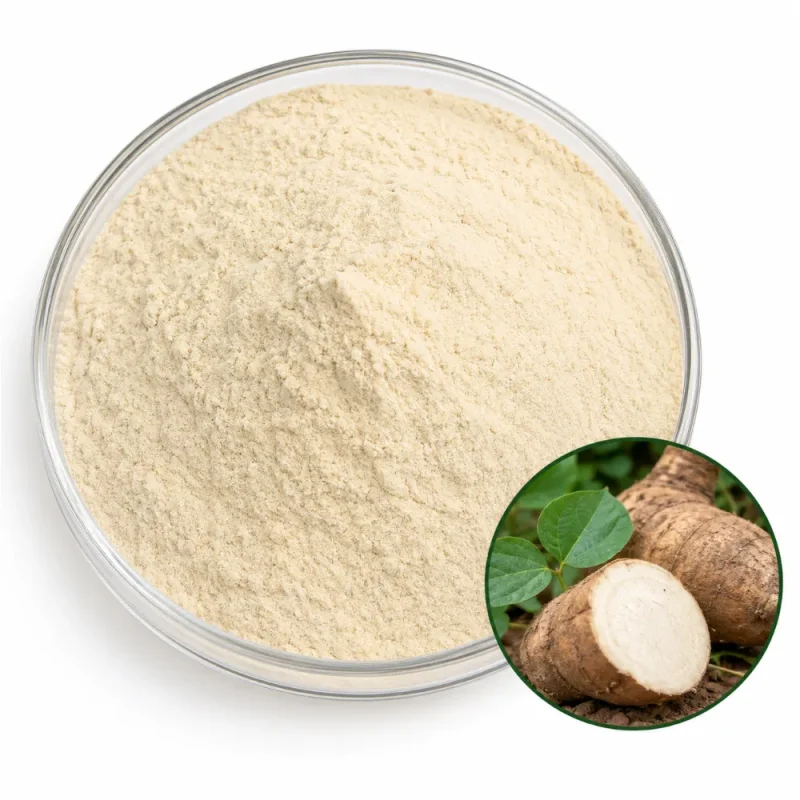
Pueraria mirifica Extract Powder

The tuberous root of Pueraria mirifica, a climbing legume of Thailand and Myanmar called white kwao krua, supplies this Pueraria mirifica extract, and the leaves and vines are not used. Water extraction concentrates the soluble root fraction, and the liquor is dried into a light brown powder.

The grade is a 10:1 ratio extract at 80 mesh, with no marker percentage. No standardized extract, powder or isolated compound of this species is listed alongside it, so this ratio extract is the single P. mirifica ingredient, with no declared isoflavone or chromene figure.

Pueraria mirifica Identity & Plant Part

The botanical entity is Pueraria mirifica Airy Shaw & Suvat., a perennial climber of the Fabaceae family native to northern and northeastern Thailand and neighboring Myanmar. The part used is the tuberous storage root. Leaves, stems, flowers and seed are not part of this ingredient.

Species identity is the main trap. Kudzu, the vine behind the Chinese root drug ge gen, is Pueraria montana var. lobata, and Indian kudzu, or vidari kanda, is Pueraria tuberosa. These are separate species with their own roots and their own markets. White kwao krua, Pueraria mirifica, differs from both, and it is also unrelated to the red and black kwao krua, which come from other genera.

The root carries isoflavonoids and chromenes, miroestrol among them, and those families set it apart from the kudzu roots, where puerarin is the signature compound.

What 10:1 Means for Pueraria Mirifica

A 10:1 ratio records how much Pueraria mirifica root went into the extract. It is not a content figure for isoflavones, miroestrol or any other constituent, and no such figure is attached to this product. The ratio describes concentration of the starting material only, and it needs to be read next to the plant part and the extraction medium.

Miroestrol is notably unstable on exposure to light and air, which is one reason a Pueraria mirifica extract is read by identity and part and not by a single compound. Water extraction leaves the insoluble starch and fiber of the root behind and gives a more concentrated powder than a milled tuber would. Because the species is a protected plant in its home range, buyers also look for a clearly stated part and a stable extraction medium, both of which the table fixes here.

Typical Specifications

Specification ItemProduct Information
Latin NamePueraria mirifica
Plant PartRoot & Rhizome
ProcessingWater Extraction
Common NameWhite Kwao Krua
Ingredient TypeRatio Extract
Extract Ratio10:1
AppearanceLight Brown powder
Solubility / DispersibilityWater Dispersible
Quality Parameters
Moisture (LOD)≤5.0%
Total Ash≤5.0%
Particle Size80 mesh
Heavy MetalsLead ≤2 ppm · Arsenic ≤1 ppm · Cadmium ≤1 ppm · Mercury ≤0.1 ppm
MicrobiologyTPC ≤1,000 cfu/g · Yeast & Mold ≤100 cfu/g · E. coli Negative · Salmonella Negative/25 g
Shelf Life24 months in unopened original packaging, cool and dry storage

Application Areas

Root Extract Capsules

Pueraria mirifica extract goes into hard capsules after a flow aid has been blended in. Because Pueraria mirifica extract disperses and does not dissolve, the finished capsule is worth a disintegration test. A fine root extract packs densely, so fill weight deserves an early check before scale-up.

Tablet Compression Blends

Microcrystalline cellulose and a disintegrant carry Pueraria mirifica extract through compression. A coating step or a tinted base is common, because a dispersible brown powder can speckle white cores, and protecting the blend from light fits the sensitivity of the constituent family.

Light-Protected Stick Fills

Powder sticks pair the extract with a flavored, dispersible carrier. Earthy or malt-style bases cover the mild root taste, and the hazy tan cup suits opaque mixes better than clear drinks. Stick lines run cleanly when the extract is pre-blended into part of the carrier.

Formulation Notes

The powder is light brown with a mild earthy aroma and a faintly bitter, starchy taste. Stirred into water, it gives a hazy tan dispersion that leaves a thin layer of fines on standing.

Chromene-type constituents of Pueraria mirifica root degrade under light and oxygen, so opaque packaging and a closed hopper protect the powder. A short premix with a carrier keeps the powder from bridging. After the first opening, press the air out of the liner and close it at each draw, because a light brown root extract that has taken up humidity darkens and cakes at the surface. The darker, tackier film is the first visible sign that a pack was left open too long.

Packaging & Commercial Supply

Essencefield supports product evaluation, formulation trials, commercial orders, and ongoing ingredient supply. Packaging, storage, and shipping arrangements are determined by product characteristics, order quantity, stability requirements, and destination-market needs.

Supply ItemGeneral Information
SampleAvailable upon request for formulation, testing, and supplier evaluation
Order Quantities100 g · 1 kg · 5 kg · 25 kg · 100 kg · 500 kg · Bulk
Sample Lead TimeTypically 5–7 days after sample confirmation
Production Lead TimeTypically 15–30 days after order and specification confirmation
PackagingSuitable protective inner packaging with bags, cartons, drums, or other appropriate outer packaging
StorageStore in tightly sealed, suitable protective packaging in a cool, dry environment. Protect from moisture, heat, and direct sunlight. Specific storage conditions follow the approved product specification.
DocumentationCOA · Product Specification · TDS · SDS · Applicable declarations (as applicable)

Final order quantities, lead times, packaging, documentation, and shipping arrangements are confirmed according to the selected product and commercial requirements.

Request Ingredient Specifications & Quote

Share your target specification, application, quantity, and documentation needs. We’ll help confirm suitable options, samples, and commercial supply details.