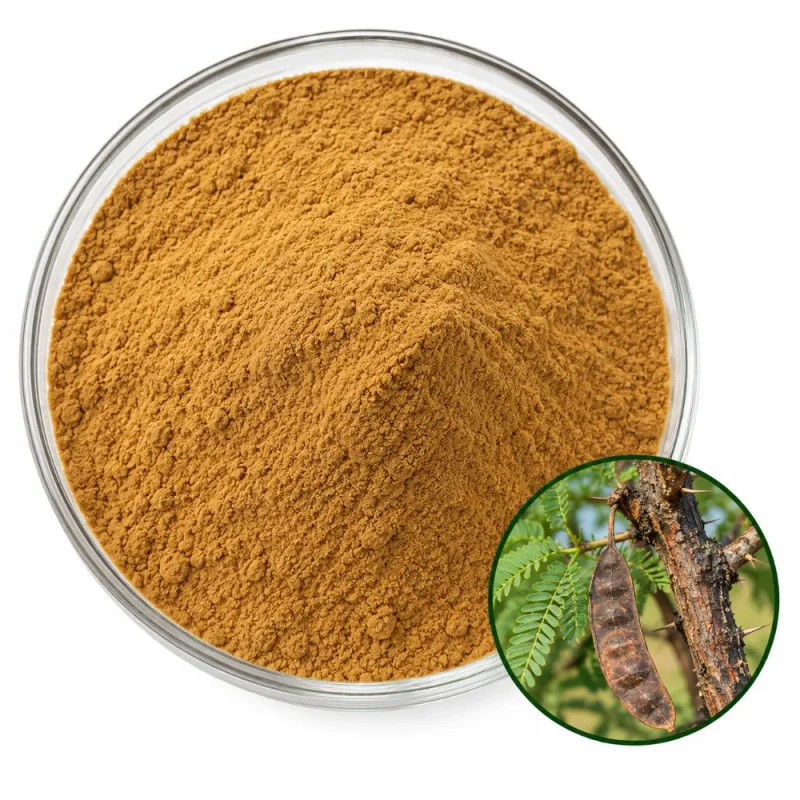
Acacia Extract Powder

Acacia extract powder here means a bark extract of Acacia nilotica, the babul tree, and not the gum arabic that many buyers associate with the word acacia. The bark is extracted with water, concentrated and dried to a light brown powder that carries the tannins of the bark.

The product is a 10:1 ratio extract with no tannin percentage attached. It is water dispersible and milled to 80 mesh. No other form of this botanical appears among the siblings, so the ratio extract is the only profile described.

Acacia nilotica Identity & Plant Part

The botanical entity is Acacia nilotica (L.) Willd. ex Delile, family Fabaceae, called babul or Egyptian acacia. Current databases move the species to Vachellia nilotica, but trade and the master data keep the Acacia name. The part used in this acacia extract is the bark; gum, pods, leaves and seeds are not part of the product.

The word acacia causes frequent confusion. Gum arabic, also called acacia gum, is a dried exudate from other trees, chiefly Senegalia senegal, and is a different material with different behavior in water. This bark extract is also not Acacia catechu, whose heartwood gives catechu. Babul bark is rich in condensed tannins, which is why it has a long history in tanning.

What 10:1 Means for Acacia nilotica

Ten parts of bark standing behind one part of powder is the whole meaning of the 10:1 ratio, and it carries no statement about tannin or any marker compound. No standardized extract, powder or isolated compound of Acacia nilotica appears among the siblings, so the ratio extract is the single form described for this botanical.

Pick it when babul bark identity and a water-dispersible, tannin-bearing extract are what the formulation needs. Because the term acacia is used for several unrelated materials, the species name and the plant part in the table are the reliable identifiers, and a buyer comparing offers should match both. The ratio itself makes no statement about astringency or polyphenol content.

Typical Specifications

Specification ItemProduct Information
Latin NameAcacia nilotica
Plant PartBark & Stem
ProcessingWater Extraction
Common NameBabul Bark, Egyptian Acacia
Ingredient TypeRatio Extract
Extract Ratio10:1
AppearanceLight Brown powder
Solubility / DispersibilityWater Dispersible
Quality Parameters
Moisture (LOD)≤5.0%
Total Ash≤5.0%
Particle Size80 mesh
Heavy MetalsLead ≤2 ppm · Arsenic ≤1 ppm · Cadmium ≤1 ppm · Mercury ≤0.1 ppm
MicrobiologyTPC ≤1,000 cfu/g · Yeast & Mold ≤100 cfu/g · E. coli Negative · Salmonella Negative/25 g
Shelf Life24 months in unopened original packaging, cool and dry storage

Application Areas

Tannin-Rich Capsule Fills

Standard capsule shells hide the light brown acacia extract. Bark extracts rich in tannins are astringent and can cake with moisture, so run a flow check on the lot and weigh capsules during the run to catch fill drift.

Astringent Tea-Style Sticks

In powder sticks the extract gives a dry, tannin-type mouthfeel, so it fits strongly flavored or sweetened tea-style drinks better than plain water. Judge the astringency in the finished serving and adjust the sweetener accordingly. A small amount of citrus acid can soften the dry bark astringency without extra sweetener.

Tablets with Bark Extracts

Tablet development pairs this powder with a dry binder and a release agent. Tannins can react with iron surfaces and some binders, so use stainless tools and check disintegration on the finished tablet before the formula is locked.

Bark-Blend Sachets

Sachets can combine babul bark extract with other bark or wood extracts. Screen the powder before mixing and match particle sizes so the brown tint stays even, then compare samples from the start and end of the filling run.

Bark Extracts in Chewable Tablets

A chewable tablet exposes the astringency of babul bark directly, so a sweetener and a robust flavor are needed to mask it. Compress at low moisture, and chew-test finished tablets for grittiness, since fine bark particles can feel dry in the mouth.

Formulation Notes

The extract is a light brown powder with a mild woody aroma and an astringent taste. In water it disperses to a brown, slightly hazy liquid. Tannins bind proteins and can form haze, so judge clarity in the real drink formula and not only in a plain-water test.

Avoid iron-bearing fillers and tools, because tannins form dark complexes with iron. Start with a premix: pre-blend it with some of the filler and sieve the result. Moisture turns it into clumps, so close the container after each use, and Keep a retained sample of the original shade to judge an opened lot before a pale blend.

Packaging & Commercial Supply

Essencefield supports product evaluation, formulation trials, commercial orders, and ongoing ingredient supply. Packaging, storage, and shipping arrangements are determined by product characteristics, order quantity, stability requirements, and destination-market needs.

Supply ItemGeneral Information
SampleAvailable upon request for formulation, testing, and supplier evaluation
Order Quantities100 g · 1 kg · 5 kg · 25 kg · 100 kg · 500 kg · Bulk
Sample Lead TimeTypically 5–7 days after sample confirmation
Production Lead TimeTypically 15–30 days after order and specification confirmation
PackagingSuitable protective inner packaging with bags, cartons, drums, or other appropriate outer packaging
StorageStore in tightly sealed, suitable protective packaging in a cool, dry environment. Protect from moisture, heat, and direct sunlight. Specific storage conditions follow the approved product specification.
DocumentationCOA · Product Specification · TDS · SDS · Applicable declarations (as applicable)

Final order quantities, lead times, packaging, documentation, and shipping arrangements are confirmed according to the selected product and commercial requirements.

Request Ingredient Specifications & Quote

Share your target specification, application, quantity, and documentation needs. We’ll help confirm suitable options, samples, and commercial supply details.