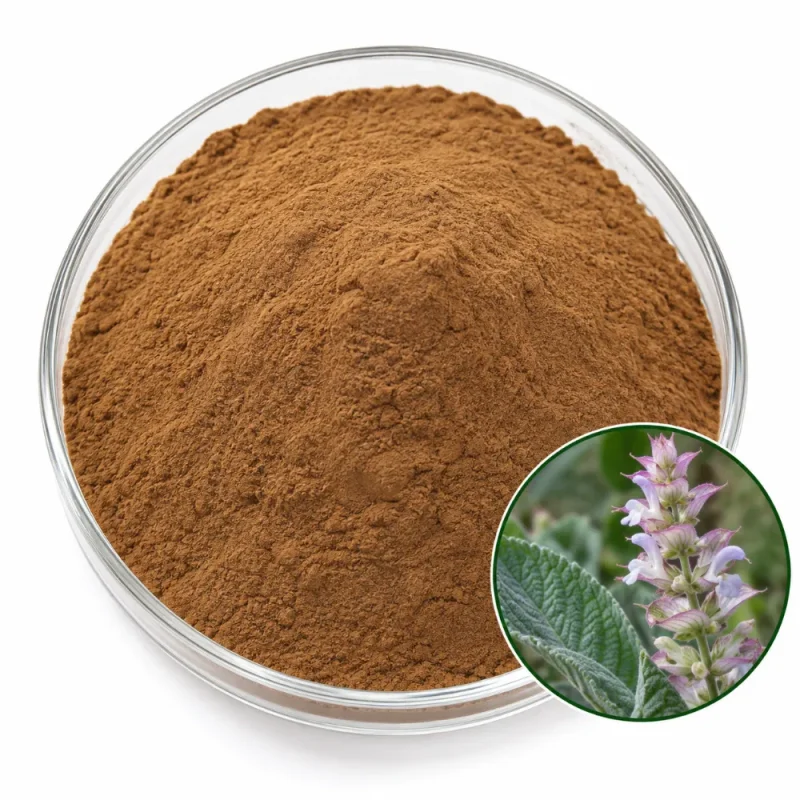
Clary Sage Extract Powder

Clary sage extract starts from the aerial parts of Salvia sclarea, the leafy flowering tops of the Mediterranean herb, with the root excluded. Water extraction concentrates the soluble herb fraction, and the liquor is dried into a light brown powder that disperses in water.

The extract is supplied at a 10:1 ratio with no marker percentage and is milled to 80 mesh. It is a plain herb extract, not the diterpene sclareol, which is sold as a separate pure compound.

Salvia sclarea Identity & Plant Part

The botanical entity is Salvia sclarea L., clary sage, a biennial or short-lived perennial of the Lamiaceae with large, hairy, wrinkled leaves and tall spikes of pale lilac flowers. The part used is the aerial part, meaning leaf and flowering top. The root is not part of this ingredient.

Two confusions matter. Garden sage, Salvia officinalis, is a different species with its own materials. The name clary sage is also used for the essential oil and for sclareol, a diterpene found in the flower glands, and both are separate raw materials. A water extract of the herb keeps phenolic acids such as rosmarinic acid and flavonoids, named only as families.

Harvest timing changes the herb, with leaves taken before the flower spikes open being milder and flower-bearing tops carrying the resinous glands.

What 10:1 Means for Clary Sage

For a fragrant herb whose scent sits in the glandular oil, a water-based 10:1 extract is a quiet material. The ratio measures concentration against the Salvia sclarea herb and does not describe sclareol, essential oil or rosmarinic acid. A stated rosmarinic acid figure would call for a marker-based product. One who names species, aerial part and ratio can use this clary sage extract directly. No powder or marker grade is listed beside it, so the ratio extract is the only form offered for the herb.

Typical Specifications

Specification ItemProduct Information
Latin NameSalvia sclarea
Plant PartLeaf & Herb
ProcessingWater Extraction
Common NameClary Sage Herb
Ingredient TypeRatio Extract
Extract Ratio10:1
AppearanceLight brown powder
Solubility / DispersibilityWater Dispersible
Quality Parameters
Moisture (LOD)≤5.0%
Total Ash≤5.0%
Particle Size80 mesh
Heavy MetalsLead ≤2 ppm · Arsenic ≤1 ppm · Cadmium ≤1 ppm · Mercury ≤0.1 ppm
MicrobiologyTPC ≤1,000 cfu/g · Yeast & Mold ≤100 cfu/g · E. coli Negative · Salmonella Negative/25 g
Shelf Life24 months in unopened original packaging, cool and dry storage

Application Areas

Herb Extract Capsules

Clary sage extract is filled into two-piece capsules as a dispersible light brown powder. With most of the oil removed, the powder is less sticky than the dried herb. A flow aid in the premix steadies the fill, and the finished capsule is checked for disintegration.

Tea-Style Instant Blends

Instant tea-style powders carry clary sage extract as a mild, herbal, slightly resinous base. Lemon, honey and chamomile flavors suit it. Dissolving gives a hazy tan cup, and a carrier in the dry blend keeps the dose even.

Gummy Premix Powders

Gummies take the extract late in the cooked base. A herbal, slightly bitter note sits well with citrus and berry flavors that cover it. Phenolics can darken the gel slightly, so the flavor and color are checked after cooling.

Tablet Granulations

The extract compresses with microcrystalline cellulose and a disintegrant, and a coating step hides the brown tint. Rosmarinic-type phenolics can discolor with iron, so stainless equipment is preferred for the run. Check hardness early, since herb extracts of this type can give soft, capping-prone tablets.

Sachet Herb Blends

Mixed-herb sachets blend the extract with chamomile, lemon balm or hops powders. The fine extract fills voids between milled herb particles and cuts the segregation that coarse herb blends show on the filling line. Blend gently to avoid grinding the herb fraction further.

Formulation Notes

Clary sage extract is a light brown powder with a faint, herbal, hay-like aroma and a mildly bitter taste. In water it forms a hazy tan cup that leaves a light sediment of herb fines. The sharp, musky scent of the fresh plant is not part of a water extract.

A flowing carrier mixed in ahead of capsule filling stops the clary sage extract bridging at the hopper outlet. Weigh in a dry room and reseal the pack after each draw, because leafy herb extracts absorb humidity and darken at the surface. Check the lot for color uniformity before blending, since herb extracts can vary slightly in shade.

Phenolic acids in the extract may darken slightly on contact with iron, so stainless equipment is used for storage and blending.

Packaging & Commercial Supply

Essencefield supports product evaluation, formulation trials, commercial orders, and ongoing ingredient supply. Packaging, storage, and shipping arrangements are determined by product characteristics, order quantity, stability requirements, and destination-market needs.

Supply ItemGeneral Information
SampleAvailable upon request for formulation, testing, and supplier evaluation
Order Quantities100 g · 1 kg · 5 kg · 25 kg · 100 kg · 500 kg · Bulk
Sample Lead TimeTypically 5–7 days after sample confirmation
Production Lead TimeTypically 15–30 days after order and specification confirmation
PackagingSuitable protective inner packaging with bags, cartons, drums, or other appropriate outer packaging
StorageStore in tightly sealed, suitable protective packaging in a cool, dry environment. Protect from moisture, heat, and direct sunlight. Specific storage conditions follow the approved product specification.
DocumentationCOA · Product Specification · TDS · SDS · Applicable declarations (as applicable)

Final order quantities, lead times, packaging, documentation, and shipping arrangements are confirmed according to the selected product and commercial requirements.

Request Ingredient Specifications & Quote

Share your target specification, application, quantity, and documentation needs. We’ll help confirm suitable options, samples, and commercial supply details.