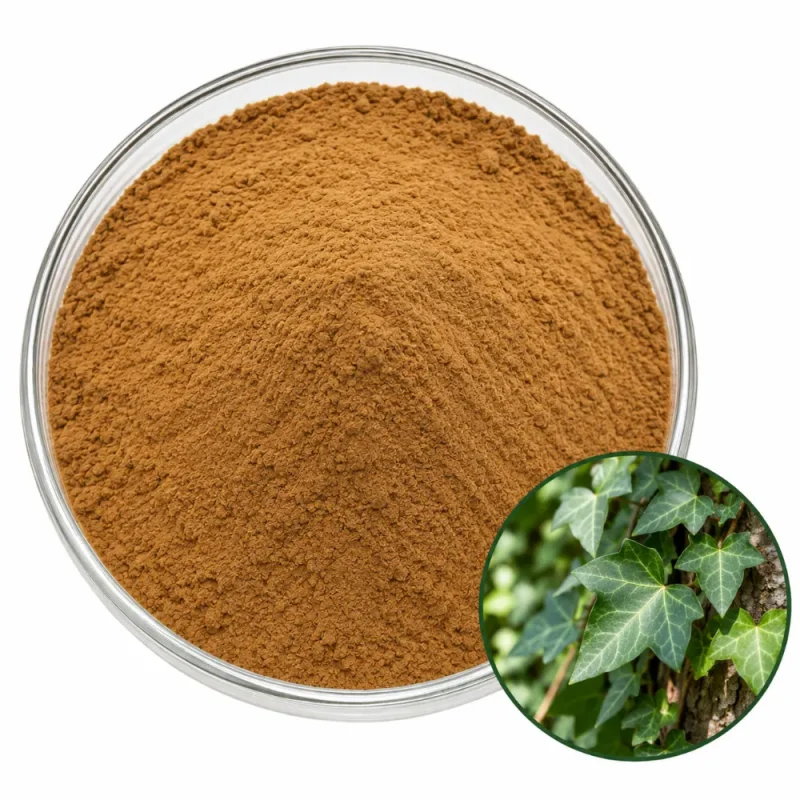
English Ivy Leaf Extract Powder

English ivy leaf extract starts from the leaf of common ivy, Hedera helix, an evergreen woody climber, with the stems, berries and roots excluded. Water extraction concentrates the soluble leaf fraction, and the liquor is dried into a green powder that disperses in water and foams on shaking.

The extract is supplied at a 10:1 ratio with no hederacoside percentage and is milled to 80 mesh. Ivy leaf extracts sold with a saponin figure are standardized products, and this ratio extract is the plain whole-leaf option without a declared marker.

Hedera helix Leaf Source & Identity

The botanical entity is Hedera helix L., common or English ivy, an evergreen climber of the Araliaceae that clings to walls and tree trunks by aerial roots. The part used is the leaf. Stems, the black berries and the roots are not part of this ingredient. Young ivy bears lobed leaves and mature flowering shoots bear unlobed ones, and both are leaf material of the same species.

Ivy names invite confusion. Boston ivy belongs to the grape family and poison ivy to the cashew family, so neither is related to Hedera. Irish ivy, Hedera hibernica, is a close relative that is often grouped with it in trade. The leaf carries triterpene saponins such as hederacoside C and alpha-hederin, flavonoids and chlorogenic-type acids, named only as constituent families.

What 10:1 Means for English Ivy

Saponin-rich leaf gives a 10:1 extract that behaves differently from a plain herb extract. The ratio records how concentrated the English ivy extract is against the leaf, and it does not state a hederacoside C figure. Grades sold on that figure are a different product with a marker specification. A formula that needs a stated saponin value has to look there. One that names the species, the leaf and the ratio can use this extract as it is. The saponins foam readily in water, which is a handling point for any liquid format.

Typical Specifications

Specification ItemProduct Information
Latin NameHedera helix (English ivy)
Plant PartLeaf & Herb
ProcessingWater Extraction
Common NameEnglish Ivy Leaf
Ingredient TypeRatio Extract
Extract Ratio10:1
AppearanceGreen powder
Solubility / DispersibilityWater Dispersible
Quality Parameters
Moisture (LOD)≤5.0%
Total Ash≤5.0%
Particle Size80 mesh
Heavy MetalsLead ≤2 ppm · Arsenic ≤1 ppm · Cadmium ≤1 ppm · Mercury ≤0.1 ppm
MicrobiologyTPC ≤1,000 cfu/g · Yeast & Mold ≤100 cfu/g · E. coli Negative · Salmonella Negative/25 g
Shelf Life24 months in unopened original packaging, cool and dry storage

Application Areas

Leaf Extract Capsules

English ivy extract suits two-piece capsules, where its green powder is protected from light by an opaque shell. The saponins make the powder slightly cohesive, so fill weights are checked early and a flow aid is added to the premix if the powder bridges. Disintegration is then tested on the finished capsule.

Foam-Controlled Drink Powders

In drink powders the extract gives a pale green, hazy cup with a faint grassy taste. Saponins create a persistent foam when stirred or shaken, so mixes are designed for gentle dissolution, and an antifoam ingredient is considered for ready-to-pour formats.

Coated Tablet Blends

Green extract speckles white tablet cores, so a film coat or a tinted base is common. English ivy powder also absorbs humidity and sticks to punch faces in damp rooms, which a dry granulation route avoids.

Sachet Premix Systems

Single-serve sachets combine the extract with sweeteners, citrus and mint flavors that cover its grassy bitterness. The powder stays green in dry storage and darkens slowly with moisture or light, so barrier film is used.

Gummy Base Additions

Gummies carry the extract in lime, apple and kiwi flavors that suit its green tint. Add it late in the cooked base at low shear, since saponins can create bubbles that stay trapped in the gel as it sets.

Formulation Notes

English ivy leaf extract is a green powder with a faint, grassy aroma and a bitter, slightly acrid taste. In water it disperses to a hazy green liquid that foams readily when stirred, and fine particles settle on standing. Chlorophyll-type pigments fade under light and heat, so the green shade slowly turns olive.

Saponin foam is the main handling point. Add the powder to liquid slowly, stir gently and allow the foam to settle before filling. Weigh the powder in a dry room and close the liner after every draw, and store it away from heat and light. Compare the shade of a new lot with a retained sample before it goes into a premix.

English ivy extract that arrives darker than expected is compared with a retained sample before it is blended.

Packaging & Commercial Supply

Essencefield supports product evaluation, formulation trials, commercial orders, and ongoing ingredient supply. Packaging, storage, and shipping arrangements are determined by product characteristics, order quantity, stability requirements, and destination-market needs.

Supply ItemGeneral Information
SampleAvailable upon request for formulation, testing, and supplier evaluation
Order Quantities100 g · 1 kg · 5 kg · 25 kg · 100 kg · 500 kg · Bulk
Sample Lead TimeTypically 5–7 days after sample confirmation
Production Lead TimeTypically 15–30 days after order and specification confirmation
PackagingSuitable protective inner packaging with bags, cartons, drums, or other appropriate outer packaging
StorageStore in tightly sealed, suitable protective packaging in a cool, dry environment. Protect from moisture, heat, and direct sunlight. Specific storage conditions follow the approved product specification.
DocumentationCOA · Product Specification · TDS · SDS · Applicable declarations (as applicable)

Final order quantities, lead times, packaging, documentation, and shipping arrangements are confirmed according to the selected product and commercial requirements.

Request Ingredient Specifications & Quote

Share your target specification, application, quantity, and documentation needs. We’ll help confirm suitable options, samples, and commercial supply details.