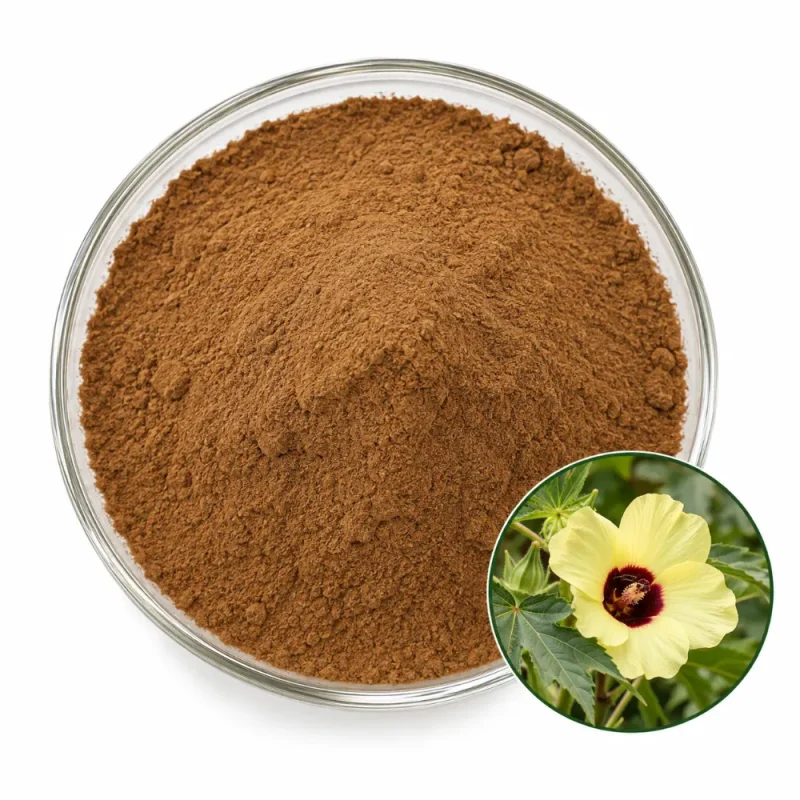
Abelmoschus Manihot Extract Powder

Abelmoschus manihot extract powder starts from the flower of a mucilage-rich Malvaceae plant, not from its leaf or root. The petals are extracted with water, concentrated and dried to a yellow-brown powder that carries the flavonoid glycosides typical of yellow flowers.

The product is a 10:1 ratio extract with no marker percentage attached. It is water dispersible and milled to 80 mesh. No other form of this botanical is listed among the siblings, so the ratio extract is the single supplied profile of the flower.

Abelmoschus manihot Identity & Plant Part

The botanical entity is Abelmoschus manihot (L.) Medik., family Malvaceae, known as sunset hibiscus and, for the leaf vegetable, aibika. The part used in this Abelmoschus manihot extract is the flower; leaves, stems, roots and seed pods are not part of the product.

The genus is easy to confuse with Abelmoschus esculentus, the okra plant, whose pods are the food part. It is also unrelated to Hibiscus sabdariffa, the roselle calyx used for red drinks. Like other Malvaceae, the flower is mucilaginous, and its yellow petals carry flavonoid glycosides rather than the anthocyanins that color roselle. A buyer comparing Abelmoschus manihot with okra or roselle offers should therefore match the species and the plant part first.

What 10:1 Means for Abelmoschus manihot

Read the 10:1 figure as a concentration ratio of the starting flower, not as a measure of any marker compound. The data for this botanical lists no standardized or powdered sibling, so the ratio extract is the only form described for Abelmoschus manihot, and it should be understood as a whole-flower water extract and not as a purified flavonoid fraction.

Buyers who need a labelled flavonoid figure would need a separate specification, because a ratio extract does not provide one. Where flower identity, a yellow-brown color and water dispersibility are the requirements, the ratio extract meets them without any marker claim. The mucilage of the flower also shapes viscosity and texture, which matters for drink and gummy formats.

Typical Specifications

Specification ItemProduct Information
Latin NameAbelmoschus manihot
Plant PartFlower
ProcessingWater Extraction
Common NameSunset Hibiscus, Aibika
Ingredient TypeRatio Extract
Extract Ratio10:1
AppearanceYellow-Brown powder
Solubility / DispersibilityWater Dispersible
Quality Parameters
Moisture (LOD)≤5.0%
Total Ash≤5.0%
Particle Size80 mesh
Heavy MetalsLead ≤2 ppm · Arsenic ≤1 ppm · Cadmium ≤1 ppm · Mercury ≤0.1 ppm
MicrobiologyTPC ≤1,000 cfu/g · Yeast & Mold ≤100 cfu/g · E. coli Negative · Salmonella Negative/25 g
Shelf Life24 months in unopened original packaging, cool and dry storage

Application Areas

Yellow-Brown Capsule Fills

The yellow-brown powder shows slightly through clear shells, so opaque capsules give a more even look. Mucilage-bearing extracts pick up moisture and can bridge, so test flow before filling and weigh capsules at intervals across the run.

Mucilage-Aware Drink Powders

In drink powders the Abelmoschus manihot extract can add slight viscosity because the flower carries mucilage. Disperse it into a vortex or premix it with sugar to avoid clumping, and let samples stand to see whether the liquid thickens or clears.

Flower-Extract Sachets

Sachets can pair Abelmoschus manihot extract with other flower extracts such as chrysanthemum or osmanthus. Match particle sizes so the yellow-brown powder does not separate, and keep the blend dry because mucilage cakes with moisture. Dry storage of the blended sachets protects the mucilage from caking before use.

Gummies with Flower Color

In gummies the extract gives a warm yellow-brown tint that suits citrus and honey flavors. Mucilage can alter gel texture, so run a small trial for set and chewiness before scaling, and add the powder late in the cooked mass.

Formulation Notes

The Abelmoschus manihot extract is a yellow-brown powder with a faint floral, slightly grassy aroma and a mild taste. In water it disperses to a yellow-brown liquid that may thicken slightly, because the mucilage of the flower hydrates. Let a test dispersion stand before judging clarity.

Because the powder is hygroscopic, weigh it quickly and close the container after each use. Start with a premix: dilute the powder in part of the filler and sieve it. Yellow flavonoid glycosides can shift color with pH, so check the shade in the finished acidic or neutral drink and not only in the dry blend. Flower extracts of this type are best stored away from direct light, because yellow flavonoid pigments fade when exposed to strong light over time.

Packaging & Commercial Supply

Essencefield supports product evaluation, formulation trials, commercial orders, and ongoing ingredient supply. Packaging, storage, and shipping arrangements are determined by product characteristics, order quantity, stability requirements, and destination-market needs.

Supply ItemGeneral Information
SampleAvailable upon request for formulation, testing, and supplier evaluation
Order Quantities100 g · 1 kg · 5 kg · 25 kg · 100 kg · 500 kg · Bulk
Sample Lead TimeTypically 5–7 days after sample confirmation
Production Lead TimeTypically 15–30 days after order and specification confirmation
PackagingSuitable protective inner packaging with bags, cartons, drums, or other appropriate outer packaging
StorageStore in tightly sealed, suitable protective packaging in a cool, dry environment. Protect from moisture, heat, and direct sunlight. Specific storage conditions follow the approved product specification.
DocumentationCOA · Product Specification · TDS · SDS · Applicable declarations (as applicable)

Final order quantities, lead times, packaging, documentation, and shipping arrangements are confirmed according to the selected product and commercial requirements.

Request Ingredient Specifications & Quote

Share your target specification, application, quantity, and documentation needs. We’ll help confirm suitable options, samples, and commercial supply details.