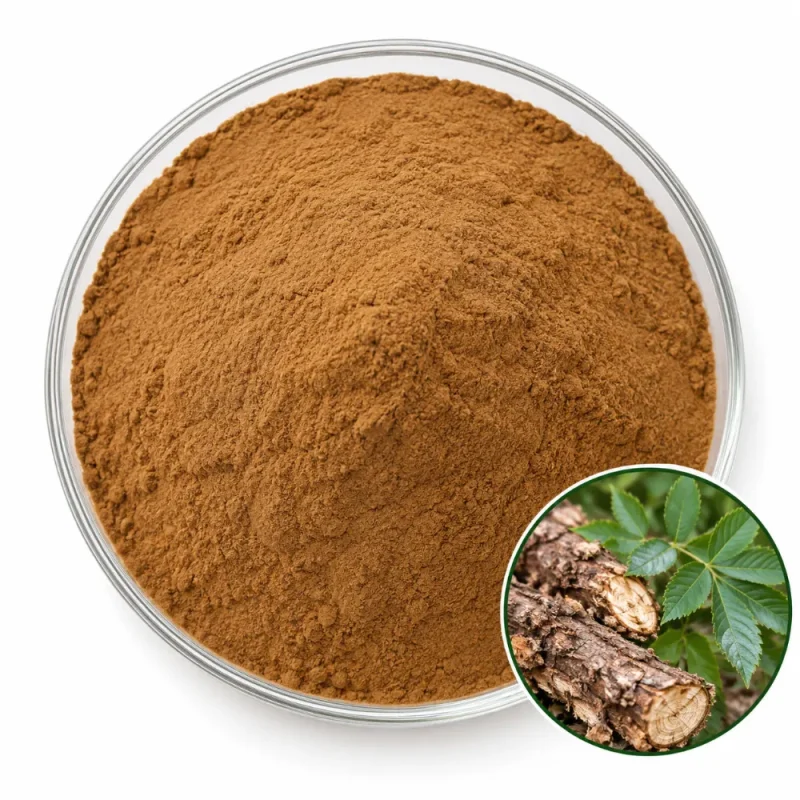
Aralia Elata Extract Powder

The bark of Aralia elata, a spiny shrub of the ginseng family (Araliaceae), is the only plant part behind this extract. Water extraction concentrates its soluble fraction, and the liquor is dried to a light brown powder. Young shoots and leaves of the shrub are not used.

This aralia elata extract is a 10:1 ratio extract and carries no marker assay. The powder is ground to 80 mesh and disperses in water. It is a plain bark extract, so no saponin percentage or other marker figure is stated for it.

Aralia elata Bark Source & Identity

The botanical entity is Aralia elata (Miq.) Seem., a prickly, multi-stemmed shrub or small tree of the family Araliaceae, known as Japanese or Korean angelica tree. The part used is the bark. The young shoots, which are eaten as a spring vegetable in Japan and Korea, and the leaves are not part of this aralia elata extract.

The name is easy to confuse. Aralia mandshurica Rupr. & Maxim., the Manchurian angelica tree, is treated by some taxonomic databases as a synonym of A. elata. Aralia chinensis and the North American A. spinosa are other spiny members of the genus, and Eleutherococcus senticosus sits in a different genus altogether.

Bark of this genus is characterised by oleanane-type triterpenoid saponins.

What 10:1 Means for Aralia elata

The 10:1 ratio measures bark going into the extract. It is not a saponin assay and it does not name a single active compound. Because the bark’s character comes from a family of related saponins rather than one marker, a ratio extract keeps the whole water-soluble profile of the bark instead of narrowing it to a single analyte.

That suits a formulator who wants an identity-led botanical, with plant, part and extraction solvent fixed, rather than a figure to chase. A brief that must declare a marker percentage needs a different kind of product from a ratio extract.

Typical Specifications

Specification ItemProduct Information
Latin NameAralia elata
Plant PartBark & Stem
ProcessingWater Extraction
Common NameJapanese Angelica Tree, Korean Angelica Tree
Ingredient TypeRatio Extract
Extract Ratio10:1
AppearanceLight Brown powder
Solubility / DispersibilityWater Dispersible
Quality Parameters
Moisture (LOD)≤5.0%
Total Ash≤5.0%
Particle Size80 mesh
Heavy MetalsLead ≤2 ppm · Arsenic ≤1 ppm · Cadmium ≤1 ppm · Mercury ≤0.1 ppm
MicrobiologyTPC ≤1,000 cfu/g · Yeast & Mold ≤100 cfu/g · E. coli Negative · Salmonella Negative/25 g
Shelf Life24 months in unopened original packaging, cool and dry storage

Application Areas

Capsules in Humidity-Controlled Filling

The water-soluble fraction of the bark is polar, so dried aralia elata extract takes up moisture from room air. Fill capsules in a humidity-controlled room and keep the hopper covered between runs. A short flow test at 80 mesh shows whether a glidant is needed before a production fill.

Tablets Needing Dry Binders

Aralia elata extract compresses best with a dry binder and a lubricant added late in the blend. Check hardness again after storage, because a polar bark extract can soften a tablet as it picks up moisture. Film coating gives a barrier and hides the light brown, speckled look of the compressed core.

Foaming Drink Powder Sticks

Saponins act as natural surfactants, so aralia elata extract foams when stirred into water. Stick packs filled for hot or cold dispersion should be tested for foam height in the cup. A flavoured, opaque or tinted base masks the slight haze better than clear water.

Blended Sachets for Dry Mixing

The aralia elata extract blends into a sugar or fibre carrier by hand-sieving before the mixer. This avoids pockets of concentrated powder and keeps the colour even across the sachet. Blend sachets with a flavour that covers a bitter bark note.

Formulation Notes

Aralia elata extract is a light brown powder with a faint plant-like aroma. It disperses in water and leaves a lightly hazy tan liquid, with the saponin fraction foaming when the liquid is shaken or stirred. Check colour and clarity in the intended base during the first trial batch.

For liquids, add the powder below the surface of the water or through a funnel to limit foam, which slows deaeration and filling. For dry blends, premix the extract with a carrier by sieving before it goes into a mixer. After opening, press out the air, close the liner tightly and keep the drum off damp floors, away from steam and heat.

Packaging & Commercial Supply

Essencefield supports product evaluation, formulation trials, commercial orders, and ongoing ingredient supply. Packaging, storage, and shipping arrangements are determined by product characteristics, order quantity, stability requirements, and destination-market needs.

Supply ItemGeneral Information
SampleAvailable upon request for formulation, testing, and supplier evaluation
Order Quantities100 g · 1 kg · 5 kg · 25 kg · 100 kg · 500 kg · Bulk
Sample Lead TimeTypically 5–7 days after sample confirmation
Production Lead TimeTypically 15–30 days after order and specification confirmation
PackagingSuitable protective inner packaging with bags, cartons, drums, or other appropriate outer packaging
StorageStore in tightly sealed, suitable protective packaging in a cool, dry environment. Protect from moisture, heat, and direct sunlight. Specific storage conditions follow the approved product specification.
DocumentationCOA · Product Specification · TDS · SDS · Applicable declarations (as applicable)

Final order quantities, lead times, packaging, documentation, and shipping arrangements are confirmed according to the selected product and commercial requirements.

Request Ingredient Specifications & Quote

Share your target specification, application, quantity, and documentation needs. We’ll help confirm suitable options, samples, and commercial supply details.