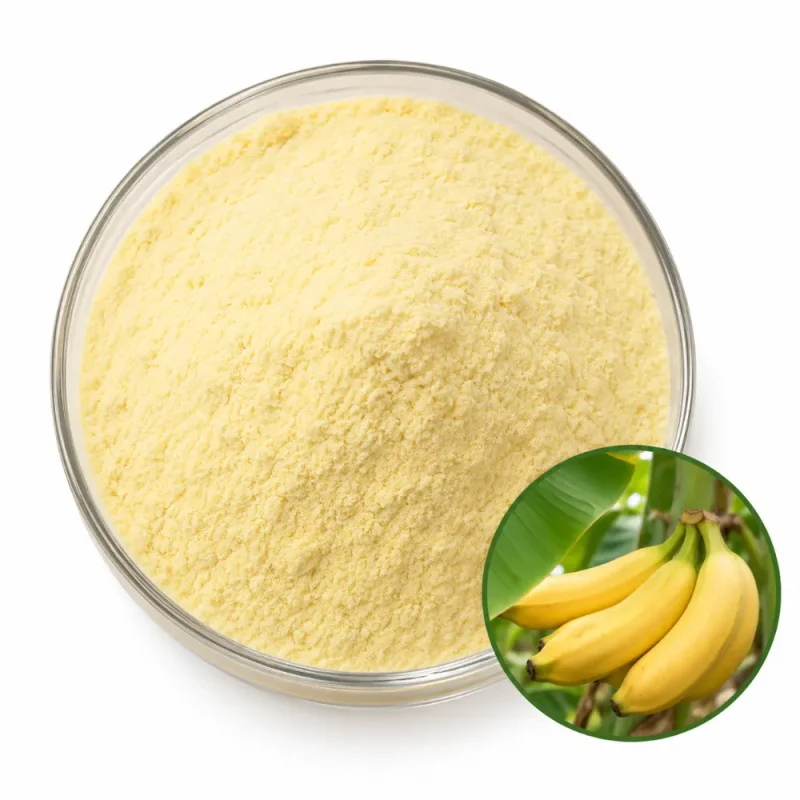
Banana Powder

Ripening bananas of the eating type Musa acuminata are pulped, and the sweet banana purée is concentrated and spray-dried onto a maltodextrin carrier to give this pale yellow powder with a rich, familiar banana aroma. The raw material is the fruit flesh, so peel and stalk stay out of the material.

Banana powder disperses in water to a smooth, creamy, pale yellow drink and has a sweet, mellow flavor with a distinct banana ester aroma. It differs from green banana powder, which is based on unripe, starch-rich fruit, and from freeze-dried banana powder, which keeps the pulp and fiber.

Banana Juice Powder Processing

The species is Musa acuminata Colla, family Musaceae, the wild ancestor of most dessert bananas. Commercial bananas are cultivars of this species or hybrids with Musa balbisiana, and plantains are starchier cooking types of the same group. The botanical name here identifies the dessert banana and not the plantain, which is why the cultivar group and the ripeness are the facts that matter on a banana specification.

The raw material is banana juice concentrate. Ripe bananas are pulped, the pulp is thinned and concentrated, the concentrate is mixed with maltodextrin and spray-dried to a fine powder. The pulp is thick, so the process includes an enzyme or heat step in practice to handle viscosity, and the carrier supports the powder so that the sticky fruit sugars do not fuse into a block.

Ripeness shapes the product. In a green banana the starch is dominant and the taste is bland and astringent. In a ripe banana the starch has converted to sugar, the aroma esters such as isoamyl acetate have formed, and the flesh has softened. A powder made from ripe fruit is therefore sweet and aromatic, and it behaves very differently from a starch-rich green banana powder.

Bananas are harvested green and ripened in controlled rooms, so ripeness at pulping is a processing decision. The riper the fruit, the more sugar and aroma the purée carries, and the less starch remains, which is why banana powder and green banana powder are two different ingredients from the same species.
Banana Flavor, Color & Forms

Banana powder is light yellow to cream and gives a creamy, opaque dispersion in water. The taste is sweet and fruity with the characteristic ester note of ripe banana. Fresh banana flesh darkens quickly because polyphenol oxidase browns its phenols, and the powder is past that stage, although heat and moisture can still brown the sugars during storage.

Banana is known for starch that converts to sugar on ripening, for potassium and for dopamine-type phenolics in the peel, named only as traits of the fruit and not as stated levels. The peel is not part of this powder, and nutrition data are not part of the specification.

FormWhat It IsChoose It When
Banana Juice PowderSpray-dried banana purée on a maltodextrin carrierA sweet, dispersible fruit powder for drinks and bases
Green Banana PowderPowder from unripe, starch-rich bananaA bland, starchy base instead of a sweet fruit
Freeze-Dried Banana PowderFreeze-dried whole banana that keeps pulp and fiberFruit texture and fiber are wanted
Freeze-Dried Green Banana PowderFreeze-dried unripe banana, starch-richA starch-rich freeze-dried green fruit is wanted

Banana powder is the choice for sweet, aromatic recipes. A formulator who needs a neutral, starchy body reaches for the green banana forms, and one who needs visible fruit and fiber reaches for the freeze-dried forms. Each version of banana serves a distinct recipe goal.

Typical Specifications

Specification ItemProduct Information
Latin NameMusa acuminata
Plant PartFruit & Berry
ProcessingSpray-Dried Juice
Common NameBanana
Raw MaterialBanana juice concentrate
Ingredient TypeJuice Powder
CarrierMaltodextrin
AppearanceLight Yellow powder
FlavorSweet, mellow, with a ripe banana ester aroma
Solubility / DispersibilityWater Dispersible
Quality Parameters
Moisture (LOD)≤5.0%
Heavy MetalsLead ≤2 ppm · Arsenic ≤1 ppm · Cadmium ≤1 ppm · Mercury ≤0.1 ppm
MicrobiologyTPC ≤10,000 cfu/g · Yeast & Mold ≤1,000 cfu/g · E. coli Negative · Salmonella Negative/25 g
Shelf Life24 months in unopened original packaging, cool and dry storage

Application Areas

Smoothie, shake and milk drink mixes

Banana powder is a classic base for smoothies and milk-style drinks, where it adds creamy body and sweet banana flavor. It combines well with cocoa, peanut and oat powders, and it is stirred or blended into the liquid so the particles wet evenly.

Cereal, bar and granola binders

Cereal mixes, bars and granola clusters use the powder for banana flavor and a soft, slightly sticky sweetness. Sugars brown quickly in baking, so temperature and time are set with the finished recipe in a trial bake.

Dessert and ice-cream mixes

Dessert bases, puddings and ice-cream mixes take the powder as a flavor and color component. It adds a pale yellow tint and a familiar aroma, and the sugar of the fruit is included in the total sugar balance of the recipe.

Bakery batters and muffins

Muffin, bread and pancake batters accept the powder for banana flavor without the water of fresh fruit. The sugars retain water, so the batter is slightly thicker, and the liquid is adjusted to keep texture.

Plant-based dairy-style bases

Oat and nut milk powders use banana powder for sweetness and body. It reduces the need for added sugar in flavored bases, and the powder is mixed with the dry blend first, to avoid lumps.

Moisture Pickup & Stability

Banana powder is one of the most hygroscopic fruit powders. The high sugar content and the carrier pull water from the air within minutes, so open packs turn sticky, clump and set to a hard cake in a humid room. Barrier packaging with low headspace, dry weighing rooms and rapid resealing are essential, and lumps are discarded and not reground.

Aroma and color are sensitive. The ester aroma that makes banana powder recognizable is volatile, so it fades from open containers, and warm storage speeds browning of the sugars, which turns the pale yellow toward tan and adds a caramel note. Opaque packs, a cool, dry store and short working periods after opening protect both.

In production lines, the sticky powder coats hoppers and screw feeders. Cleaning is done dry or with minimal water, and equipment is warmed gently to avoid condensation. A premix of banana powder with a free-flowing dry ingredient keeps dosing steady.

Banana powder shipped to humid regions travels in a sealed liner with a desiccant. Working containers are small, filled in a dry room and closed after each dosing, and the opening date is written on the label.

Packaging & Commercial Supply

Essencefield supports product evaluation, formulation trials, commercial orders, and ongoing ingredient supply. Packaging, storage, and shipping arrangements are determined by product characteristics, order quantity, stability requirements, and destination-market needs.

Supply ItemGeneral Information
SampleAvailable upon request for formulation, testing, and supplier evaluation
Order Quantities100 g · 1 kg · 5 kg · 25 kg · 100 kg · 500 kg · Bulk
Sample Lead TimeTypically 5–7 days after sample confirmation
Production Lead TimeTypically 15–30 days after order and specification confirmation
PackagingSuitable protective inner packaging with bags, cartons, drums, or other appropriate outer packaging
StorageStore in tightly sealed, suitable protective packaging in a cool, dry environment. Protect from moisture, heat, and direct sunlight. Specific storage conditions follow the approved product specification.
DocumentationCOA · Product Specification · TDS · SDS · Applicable declarations (as applicable)

Final order quantities, lead times, packaging, documentation, and shipping arrangements are confirmed according to the selected product and commercial requirements.

Request Ingredient Specifications & Quote

Share your target specification, application, quantity, and documentation needs. We’ll help confirm suitable options, samples, and commercial supply details.