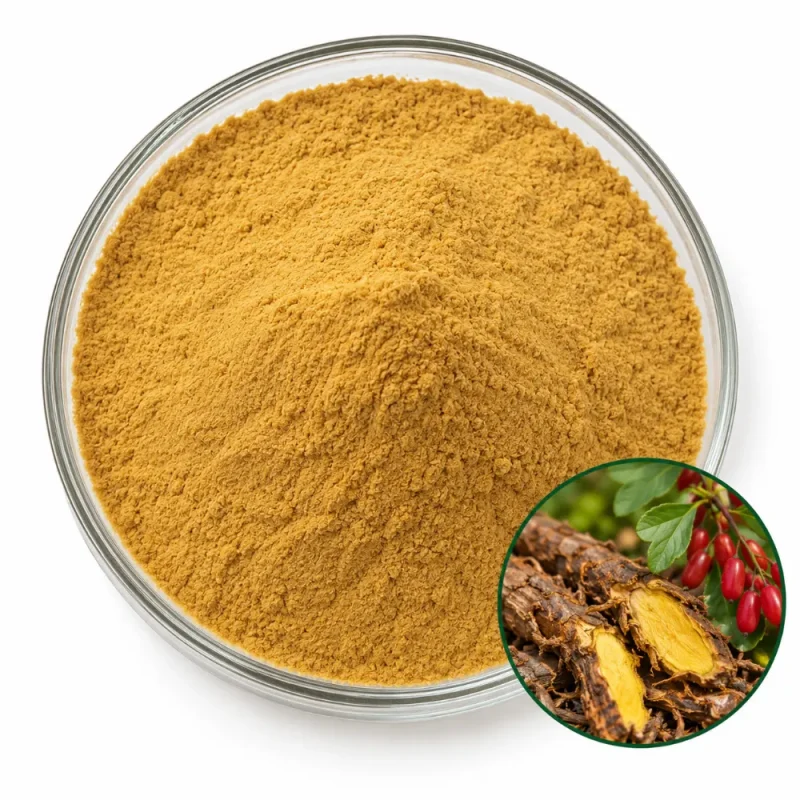
Barberry Root Extract Powder

The root of Berberis vulgaris, the European barberry, is the only plant part behind this extract. The root is extracted in water, concentrated and dried to a light brown powder. Berries, leaves and stem bark of the shrub are not used.

This barberry root extract is a 10:1 ratio extract with no marker assay and no berberine percentage. The powder is milled to 80 mesh and disperses in water. It is defined by species, part and ratio, not by an alkaloid figure.

Berberis vulgaris Root Source & Identity

The botanical entity is Berberis vulgaris L., a spiny deciduous shrub of the barberry family, Berberidaceae, native to Europe and western Asia and naturalised in North America. The part used is the root, whose inner tissue is bright yellow. The red berries, which are a separate food raw material, and the leaves are not part of this barberry root extract.

Several plants share the barberry name or its main alkaloid. Berberis aristata, the Indian tree turmeric, is a different species, Mahonia is a related genus, and goldenseal and Chinese goldthread belong to other families that also contain berberine.

Isoquinoline alkaloids, led by berberine, are the characteristic constituent family of the root.

What 10:1 Means for Berberis vulgaris

The 10:1 ratio measures root going into the barberry root extract. It is not a berberine assay, and the powder carries no alkaloid percentage. A ratio extract keeps the whole water-soluble profile of the root rather than concentrating a single alkaloid, which suits a specification that fixes species, part and solvent.

Naming the species matters for this ingredient, because several barberry-family roots are traded under similar names and contain the same alkaloid. A buyer comparing offers should check the botanical name first, the part second, and only then the ratio.

Typical Specifications

Specification ItemProduct Information
Latin NameBerberis vulgaris
Plant PartRoot & Rhizome
ProcessingWater Extraction
Common NameEuropean Barberry, Common Barberry
Ingredient TypeRatio Extract
Extract Ratio10:1
AppearanceLight Brown powder
Solubility / DispersibilityWater Dispersible
Quality Parameters
Moisture (LOD)≤5.0%
Total Ash≤5.0%
Particle Size80 mesh
Heavy MetalsLead ≤2 ppm · Arsenic ≤1 ppm · Cadmium ≤1 ppm · Mercury ≤0.1 ppm
MicrobiologyTPC ≤1,000 cfu/g · Yeast & Mold ≤100 cfu/g · E. coli Negative · Salmonella Negative/25 g
Shelf Life24 months in unopened original packaging, cool and dry storage

Application Areas

Capsules for an Alkaloid-Bearing Extract

Barberry root extract fills hard capsules after a flow check at 80 mesh. Alkaloid-rich root extracts taste distinctly bitter, and a capsule shell keeps that taste out of the mouth. If the powder bridges in the hopper, add a glidant and keep the hopper covered between runs.

Tablets with Coating

Barberry root extract tablets benefit from a film coat that covers both colour and bitterness. Use a dry binder and a late-added lubricant, and compare hardness at pressing and after a week of storage, because a polar root extract slowly takes on moisture.

Powder Sticks for Pale Bases

Alkaloid pigments in root extracts can tint a pale drink, so a stick for water or tea needs a trial to confirm the colour at the planned dose. Spiced, ginger or citrus flavours help to balance the strong bitter note.

Stick Pack Blends

Sachets carry barberry root extract in a sugar or fibre carrier. Sieve the powder into the carrier before filling so that the colour is even, and run a dose-uniformity check at the start, middle and end of the filling run.

Granola-Style Bar Mixes

For bars, premix the extract with part of the dry ingredients before the syrup is added. Cocoa, dried fruit and spice bases hide the bitterness better than a plain oat base. Taste the finished bar after a week of storage, because barberry root extract can taste more bitter once the bar has aged.

Formulation Notes

Barberry root extract is a light brown powder with a mild, earthy odour and a pronounced bitter taste. In water it forms a brown dispersion with a light haze. Alkaloid-bearing extracts can darken or shift colour in alkaline media, so test the extract in the actual base and read colour after the liquid has rested.

Add the powder slowly under agitation, or wet it in a small volume of water before the full dilution. Blend dry by sieving the extract with some of the carrier before the full batch is mixed. For barberry root, once a drum is opened, squeeze the air from the liner, reseal it and store it off the floor in a dry, cool place.

Packaging & Commercial Supply

Essencefield supports product evaluation, formulation trials, commercial orders, and ongoing ingredient supply. Packaging, storage, and shipping arrangements are determined by product characteristics, order quantity, stability requirements, and destination-market needs.

Supply ItemGeneral Information
SampleAvailable upon request for formulation, testing, and supplier evaluation
Order Quantities100 g · 1 kg · 5 kg · 25 kg · 100 kg · 500 kg · Bulk
Sample Lead TimeTypically 5–7 days after sample confirmation
Production Lead TimeTypically 15–30 days after order and specification confirmation
PackagingSuitable protective inner packaging with bags, cartons, drums, or other appropriate outer packaging
StorageStore in tightly sealed, suitable protective packaging in a cool, dry environment. Protect from moisture, heat, and direct sunlight. Specific storage conditions follow the approved product specification.
DocumentationCOA · Product Specification · TDS · SDS · Applicable declarations (as applicable)

Final order quantities, lead times, packaging, documentation, and shipping arrangements are confirmed according to the selected product and commercial requirements.

Request Ingredient Specifications & Quote

Share your target specification, application, quantity, and documentation needs. We’ll help confirm suitable options, samples, and commercial supply details.