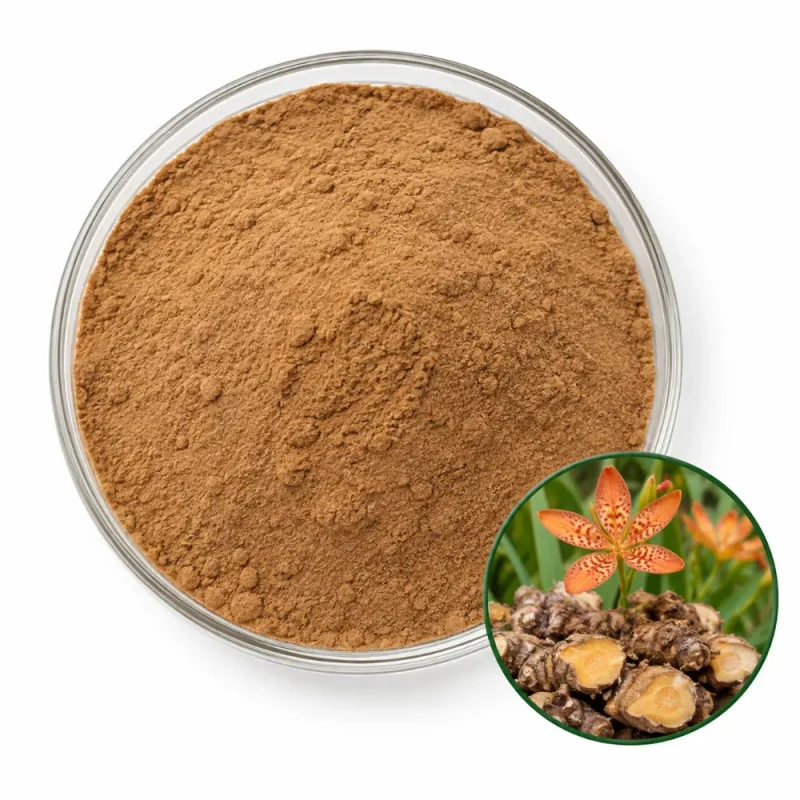
Belamcanda Rhizome Extract Powder

The rhizome of Belamcanda chinensis, the blackberry lily called shegan in Chinese herbal practice, is the only plant part behind this extract. The rhizome is extracted in water, concentrated and dried to a light brown powder. Leaves, flower stalks and the black seeds are not used.

This belamcanda rhizome extract is a 10:1 ratio extract with no marker assay. The powder is milled to 80 mesh and disperses in water. No isoflavone percentage is stated, so the product is defined by species, part and ratio.

Belamcanda chinensis Rhizome Source & Identity

The botanical entity is Belamcanda chinensis (L.) DC., a perennial of the iris family, Iridaceae, with sword-shaped leaves and orange flowers speckled with red. The part used is the rhizome, a knobbly underground stem. Leaves, flowers, blackberry-like seed clusters and roots are not part of this belamcanda rhizome extract.

Botanical databases treat the name as a synonym. GBIF lists B. chinensis under Iris domestica, so literature may use either name. Chuan shegan, from Iris tectorum, is a different rhizome with a similar use and should not be mistaken for it.

Isoflavones such as tectoridin and irigenin are the constituent family characteristic of the rhizome.

What 10:1 Means for Belamcanda chinensis

The 10:1 ratio measures rhizome going into the belamcanda rhizome extract. It is not an isoflavone assay, and it names no single marker. The ratio extract keeps the whole water-soluble profile of the rhizome, so the specification depends on species, part and solvent rather than on one measured compound.

The taxonomic change is the main trap for buyers. A search for the extract under Iris domestica or under Belamcanda chinensis can reach the same plant, but a search for chuan shegan reaches a different one. The Latin name on the specification and the part, rhizome, settle the question.

Typical Specifications

Specification ItemProduct Information
Latin NameBelamcanda chinensis
Plant PartRoot & Rhizome
ProcessingWater Extraction
Common NameBlackberry Lily, Leopard Flower
Ingredient TypeRatio Extract
Extract Ratio10:1
AppearanceLight Brown powder
Solubility / DispersibilityWater Dispersible
Quality Parameters
Moisture (LOD)≤5.0%
Total Ash≤5.0%
Particle Size80 mesh
Heavy MetalsLead ≤2 ppm · Arsenic ≤1 ppm · Cadmium ≤1 ppm · Mercury ≤0.1 ppm
MicrobiologyTPC ≤1,000 cfu/g · Yeast & Mold ≤100 cfu/g · E. coli Negative · Salmonella Negative/25 g
Shelf Life24 months in unopened original packaging, cool and dry storage

Application Areas

Capsules for an Isoflavone-Bearing Extract

Belamcanda rhizome extract fills hard capsules after a flow check at 80 mesh. For belamcanda rhizome, the rhizome gives a dense, free-flowing extract, so fill weight is rarely a limit. Add a glidant only where bridging appears, and check fill weight at the start of each run.

Tablets with Dry Binders

The compression blend wants a dry binder, while the lubricant joins only for the final pass. A standard film coat covers the light brown core. Compare hardness at pressing and after a week in the final pack, since polar rhizome extracts slowly take on moisture from the air.

Tea-Style Instant Sticks

Shegan is traditionally prepared as a decoction, so tea-style sticks suit the extract. It disperses in hot water to a tan cup with a light haze. Bitter-leaning rhizome extracts match licorice, ginger or citrus-peel flavours well, and a stirring test at the planned dose shows how much haze remains in the cup.

Sachets in Sugar Carriers

Sachets carry belamcanda rhizome extract in a sugar or fibre carrier. Sieve the powder into the carrier first so the tan tone is even, and run a dose-uniformity check at the start, middle and end of the filling run.

Dry Bar Blends

Bar recipes work best when the extract is dispersed through the dry mix before binding. A cocoa or cinnamon bar masks the slightly bitter note and the tan colour of the rhizome extract. Taste the finished bar after a week of storage, because the bitter note can become more noticeable as the bar ages.

Formulation Notes

Belamcanda rhizome extract is a light brown powder with a mild, earthy aroma and a bitter-leaning taste. For belamcanda rhizome, in water it forms a tan dispersion with a light haze. The glycoside form of the isoflavones is more water-soluble than the aglycone, so the extract disperses more readily than a milled rhizome.

Stir during addition and keep portions small so the powder wets evenly. Prepare the dry blend in stages, starting with a sieved premix of the powder and a carrier portion. For belamcanda rhizome, opened drums go back into storage with the liner tied or clipped shut, away from humid corners.

Packaging & Commercial Supply

Essencefield supports product evaluation, formulation trials, commercial orders, and ongoing ingredient supply. Packaging, storage, and shipping arrangements are determined by product characteristics, order quantity, stability requirements, and destination-market needs.

Supply ItemGeneral Information
SampleAvailable upon request for formulation, testing, and supplier evaluation
Order Quantities100 g · 1 kg · 5 kg · 25 kg · 100 kg · 500 kg · Bulk
Sample Lead TimeTypically 5–7 days after sample confirmation
Production Lead TimeTypically 15–30 days after order and specification confirmation
PackagingSuitable protective inner packaging with bags, cartons, drums, or other appropriate outer packaging
StorageStore in tightly sealed, suitable protective packaging in a cool, dry environment. Protect from moisture, heat, and direct sunlight. Specific storage conditions follow the approved product specification.
DocumentationCOA · Product Specification · TDS · SDS · Applicable declarations (as applicable)

Final order quantities, lead times, packaging, documentation, and shipping arrangements are confirmed according to the selected product and commercial requirements.

Request Ingredient Specifications & Quote

Share your target specification, application, quantity, and documentation needs. We’ll help confirm suitable options, samples, and commercial supply details.