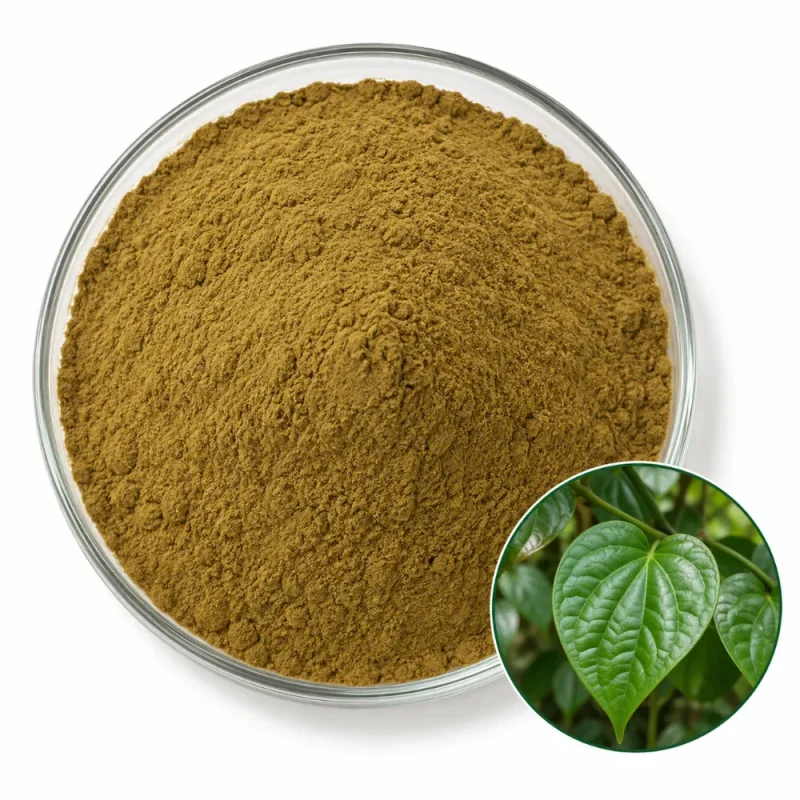
Betel Leaf Extract Powder

The glossy, heart-shaped leaves of Piper betle, the betel vine of South and Southeast Asia, supply this betel leaf extract, and the areca nut and lime that are chewed with it are not part of the product. Water extraction concentrates the soluble leaf fraction, and the liquor is dried into a green powder that disperses in water.

The grade is a 10:1 ratio extract at 80 mesh, with no marker percentage. No standardized extract, powder or isolated compound of this species is listed alongside it, so this ratio extract is the single betel leaf ingredient, with no declared essential oil or phenolic figure.

Piper betle Identity & Plant Part

The botanical entity is Piper betle L., a perennial climbing vine of the Piperaceae family, the same family as black pepper. The part used is the leaf. Stems, roots, flowers and the fruiting spikes are not part of this ingredient.

The identity point is that betel leaf is not betel quid. The chewed quid combines the leaf with areca nut, the seed of the palm Areca catechu, and often lime and tobacco. Areca nut is a separate, regulated material and has no place in this ingredient. This extract comes from the leaf only.

Two other forms of the leaf are traded: fresh leaf sold in South Asian markets and dried or ground leaf. Neither is the dispersible 10:1 betel leaf extract described here.

Betel leaf carries a volatile oil rich in phenylpropanoids such as hydroxychavicol, chavicol and eugenol, together with phenolic compounds, and the oil gives the fresh leaf its warm, spicy aroma.

What 10:1 Means for Betel Leaf

A 10:1 ratio records how much betel leaf went into the extract. It is not a content figure for essential oil, hydroxychavicol or any other constituent, and no such figure is attached to this product. The ratio describes concentration of the starting material only, and betel leaf extract stays an herbal leaf material.

Volatile oil is lipophilic and evaporates during drying, so a water extract of the leaf keeps the polar phenolics and loses much of the spicy top note. The powder is therefore mild beside the fresh leaf, and its flavor is a muted herbal green. Betel leaf extract is judged by identity and handling more than by aroma.

Typical Specifications

Specification ItemProduct Information
Latin NamePiper betle
Plant PartLeaf & Herb
ProcessingWater Extraction
Common NameBetel Leaf
Ingredient TypeRatio Extract
Extract Ratio10:1
AppearanceGreen powder
Solubility / DispersibilityWater Dispersible
Quality Parameters
Moisture (LOD)≤5.0%
Total Ash≤5.0%
Particle Size80 mesh
Heavy MetalsLead ≤2 ppm · Arsenic ≤1 ppm · Cadmium ≤1 ppm · Mercury ≤0.1 ppm
MicrobiologyTPC ≤1,000 cfu/g · Yeast & Mold ≤100 cfu/g · E. coli Negative · Salmonella Negative/25 g
Shelf Life24 months in unopened original packaging, cool and dry storage

Application Areas

Betel Leaf Capsule Fills

Betel leaf extract is filled into hard capsules once a flow aid is blended in. It disperses without dissolving, so disintegration on the finished fill is worth testing, and the dense green powder makes fill weight an early check on the capsule line.

Herbal Tea-Style Mixes

Betel leaf has a long place in infusions and chews, so tea-style instant mixes are a natural format. Betel leaf extract disperses to a hazy olive cup with a mild spicy-herbal note that mint, clove-style and ginger flavors lift.

Spiced-Leaf Stick Packs

Stick packs combine the extract with a flavored dispersible base. A matched particle size across the components stops the dense green extract from sifting out of a lighter base, and a dry filling room avoids early lumping at the seal.

Compressed Lozenge Blends

The extract can be compressed into dissolving tablets or lozenges alongside sorbitol or isomalt. The leaf’s mild spice suits mint and clove-style flavors, and its green-brown tint is hidden by a coating or a dark base.

Formulation Notes

The powder is green with a faint herbal-spicy aroma and a slightly bitter, mildly pungent taste. In water it disperses to a hazy olive-green liquid, and a little fine material settles on standing.

Phenolic constituents darken in alkaline conditions and near iron, so keep drinks neutral or slightly acidic and avoid iron contact surfaces. Blend betel leaf extract with a carrier first so that it does not arch in the hopper. Reseal the liner after each draw, since a damp leaf extract cakes and its green tone dulls toward brown.

Packaging & Commercial Supply

Essencefield supports product evaluation, formulation trials, commercial orders, and ongoing ingredient supply. Packaging, storage, and shipping arrangements are determined by product characteristics, order quantity, stability requirements, and destination-market needs.

Supply ItemGeneral Information
SampleAvailable upon request for formulation, testing, and supplier evaluation
Order Quantities100 g · 1 kg · 5 kg · 25 kg · 100 kg · 500 kg · Bulk
Sample Lead TimeTypically 5–7 days after sample confirmation
Production Lead TimeTypically 15–30 days after order and specification confirmation
PackagingSuitable protective inner packaging with bags, cartons, drums, or other appropriate outer packaging
StorageStore in tightly sealed, suitable protective packaging in a cool, dry environment. Protect from moisture, heat, and direct sunlight. Specific storage conditions follow the approved product specification.
DocumentationCOA · Product Specification · TDS · SDS · Applicable declarations (as applicable)

Final order quantities, lead times, packaging, documentation, and shipping arrangements are confirmed according to the selected product and commercial requirements.

Request Ingredient Specifications & Quote

Share your target specification, application, quantity, and documentation needs. We’ll help confirm suitable options, samples, and commercial supply details.