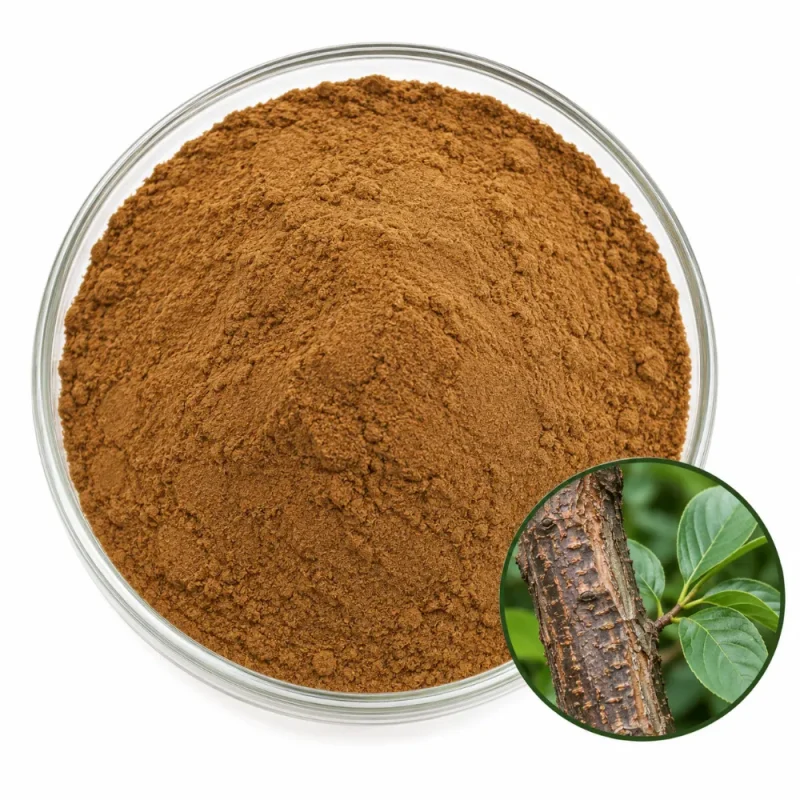
Buckthorn Bark Extract Powder

The dark inner and outer bark of Frangula alnus, the alder buckthorn of European woodland, supplies this buckthorn bark extract, and the berries and leaves are not used. Water extraction concentrates the soluble bark fraction, and the liquor is dried into a light brown powder that disperses in water.

Supplied as a 10:1 ratio extract with no marker percentage, it is milled to 80 mesh. No standardized extract, powder or isolated compound of this species is listed alongside it, so this ratio extract is the single buckthorn bark ingredient, with no declared anthranoid figure.

Frangula alnus Identity & Plant Part

The botanical entity is Frangula alnus Mill., a small deciduous tree or shrub of the Rhamnaceae family, formerly named Rhamnus frangula. The part used is the bark. Berries, leaves, wood and roots are not part of this ingredient.

The word buckthorn is shared by several plants. Common buckthorn is Rhamnus cathartica, a different species with thorns and a different bark, and cascara is Frangula purshiana, a North American relative sold as cascara sagrada. Alder buckthorn is distinguished by its smooth thornless twigs and its bark, which shows pale lenticels.

The bark carries anthranoid glycosides, including frangulins and glucofrangulins, along with tannins, and these coloring compounds give its extracts a deep red-brown tone.

Alder buckthorn bark is gathered from young stems and dried in the form of curled quills, which is a physical identity check that precedes extraction.

What 10:1 Means for Buckthorn Bark

A 10:1 ratio records how much buckthorn bark went into the buckthorn extract. It is not a content figure for anthranoid glycosides or tannins, and no such figure is attached to this product. The ratio describes concentration of the starting material only, and it needs to be read beside the plant part and the extraction medium.

Pharmacopoeial practice treats the fresh bark of this species as a different material from the aged bark, since compounds present in the fresh tissue are altered by storage or heating. That is a reason buckthorn bark is bought by supplier documentation and not by name alone, and the ratio does not capture it.

Cut dried bark is also traded for decoctions, and that coarse material is not a dispersible extract.

Typical Specifications

Specification ItemProduct Information
Latin NameFrangula alnus
Plant PartBark & Stem
ProcessingWater Extraction
Common NameAlder Buckthorn Bark
Ingredient TypeRatio Extract
Extract Ratio10:1
AppearanceLight Brown powder
Solubility / DispersibilityWater Dispersible
Quality Parameters
Moisture (LOD)≤5.0%
Total Ash≤5.0%
Particle Size80 mesh
Heavy MetalsLead ≤2 ppm · Arsenic ≤1 ppm · Cadmium ≤1 ppm · Mercury ≤0.1 ppm
MicrobiologyTPC ≤1,000 cfu/g · Yeast & Mold ≤100 cfu/g · E. coli Negative · Salmonella Negative/25 g
Shelf Life24 months in unopened original packaging, cool and dry storage

Application Areas

Herbal Bark Capsule Lots

Two-piece capsules accept buckthorn bark extract after a flow aid is mixed in. The tannin-bearing powder disperses without dissolving, so disintegration on the finished fill is worth testing, and fill weight is an early check on a new lot.

Tea-Style Instant Mixes

Bark infusions are a traditional herbal format, so tea-style mixes suit buckthorn extract. It disperses to a hazy red-brown cup with a bitter, astringent edge that sweeteners and spiced flavors soften, and the red-brown shade shifts with acid.

Coated Tablet Cores

Buckthorn bark extract tablets are built on microcrystalline cellulose and a disintegrant. A film coat hides the brown core and its bitter taste, and anthranoid pigments can stain, so equipment is cleaned between lots and punches are wiped dry.

Dry Sachet Blends

Sachets pair the extract with a dispersible base and a sweetener. A matched particle size stops the dense brown powder from sinking, and a dry filling room avoids lumping before the seal closes, which keeps fine tannin dust off the seam.

Formulation Notes

The powder is light brown with a faint woody aroma and a bitter, astringent taste. In water it disperses to a hazy red-brown liquid whose shade moves with pH, deeper in alkaline conditions and paler under acid.

Anthranoid pigments change color with pH, which affects drinks that include an acidulant. Tannins bind proteins and darken with iron, so keep iron contact surfaces out of the line. Buckthorn bark extract flows steadily once it has been premixed with a carrier. Reseal the liner after each draw, since a damp bark extract cakes.

Packaging & Commercial Supply

Essencefield supports product evaluation, formulation trials, commercial orders, and ongoing ingredient supply. Packaging, storage, and shipping arrangements are determined by product characteristics, order quantity, stability requirements, and destination-market needs.

Supply ItemGeneral Information
SampleAvailable upon request for formulation, testing, and supplier evaluation
Order Quantities100 g · 1 kg · 5 kg · 25 kg · 100 kg · 500 kg · Bulk
Sample Lead TimeTypically 5–7 days after sample confirmation
Production Lead TimeTypically 15–30 days after order and specification confirmation
PackagingSuitable protective inner packaging with bags, cartons, drums, or other appropriate outer packaging
StorageStore in tightly sealed, suitable protective packaging in a cool, dry environment. Protect from moisture, heat, and direct sunlight. Specific storage conditions follow the approved product specification.
DocumentationCOA · Product Specification · TDS · SDS · Applicable declarations (as applicable)

Final order quantities, lead times, packaging, documentation, and shipping arrangements are confirmed according to the selected product and commercial requirements.

Request Ingredient Specifications & Quote

Share your target specification, application, quantity, and documentation needs. We’ll help confirm suitable options, samples, and commercial supply details.