Dendrobium officinale Polysaccharide Powder

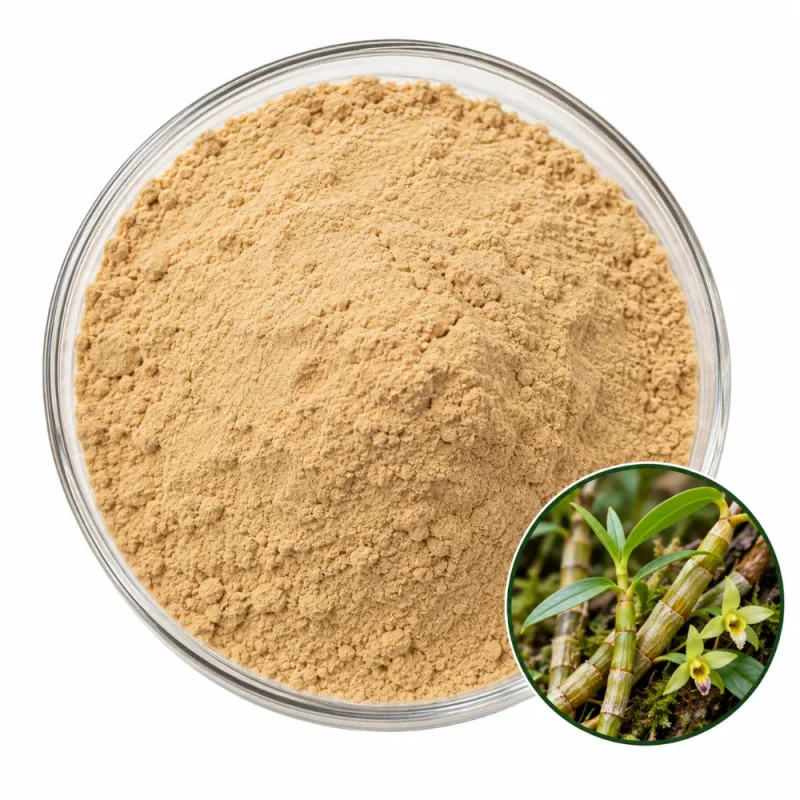
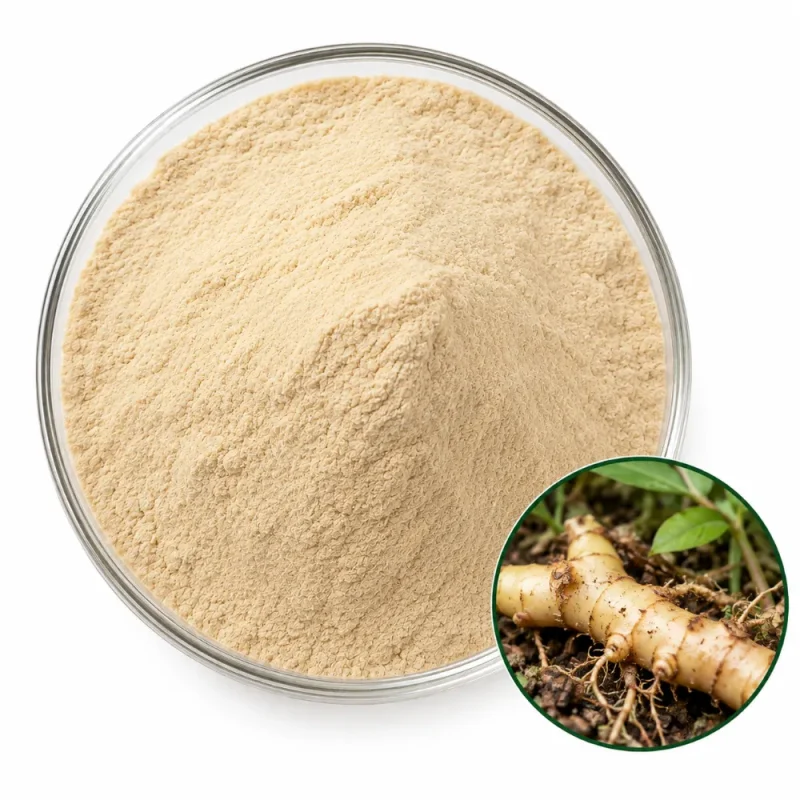
Extracted in hot water from the stem of Dendrobium officinale, this polysaccharide powder is built around the orchid’s acetylated glucomannan, the mucilage that makes the stem slippery when chewed. Purified and dried, it forms a fine light yellow powder.

Polysaccharide content is ≥30% by UV-Vis (phenol–sulfuric, as glucose), moisture and total ash are each ≤5.0%, and the powder is milled to 80 mesh. It is supplied for dietary supplements, functional beverages and functional foods, with the method stated alongside the percentage.

Dendrobium officinale Polysaccharide Identity

Dendrobium officinale polysaccharide powder is made from the stem of Dendrobium officinale Kimura & Migo, an epiphytic orchid grown on rock, bark or in facility beds, and known in Chinese trade as Tiepi Shihu. Dendrobium officinale stem is the only part used. Other Dendrobium species, such as Dendrobium nobile and Dendrobium huoshanense, are sold under similar names, and their polysaccharides differ in ratio and acetylation.

The main polymer is a glucomannan with a backbone of β-(1→4)-linked mannose and glucose units, with mannose in clear excess. Acetyl groups on some residues control how the chain behaves in water. The mucilage is stored in the stem as a reserve and swells strongly on contact with water, which is why raw stem decoctions are thick and slippery.

Hot-water extraction, followed by ethanol precipitation, removes most small sugars and phenolics from Dendrobium officinale, and leaves the glucomannan as the dominant carbohydrate. Dendrobium officinale polysaccharide is therefore a mannose-led fraction, distinct from the starch- and fructan-led fractions of roots and rhizomes.

The stem is harvested after a long growth period and is traditionally dried by twisting into coils, known as fengdou, which concentrates the mucilage. Dendrobium officinale polysaccharide starts from the dried stem, so stem age and drying method change the starting carbohydrate content before purification.

Two related products from the same species have different roles. Dendrobium Stem Powder is the milled stem and Dendrobium Extract Powder is a ratio extract. Neither is specified by a carbohydrate assay.

Polysaccharide Content & Test Method

The stated content for Dendrobium officinale is polysaccharides ≥30% by UV-Vis, a total-carbohydrate value. In the phenol–sulfuric reaction, hot sulfuric acid breaks the glucomannan into mannose and glucose, phenol converts them into a colored product, and absorbance is read against a glucose curve. The percentage is therefore a glucose equivalent.

For Dendrobium officinale polysaccharide this has a small but real consequence. Mannose does not give exactly the same color intensity as glucose in this reaction, so a mannose-rich polymer read against a glucose curve is slightly over- or under-estimated depending on the batch. The figure is a comparable measure of total carbohydrate for the same method, not an absolute mass of glucomannan.

Gravimetric ethanol-precipitate figures would include protein and any co-precipitated mucilage fragments, while an enzymatic assay is specific for one linkage and is not used for this grade. Sample handling matters too. Viscous glucomannan solutions are slow to filter and mix, so the reading is taken only after the polymer is fully hydrated and the solution is diluted to a measurable range.

The 30% value should be compared only with other UV-Vis values, and it says nothing about the mannose-to-glucose ratio or the degree of acetylation.

Typical Specifications

Specification ItemProduct Information
Latin NameDendrobium officinale
Plant PartBark & Stem
ProcessingWater Extraction & Purification
Common NameDendrobium (Tiepi Shihu)
Ingredient TypePolysaccharide Extract
Polysaccharide TypeAcetylated glucomannan
ContentPolysaccharides ≥30% (UV-Vis, as glucose)
AppearanceLight Yellow powder
Solubility / DispersibilityWater Soluble
Quality Parameters
Moisture≤5.0% (LOD)
Total Ash≤5.0%
Particle Size80 mesh
Heavy MetalsLead ≤2 ppm · Arsenic ≤1 ppm · Cadmium ≤1 ppm · Mercury ≤0.1 ppm
MicrobiologyTPC ≤1,000 cfu/g · Yeast & Mold ≤100 cfu/g · E. coli Negative · Salmonella Negative/25 g
Shelf Life24 months in unopened original packaging, cool and dry storage

Dendrobium officinale Polysaccharide Solution Behavior

The powder is water soluble and builds viscosity noticeably more than the pectic or fructan polysaccharides of roots, because glucomannan chains are long and hydrate strongly. Solutions turn slightly thick and slippery as concentration rises, and the feel is the audible signature of Dendrobium officinale polysaccharide.

Dissolution is steadier when the powder is sifted into stirred water than when it is dumped onto the surface, where the first layer swells into a film and slows the rest. Warm water speeds hydration, and the viscosity continues to climb for some minutes after the powder appears dissolved.

Acetyl groups keep neighboring chains apart and help solubility, but alkaline conditions strip them and lead to association and eventual gel-like behavior in concentrated solutions. Strong acid and prolonged heat shorten the backbone and lower viscosity, while ordinary pasteurization leaves it intact.

Glucomannan can hold water and stabilize suspensions, and it combines well with xanthan or gellan for body control. No viscosity values are stated for this grade, and trials at the final pH are recommended.

Application Areas

Instant Beverage Powders

Dendrobium officinale polysaccharide thickens drink powders slightly and dissolves in hot or cold water. Keep the inclusion modest, because glucomannan viscosity builds over several minutes and a drink that looks thin when mixed can feel heavy after standing, so judge the product after at least ten minutes.

Capsule and Granule Blends

In capsules, the powder adds a mannose-led fraction to blends with stem extract or other botanicals. Dry granulation avoids the sticky surface that forms when water contacts the mucilage, and a desiccant keeps the powder free-flowing during storage of the finished capsule or granule blend.

Jelly and Gel Desserts

At low levels the glucomannan reinforces gels made with agar or carrageenan and adds a soft, slippery mouthfeel. It forms weak gels by itself, so a partner gelling agent is needed for firm textures, and the Dendrobium officinale polysaccharide level should be set after the gel base is fixed.

Stick-Pack Mixes

Blends with soluble fiber and sweetener pre-disperse the Dendrobium officinale polysaccharide so it hydrates without lumps, which is the main difference between a smooth and a stringy drink. A barrier film protects the powder, which absorbs moisture and sticks together if the pack is left open.

Tea-Style Instant Infusions

Combined with powdered tea or herbal extracts, the powder gives body to infusions and dissolves without residue. Check clarity in the cup, since high loadings produce a slightly cloudy, viscous drink. Cold-brew formats need longer stirring to hydrate the powder.

Packaging & Commercial Supply

Essencefield supports product evaluation, formulation trials, commercial orders, and ongoing ingredient supply. Packaging, storage, and shipping arrangements are determined by product characteristics, order quantity, stability requirements, and destination-market needs.

Supply ItemGeneral Information
SampleAvailable upon request for formulation, testing, and supplier evaluation
Order Quantities100 g · 1 kg · 5 kg · 25 kg · 100 kg · 500 kg · Bulk
Sample Lead TimeTypically 5–7 days after sample confirmation
Production Lead TimeTypically 15–30 days after order and specification confirmation
PackagingSuitable protective inner packaging with bags, cartons, drums, or other appropriate outer packaging
StorageStore in tightly sealed, suitable protective packaging in a cool, dry environment. Protect from moisture, heat, and direct sunlight. Specific storage conditions follow the approved product specification.
DocumentationCOA · Product Specification · TDS · SDS · Applicable declarations (as applicable)

Final order quantities, lead times, packaging, documentation, and shipping arrangements are confirmed according to the selected product and commercial requirements.

Request Ingredient Specifications & Quote

Share your target specification, application, quantity, and documentation needs. We’ll help confirm suitable options, samples, and commercial supply details.