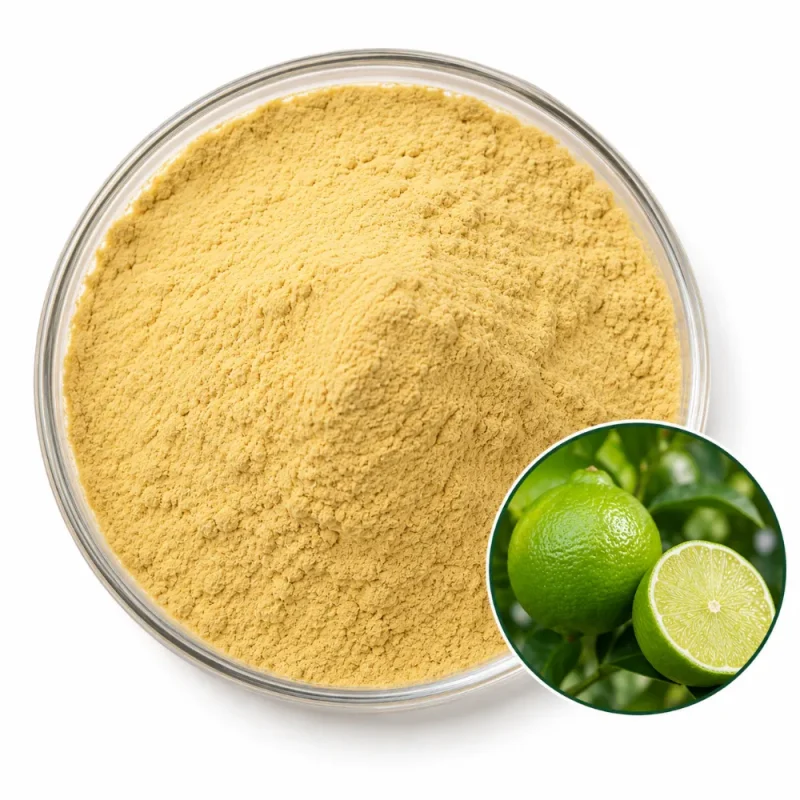
Lime Extract Powder

Lime extract is made from the fruit of Citrus aurantiifolia, the acid lime or key lime, and not from the leaves or flowers. Water extraction concentrates the soluble fruit fraction, and the liquor is dried into a light yellow powder that disperses in water.

The extract is supplied at a 10:1 ratio and milled to 80 mesh, with no marker percentage declared. A lime juice powder dried with a carrier is listed separately, so this lime extract is the water-extracted, carrier-free option.

Citrus aurantiifolia Identity & Plant Part

The botanical entity is Citrus aurantiifolia (Christm.) Swingle, the key or acid lime, a small thorny citrus tree of the Rutaceae with fragrant white flowers and small, thin-skinned green fruit. The part used is the fruit. Leaves, flowers and seeds are not included. The larger Persian lime, Citrus latifolia, is another lime species, and lemon is a separate species altogether. Citric acid, flavonoid glycosides and pectin are the main constituent families of the fruit extract, named here without figures. The volatile peel oil is largely absent from a water extract.

Lime Extract vs Other Forms

FormWhat It IsChoose It When
10:1 Fruit ExtractWater-extracted, concentrated and dried acid lime fruitA carrier-free fruit extract is wanted
Lime PowderLime juice dried with a maltodextrin carrierA juice powder with a carrier is acceptable

The 10:1 ratio gives how concentrated the extract is against the starting fruit, and it is not an acidity figure.

The juice powder is made by drying lime juice together with a carrier, so part of its weight is carrier, while this Citrus aurantiifolia extract has none. Both are sour, since citric acid is soluble in water and comes through either route. The extract has more pectin and flavonoid character from the whole fruit, whereas the juice powder is cleaner and nearer to juice in flavor. Naming species and the form on the order keeps the two lines apart.

Typical Specifications

Specification ItemProduct Information
Latin NameCitrus aurantiifolia
Plant PartFruit & Berry
ProcessingWater Extraction
Common NameKey Lime
Ingredient TypeRatio Extract
Extract Ratio10:1
AppearanceLight yellow powder
Solubility / DispersibilityWater Dispersible
Quality Parameters
Moisture (LOD)≤5.0%
Total Ash≤5.0%
Particle Size80 mesh
Heavy MetalsLead ≤2 ppm · Arsenic ≤1 ppm · Cadmium ≤1 ppm · Mercury ≤0.1 ppm
MicrobiologyTPC ≤1,000 cfu/g · Yeast & Mold ≤100 cfu/g · E. coli Negative · Salmonella Negative/25 g
Shelf Life24 months in unopened original packaging, cool and dry storage

Application Areas

Fruit Extract Capsules

Lime extract goes into two-piece capsules as a light yellow powder with a sharp, sour edge and a faint citrus note. Because acids can attack some capsule shells over long storage, check shell compatibility and disintegration on the finished fill early in development.

Sour Drink Powder Blends

In drink powders the extract supplies sourness and a pale yellow tint, and it combines with sugar, mint and soda-style flavors. The powder is hygroscopic, so blend it into the dry base first and keep the mix in a sealed pouch.

Effervescent Tablet Bases

In effervescent tablets, acid from the extract reacts with carbonate, so it counts toward the acid balance of the tablet. Keep the extract dry during blending, because moisture starts the effervescent reaction early and ruins the tablet.

Sour-Coat Gummy Premixes

Gummies carry the extract in a sour sanding or in the base itself, where its acidity sharpens lime and citrus flavors. High acid can thin a pectin or gelatin gel, so test set time and texture on the finished line.

Stick Pack Sour Mixes

Sticks combine the extract with a sweetener for stirred drinks, giving sourness without liquid. Foil laminate limits humidity, and a dry filling room avoids the caking that acidic, fruit-derived powders show around the seal. Fill sticks promptly after opening the drum to keep the acidic powder from absorbing moisture.

Formulation Notes

Lime extract is a light yellow powder with a faint citrus aroma and a sharp, sour taste from citric acid. It wets quickly in water to a pale, slightly hazy liquid, and a little fine material drops out over time. The sour taste is the first sensory point, and it is strong even at low inclusion.

Acidic fruit powders take up moisture and cake, so weigh the lime extract in a dry room and reseal the pack after each draw. Surface hardening is the first sign. Keep the powder away from carbonates and bicarbonates until the intended mixing step, since moisture triggers an early reaction.

Acid can corrode mild steel and attack some metal surfaces. Use stainless steel or plastic scoops and mixing equipment with lime extract, and rinse tooling soon after use, because the powder is acidic once moist and leaves a sticky film that attracts dust.

Packaging & Commercial Supply

Essencefield supports product evaluation, formulation trials, commercial orders, and ongoing ingredient supply. Packaging, storage, and shipping arrangements are determined by product characteristics, order quantity, stability requirements, and destination-market needs.

Supply ItemGeneral Information
SampleAvailable upon request for formulation, testing, and supplier evaluation
Order Quantities100 g · 1 kg · 5 kg · 25 kg · 100 kg · 500 kg · Bulk
Sample Lead TimeTypically 5–7 days after sample confirmation
Production Lead TimeTypically 15–30 days after order and specification confirmation
PackagingSuitable protective inner packaging with bags, cartons, drums, or other appropriate outer packaging
StorageStore in tightly sealed, suitable protective packaging in a cool, dry environment. Protect from moisture, heat, and direct sunlight. Specific storage conditions follow the approved product specification.
DocumentationCOA · Product Specification · TDS · SDS · Applicable declarations (as applicable)

Final order quantities, lead times, packaging, documentation, and shipping arrangements are confirmed according to the selected product and commercial requirements.

Request Ingredient Specifications & Quote

Share your target specification, application, quantity, and documentation needs. We’ll help confirm suitable options, samples, and commercial supply details.