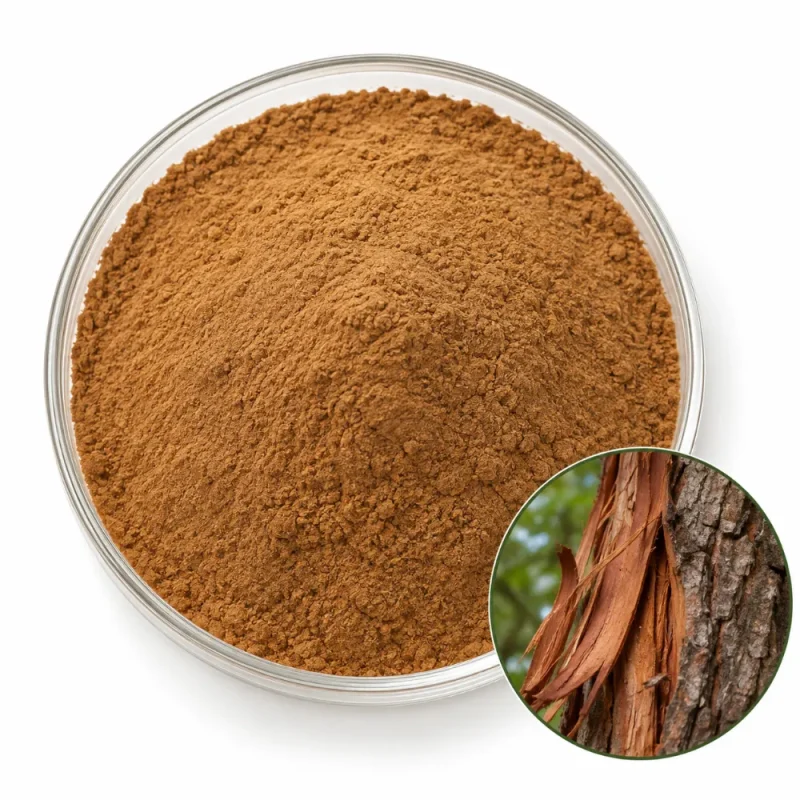
Pau D’Arco Extract Powder

Pau d’arco bark extract starts from the bark of Tabebuia impetiginosa, the pink-flowered lapacho tree of South America, taking the inner bark and leaving the wood and leaf aside. Water extraction concentrates the soluble bark fraction, and the liquor is dried into a light brown powder that disperses in water.

The extract is supplied at a 10:1 ratio with no marker percentage and is milled to 80 mesh. Pau d’arco is a trade name shared by several trees, so the Latin binomial defines the entry. It is a whole-bark ratio extract and not a naphthoquinone-defined grade.

Tabebuia impetiginosa Bark Source & Identity

The botanical entity is Tabebuia impetiginosa Mart. ex DC., a large tree of the Bignoniaceae that bursts into pink-purple bloom on bare branches, known as lapacho, ipê roxo and taheebo. The part used is the bark, mainly the inner layer. Wood, leaf and flower are not part of this pau d’arco extract. Some floras place the species in Handroanthus.

Pau d’arco is applied to more than one tree, including yellow-flowered relatives, so a specification should state the Latin binomial. The inner bark holds naphthoquinones such as lapachol, together with anthraquinones, flavonoids and phenylethanoid glycosides, named here only as families. Their levels depend strongly on tree age and species.

What 10:1 Means for Pau D’Arco

A 10:1 ratio on a pau d’arco extract describes concentration against the starting bark and reports no naphthoquinone figure. Lapachol is lipophilic and only partly recovered by a water process, so the powder is a polar, tannin-bearing bark profile. A buyer who needs a declared marker must look at a defined grade, which is not listed for Tabebuia impetiginosa. The extract is ordered by species, part and ratio, and no powder form is listed beside it.

Typical Specifications

Specification ItemProduct Information
Latin NameTabebuia impetiginosa
Plant PartBark & Stem
ProcessingWater Extraction
Common NameLapacho Inner Bark
Ingredient TypeRatio Extract
Extract Ratio10:1
AppearanceLight brown powder
Solubility / DispersibilityWater Dispersible
Quality Parameters
Moisture (LOD)≤5.0%
Total Ash≤5.0%
Particle Size80 mesh
Heavy MetalsLead ≤2 ppm · Arsenic ≤1 ppm · Cadmium ≤1 ppm · Mercury ≤0.1 ppm
MicrobiologyTPC ≤1,000 cfu/g · Yeast & Mold ≤100 cfu/g · E. coli Negative · Salmonella Negative/25 g
Shelf Life24 months in unopened original packaging, cool and dry storage

Application Areas

Bark Extract Capsules

Pau d’arco extract is a light brown powder with a woody, mildly bitter note, and capsules keep it off the palate. Bark powders are fibrous and cohesive, so a flow aid goes into the premix and tapped density is measured before a fill weight is chosen.

Tea-Style Bark Blends

Instant tea-style powders use pau d’arco extract for an amber cup with a woody, slightly vanilla-like depth. Cinnamon, orange peel and ginger flavors suit it, and a carrier in the dry blend keeps each sachet at the same dose.

Tablets with Iron Control

Pau d’arco extract is granulated with microcrystalline cellulose and a disintegrant before it is compressed. Naphthoquinones and tannins darken on contact with iron, so stainless tooling is used and the tablet color is checked after a few weeks of storage.

Dark Drink Sticks

Sticks pair the extract with cola, cherry or spiced flavors in barrier laminate. The dark tint of a bark extract is hidden in these systems, and a dry premix prevents lumps at the seal in humid storage.

Tannin-Tolerant Gummies

Cooked gummies take pau d’arco extract late in the base, with dark fruit flavors that cover both tint and astringency. Tannins can toughen a gel, so cooking viscosity and finished texture are checked in trials.

Formulation Notes

Pau d’arco extract is a light brown powder with a faint, woody, tea-like aroma and a mildly bitter, astringent taste. In water it forms a reddish tan liquid with some fine sediment. Tannins leave a dry finish, which limits the dose in clear drinks.

Weigh the extract in a dry area, reseal the liner after each draw and keep the opened pack away from heat and light. A bark extract rich in tannins picks up moisture and clumps, and the powder darkens when it meets iron, so use stainless or plastic scoops.

Premix the extract with a carrier and screen it into the bulk in one stage. Drinks wet more evenly when the powder is dry-blended with sugar before water is added. Pilot lots show how the amber tint behaves with the chosen acid and sweetener.

Packaging & Commercial Supply

Essencefield supports product evaluation, formulation trials, commercial orders, and ongoing ingredient supply. Packaging, storage, and shipping arrangements are determined by product characteristics, order quantity, stability requirements, and destination-market needs.

Supply ItemGeneral Information
SampleAvailable upon request for formulation, testing, and supplier evaluation
Order Quantities100 g · 1 kg · 5 kg · 25 kg · 100 kg · 500 kg · Bulk
Sample Lead TimeTypically 5–7 days after sample confirmation
Production Lead TimeTypically 15–30 days after order and specification confirmation
PackagingSuitable protective inner packaging with bags, cartons, drums, or other appropriate outer packaging
StorageStore in tightly sealed, suitable protective packaging in a cool, dry environment. Protect from moisture, heat, and direct sunlight. Specific storage conditions follow the approved product specification.
DocumentationCOA · Product Specification · TDS · SDS · Applicable declarations (as applicable)

Final order quantities, lead times, packaging, documentation, and shipping arrangements are confirmed according to the selected product and commercial requirements.

Request Ingredient Specifications & Quote

Share your target specification, application, quantity, and documentation needs. We’ll help confirm suitable options, samples, and commercial supply details.