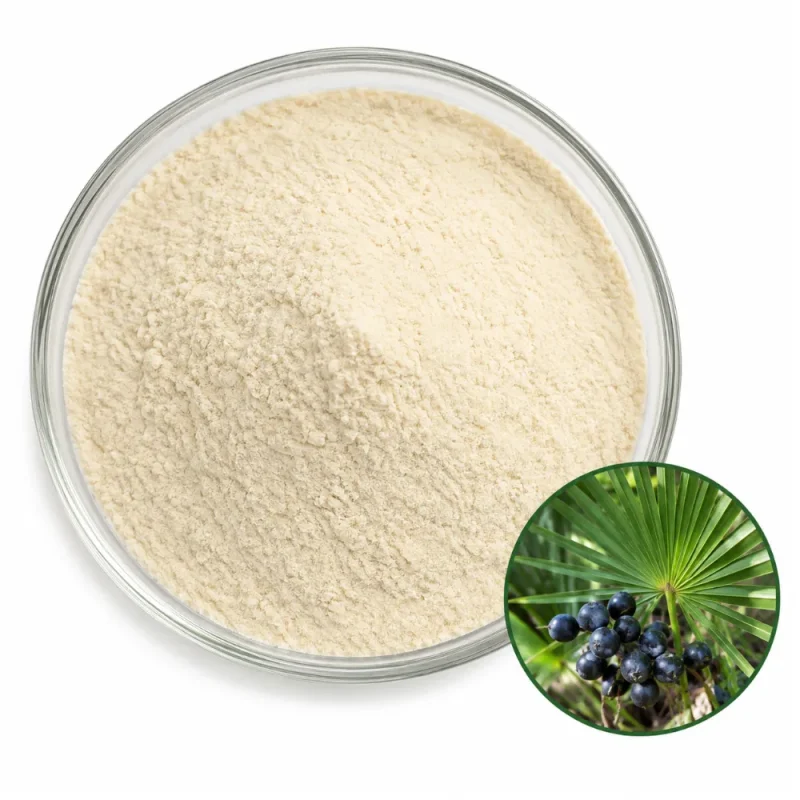
Saw Palmetto Extract Powder

Dark berries of a low fan palm native to the southeastern United States, Serenoa repens, are the raw material for this saw palmetto extract. Ethanol extraction concentrates the berry fraction, and the extract is dried to a light brown powder.

This is an ethanol ratio extract rather than a lipid-defined one: no fatty acid figure is attached, the powder is milled to 80 mesh and it is listed as water dispersible. The fatty acid-standardized extract and the plain berry powder are separate products, compared below.

Serenoa repens Berry Identity & Plant Part

The botanical entity is Serenoa repens (W.Bartram) Small, a clumping, creeping fan palm (Arecaceae) that forms dense stands in the coastal pine flatwoods and sand dunes of the southeastern United States. The part used is the ripe fruit, an olive-sized drupe that turns from orange-red to dark blue-black before it is picked and dried. Leaves, stems and roots are not included in this saw palmetto extract.

The species is rarely confused; the product form is. Saw palmetto is traded as dried berry powder, as a lipid-rich extract made with supercritical carbon dioxide or hexane, and as an ethanol ratio extract such as this one. Its composition and physical form differ from this powder. The ratio and the solvent matter as much as the name.

Saw Palmetto Extract vs Berry Powder

FormWhat It IsChoose It When
10:1 Berry ExtractEthanol-extracted, concentrated and dried S. repens fruitA dispersible, dry powder extract without a marker is wanted
Saw Palmetto Extract 25–45% fatty acidsStandardized extract with a defined fatty acid rangeThe specification names a fatty acid figure
Saw Palmetto Berry PowderDried, milled berry with no extractionWhole-berry oil and fiber are wanted

A 10:1 ratio on saw palmetto says how far the berry was concentrated. It carries no fatty acid or sterol value, and the lipid-defined extract in the table is the product to choose when such a figure must be declared.

The berry powder is the other pole. It keeps the full natural oil, which makes it sticky and prone to oxidation, while this ratio extract serves buyers who want ethanol-extracted saw palmetto in a drier powder format.

Typical Specifications

Specification ItemProduct Information
Latin NameSerenoa repens
Plant PartFruit & Berry
ProcessingEthanol Extraction
Common NameSaw Palmetto
Ingredient TypeRatio Extract
Extract Ratio10:1
AppearanceLight Brown powder
Solubility / DispersibilityWater Dispersible
Quality Parameters
Moisture (LOD)≤5.0%
Total Ash≤5.0%
Particle Size80 mesh
Heavy MetalsLead ≤2 ppm · Arsenic ≤1 ppm · Cadmium ≤1 ppm · Mercury ≤0.1 ppm
MicrobiologyTPC ≤1,000 cfu/g · Yeast & Mold ≤100 cfu/g · E. coli Negative · Salmonella Negative/25 g
Shelf Life24 months in unopened original packaging, cool and dry storage

Application Areas

Dry-Powder Capsule Fills

Milled berry is sticky because of its natural oil, and a ratio extract is meant to behave as a drier solid in the capsule hopper. A flow trial remains worthwhile, since any lipid that survives extraction can still coat particles and slow filling in a warm room.

Tablets with Oil Control

Residual lipid can cause sticking to punch faces, so tablets of saw palmetto extract need a lubricant plan tested on the actual lot. A film coat limits moisture uptake and covers the faintly fatty, nutty taste that may show at higher inclusion.

Citrus-Flavored Powder Sachets

Sachets carry the extract with a flavored carrier. A mild, fatty-sweet taste is easy to cover with citrus or cocoa-style flavors, and because the powder wets slowly in water, premixing it with the carrier keeps oily particles from floating as a film.

Oil-Aware Bar Mixes

Bars take saw palmetto extract in the dry premix, where the fine powder spreads evenly. Because a berry lipid is prone to oxidation, aged bars are worth testing for stale notes, and other fat sources in the recipe are best kept low.

Formulation Notes

The powder is light brown with a mild, fatty, nutty aroma and a slightly soapy, sweet-fatty taste that stands out in plain water. In water it wets slowly and gives a pale tan, hazy liquid; the lipid share can leave a faint oily film on the surface.

Fatty acids oxidize into stale or rancid notes over time, so keep exposure to air and light short and protect the finished product from heat. Oxygen-scavenging pouches can help where shelf life is critical. Premix the extract with a portion of the filler before the main mixer, and screen out soft lumps before filling.

A powder that carries residual oil turns tacky as it warms, so keep opened containers away from heat sources and press the liner flat after use; repeated exposure to room air also dulls the aroma.

Packaging & Commercial Supply

Essencefield supports product evaluation, formulation trials, commercial orders, and ongoing ingredient supply. Packaging, storage, and shipping arrangements are determined by product characteristics, order quantity, stability requirements, and destination-market needs.

Supply ItemGeneral Information
SampleAvailable upon request for formulation, testing, and supplier evaluation
Order Quantities100 g · 1 kg · 5 kg · 25 kg · 100 kg · 500 kg · Bulk
Sample Lead TimeTypically 5–7 days after sample confirmation
Production Lead TimeTypically 15–30 days after order and specification confirmation
PackagingSuitable protective inner packaging with bags, cartons, drums, or other appropriate outer packaging
StorageStore in tightly sealed, suitable protective packaging in a cool, dry environment. Protect from moisture, heat, and direct sunlight. Specific storage conditions follow the approved product specification.
DocumentationCOA · Product Specification · TDS · SDS · Applicable declarations (as applicable)

Final order quantities, lead times, packaging, documentation, and shipping arrangements are confirmed according to the selected product and commercial requirements.

Request Ingredient Specifications & Quote

Share your target specification, application, quantity, and documentation needs. We’ll help confirm suitable options, samples, and commercial supply details.