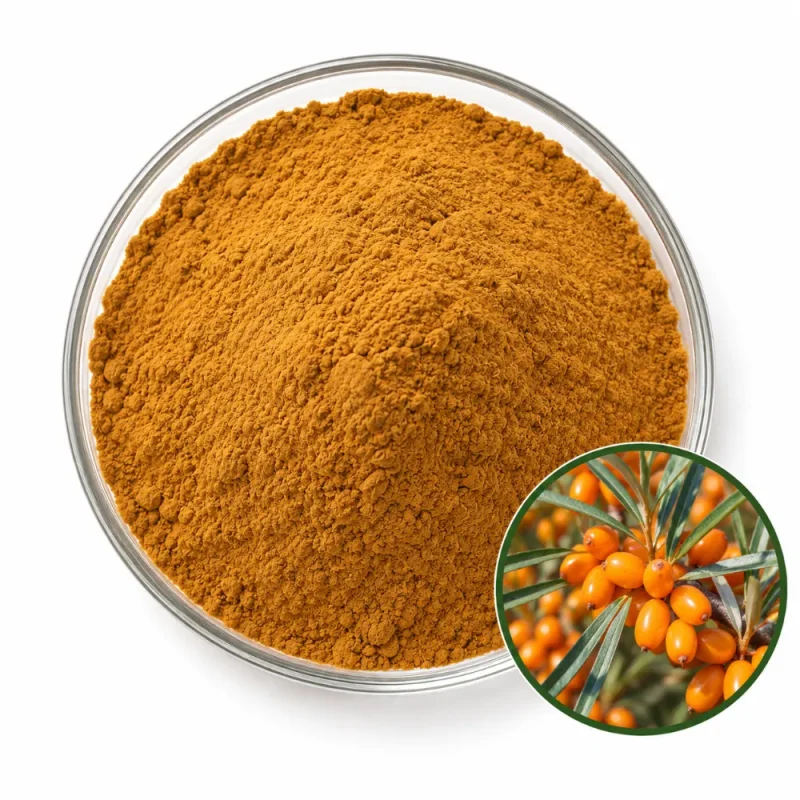
Sea Buckthorn Berry Extract Powder

Ripe orange berries of Hippophae rhamnoides, the thorny sea buckthorn shrub, are the only plant part behind this extract. Water extraction concentrates the soluble berry fraction, and the liquor is dried to a yellow-orange 10:1 powder. Leaves, twigs and the oil-rich seed fraction are left out of this sea buckthorn berry extract.

The 10:1 ratio carries no flavonoid percentage. The powder is yellow-orange, ground to 80 mesh and water dispersible. A flavonoid-graded sea buckthorn extract and the leaf extract are separate products, and sea buckthorn oil, a lipid fraction, is not what this water extract delivers.

Hippophae rhamnoides Berry Identity & Plant Part

The botanical entity is Hippophae rhamnoides L., a thorny deciduous shrub of the oleaster family, Elaeagnaceae. The part used is the ripe berry, a small orange to yellow fruit that sits tightly along the branch. Leaves, thorny twigs and the pressed seed fraction are not added to this sea buckthorn berry extract.

Berries and leaves are separate raw materials with different pigment and flavonoid profiles, so a specification needs to name the part. Berry material holds flavonoid glycosides, carotenoids and organic acids, while a separate oil fraction carries the fatty acids that dominate sea buckthorn oil products and does not belong in this water extract.

Buckthorn Extract vs Powder & Standardized Grades

FormWhat It IsChoose It When
10:1 Sea Buckthorn Berry ExtractWater-extracted, concentrated and dried H. rhamnoides berryA dispersible berry extract without a marker is wanted
Sea Buckthorn Extract PowderRatio extract listed under the shorter nameA document already uses the shorter product name
Sea Buckthorn Extract 5–20% FlavonoidsExtract with a defined flavonoid rangeThe specification names a flavonoid figure
Sea Buckthorn Leaf Extract Powder10:1 water extract of the leafLeaf identity, not fruit, is the required source

The 10:1 on a sea buckthorn berry extract label is a concentration ratio of the starting berries. It does not state flavonoid or carotenoid content, and it should not be read as a stand-in for the oil-based sea buckthorn ingredients sold under similar names. Berry material also differs lot to lot in acidity and color with ripeness, so the ratio is a statement about concentration, not about composition.

Where a label must declare flavonoids, the graded extract is the product to use. The ratio extract suits blends that need sea buckthorn berry identity, a warm orange tint and a dry, low-fat form. The leaf extract serves a different botanical part and a green-to-brown color, so it is not interchangeable with the berry.

Typical Specifications

Specification ItemProduct Information
Latin NameHippophae rhamnoides
Plant PartFruit & Berry
ProcessingWater Extraction
Common NameSea Buckthorn, Seaberry
Ingredient TypeRatio Extract
Extract Ratio10:1
AppearanceYellow-Orange powder
Solubility / DispersibilityWater Dispersible
Quality Parameters
Moisture (LOD)≤5.0%
Total Ash≤5.0%
Particle Size80 mesh
Heavy MetalsLead ≤2 ppm · Arsenic ≤1 ppm · Cadmium ≤1 ppm · Mercury ≤0.1 ppm
MicrobiologyTPC ≤1,000 cfu/g · Yeast & Mold ≤100 cfu/g · E. coli Negative · Salmonella Negative/25 g
Shelf Life24 months in unopened original packaging, cool and dry storage

Application Areas

Sour Orange Drink Sticks

Drink sticks use the extract for an orange tint and a tart fruit note. The berry’s organic acids are noticeable in cold water, so sweetener levels are set against that sourness rather than after it, and citrus flavors usually blend naturally.

Warm-Colored Capsule Fills

Capsule blends take the extract as a dry yellow-orange component. Carotenoid pigments can stain filling equipment and clear shells, so opaque capsules are chosen and the line is wiped between runs. A sea buckthorn berry extract fill also looks speckled when it is blended with pale powders, so the mixing time is fixed by a color check on the blend.

Tangy Gummy Premixes

Gummy premixes add sea buckthorn extract after the cook, once the mass has cooled, so the pigment is not held at high temperature. Its acidity sits well with pectin sets, but the tart note limits how much can be added to a mild base.

Light Bar and Cereal Blends

Bars and cereal coatings use the extract for berry identity and a warm tone. Because it is dry and low in fat, it does not add the oiliness of the whole berry, but it may soften coatings if humidity is high.

Formulation Notes

The powder is yellow-orange with a fruity, acidic aroma and a pronounced sour taste. In water it disperses to a cloudy orange liquid, with cloudiness increasing at higher concentration. Carotenoid pigments respond to light and oxygen, so the extract is added late in the blend, and finished products are kept in opaque or light-protected packs.

Premix the powder with a measured part of the dry base before the main mix to avoid orange streaks. Sugars and acids make the extract hygroscopic, so it cakes quickly once exposed. After opening, press out the air, close the liner firmly and store the container away from moisture and direct light. In a tablet or capsule, the acidic extract can react with alkaline fillers such as magnesium carbonate, so filler choice is reviewed when the sea buckthorn extract is blended in.

Packaging & Commercial Supply

Essencefield supports product evaluation, formulation trials, commercial orders, and ongoing ingredient supply. Packaging, storage, and shipping arrangements are determined by product characteristics, order quantity, stability requirements, and destination-market needs.

Supply ItemGeneral Information
SampleAvailable upon request for formulation, testing, and supplier evaluation
Order Quantities100 g · 1 kg · 5 kg · 25 kg · 100 kg · 500 kg · Bulk
Sample Lead TimeTypically 5–7 days after sample confirmation
Production Lead TimeTypically 15–30 days after order and specification confirmation
PackagingSuitable protective inner packaging with bags, cartons, drums, or other appropriate outer packaging
StorageStore in tightly sealed, suitable protective packaging in a cool, dry environment. Protect from moisture, heat, and direct sunlight. Specific storage conditions follow the approved product specification.
DocumentationCOA · Product Specification · TDS · SDS · Applicable declarations (as applicable)

Final order quantities, lead times, packaging, documentation, and shipping arrangements are confirmed according to the selected product and commercial requirements.

Request Ingredient Specifications & Quote

Share your target specification, application, quantity, and documentation needs. We’ll help confirm suitable options, samples, and commercial supply details.