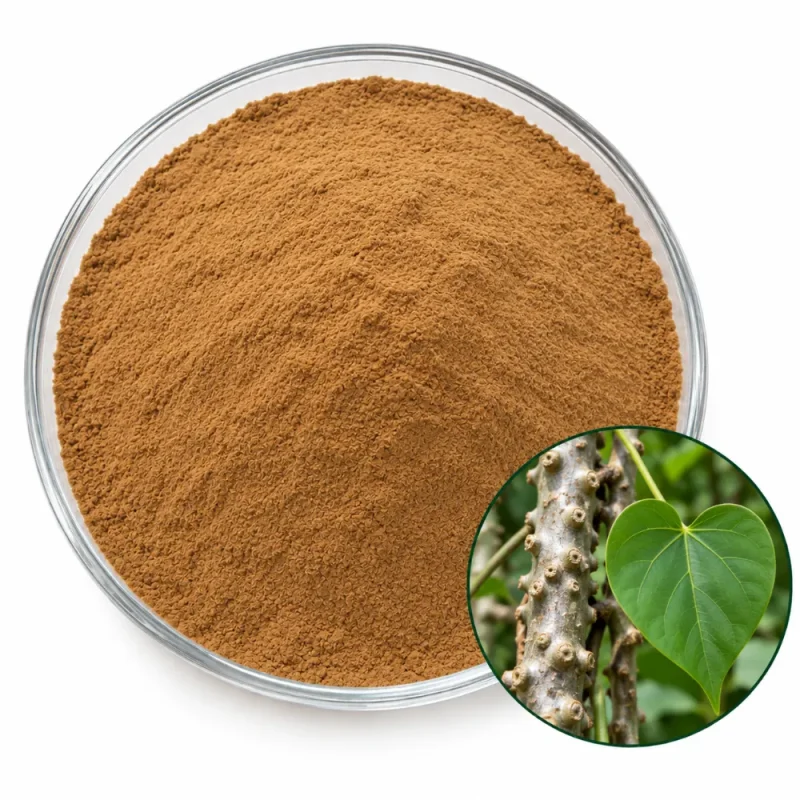
Tinospora Cordifolia Extract Powder

Tinospora cordifolia extract starts from the stem of giloy, also called guduchi, a climbing vine of the moonseed family widely used in Ayurvedic practice. Water extraction concentrates the soluble stem fraction, and the liquor is dried to a light brown powder.

The extract is supplied at a 10:1 ratio with no marker percentage and is milled to 80 mesh. A bitter-principle grade, the milled stem powder and the pure alkaloid are separate products, so this ratio extract is the entry for a whole-stem water concentrate.

Tinospora cordifolia Identity & Plant Part

The botanical entity is Tinospora cordifolia (Willd.) Miers, a large deciduous climber of the Menispermaceae with heart-shaped leaves and fleshy, succulent stems. The part used is the stem, while leaves, roots and fruit are not part of this ingredient, and dried stem is gray-brown with a bitter taste. The vine climbs over tall trees in tropical and subtropical India and Southeast Asia.

Several Tinospora species look alike, and market studies have found large differences between commercial samples, including mineral adulteration in one. Species and part are therefore fixed in the specification, and Tinospora cordifolia stem carries aporphine and protoberberine alkaloids, diterpenoid lactones, polysaccharides and sterols, named here as families only.

Tinospora Extract vs Powder and Pure Forms

FormWhat It IsChoose It When
10:1 Stem ExtractWater-extracted and concentrated giloy stemA whole-stem concentrate without a marker target is specified
Guduchi Extract 2.5–5% Bitter PrinciplesSeparate extract graded by bitter principlesA defined bitter-principle grade is the specification
Giloy (Tinospora cordifolia) PowderDried giloy stem milled to powderA fibrous stem powder is wanted
Magnoflorine 98%Single alkaloid sold as a pure ingredientA single compound is the specification

The 10:1 ratio is a concentration step from dried stem. It does not state an alkaloid or bitter-principle figure, and each sibling uses its own method. A buyer who needs a numeric target or a single molecule specifies one of those instead.

The stem powder gives bulk and fiber, while the Tinospora cordifolia extract concentrates the water-soluble part and flows better. The marker-graded extract and the pure alkaloid answer different questions entirely, which is why the ratio extract stays a plain, whole-stem option for buyers who want the stem as a plant material. The extract also occupies less volume than the stem powder, which helps in capsules and sticks. Species, part and ratio together define it.

Typical Specifications

Specification ItemProduct Information
Latin NameTinospora cordifolia
Plant PartBark & Stem
ProcessingWater Extraction
Common NameGiloy (Guduchi) Stem
Ingredient TypeRatio Extract
Extract Ratio10:1
AppearanceLight brown powder
Solubility / DispersibilityWater Dispersible
Quality Parameters
Moisture (LOD)≤5.0%
Total Ash≤5.0%
Particle Size80 mesh
Heavy MetalsLead ≤2 ppm · Arsenic ≤1 ppm · Cadmium ≤1 ppm · Mercury ≤0.1 ppm
MicrobiologyTPC ≤1,000 cfu/g · Yeast & Mold ≤100 cfu/g · E. coli Negative · Salmonella Negative/25 g
Shelf Life24 months in unopened original packaging, cool and dry storage

Application Areas

Capsule Fills for Giloy Stem

Two-piece capsules take the Tinospora cordifolia extract as a free-flowing light brown powder once a flow aid is added. The bitter taste stays inside the shell, which is why capsules lead for this stem. Fill-weight checks and a disintegration test close each lot.

Coated Giloy Tablets

Tablets compress the Tinospora cordifolia extract with cellulose filler and a disintegrant, with a sugar or film coat to cover the bitterness. Tannin-like compounds can bind some excipients, so granulate compatibility is tested. Hardness is checked on coated tablets.

Ayurvedic-Style Tea Sachets

Instant sachets blend the Tinospora cordifolia extract with ginger, tulsi-style herbs and a sweetener to soften the bitter note. The cup is a hazy tan liquid. A low inclusion level keeps the drink acceptable, and tasting trials set the limit.

Dry Botanical Stick Packs

Stick packs combine the extract with other herb extracts, flavor and a dry carrier. Because the tint is light brown, it blends into most herbal mixes. Uniform blending and a sieve step keep the dose steady across the run.

Date and Cocoa Bar Premixes

Bars take the extract in the dry blend with dates, cocoa and nuts, which cover the bitter edge best. The powder is mixed with dry ingredients before the syrup, and finished bars are checked for moisture and for color.

Formulation Notes

Tinospora cordifolia extract is a light brown powder with a faint woody aroma and a bitter taste that lingers. In water it disperses to a hazy amber liquid, and polysaccharides give a slight viscosity at higher concentrations. Dried stem is gray-brown, and the extract is a lighter brown.

The powder takes up humidity at a moderate rate and clumps when left open, so it is weighed in a dry room, premixed with a flow agent and resealed after each draw. Polysaccharides slow wetting, so adding the powder to liquids in small portions avoids lumps. Opened packs keep best in a closed container, protected from heat and light.

Packaging & Commercial Supply

Essencefield supports product evaluation, formulation trials, commercial orders, and ongoing ingredient supply. Packaging, storage, and shipping arrangements are determined by product characteristics, order quantity, stability requirements, and destination-market needs.

Supply ItemGeneral Information
SampleAvailable upon request for formulation, testing, and supplier evaluation
Order Quantities100 g · 1 kg · 5 kg · 25 kg · 100 kg · 500 kg · Bulk
Sample Lead TimeTypically 5–7 days after sample confirmation
Production Lead TimeTypically 15–30 days after order and specification confirmation
PackagingSuitable protective inner packaging with bags, cartons, drums, or other appropriate outer packaging
StorageStore in tightly sealed, suitable protective packaging in a cool, dry environment. Protect from moisture, heat, and direct sunlight. Specific storage conditions follow the approved product specification.
DocumentationCOA · Product Specification · TDS · SDS · Applicable declarations (as applicable)

Final order quantities, lead times, packaging, documentation, and shipping arrangements are confirmed according to the selected product and commercial requirements.

Request Ingredient Specifications & Quote

Share your target specification, application, quantity, and documentation needs. We’ll help confirm suitable options, samples, and commercial supply details.