Yeast Beta Glucan Powder

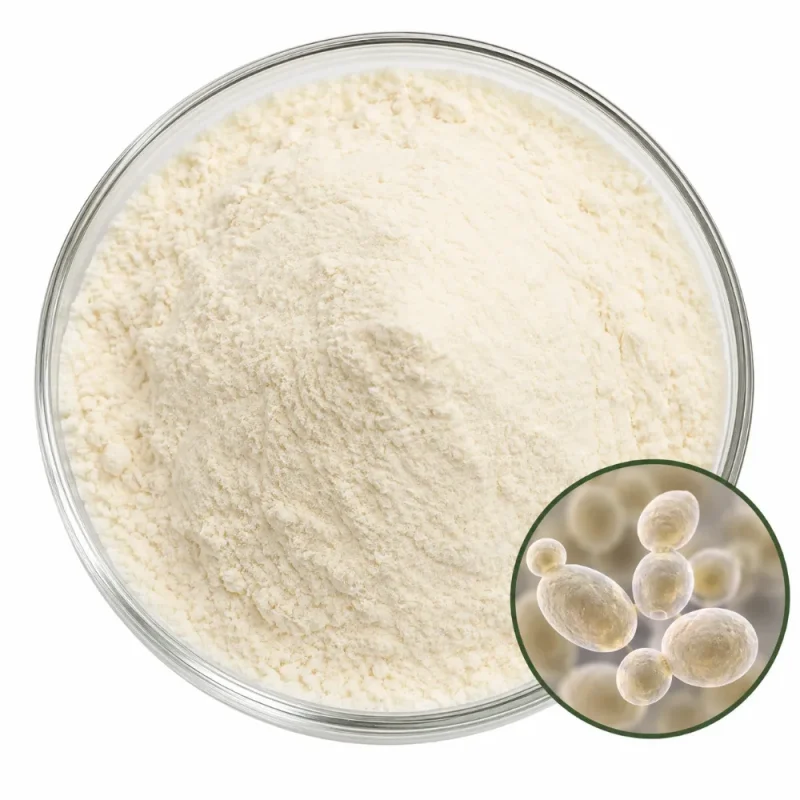
Yeast beta-glucan powder is the cell-wall glucan of Saccharomyces cerevisiae, separated from the mannoprotein, glycogen and cell contents that make up the rest of the yeast. The wall fraction is washed and dried to a fine light yellow powder that does not dissolve in water.

The primary grade carries beta-glucans ≥70% by enzymatic assay, with an 80% option, and moisture and ash are each ≤5.0%. The powder is milled to 80 mesh and supplied as an insoluble particulate for capsules, tablets, bars and suspensions.

Yeast Beta-Glucan Identity

Yeast beta-glucan powder is made from the cell wall of Saccharomyces cerevisiae (Desm.) Meyen, the baker’s and brewer’s yeast. The part used is the wall that surrounds each cell, and the cell contents are removed. The source is a single-celled fungus and not a plant, and it is a different material from the glucans of cereals or seaweed.

The inner layer of the yeast cell wall is a network of β-(1→3)-glucan with β-(1→6)-linked side chains, and this layer gives the cell its shape and strength. Outside it sits a coat of mannoprotein, and chitin forms a small fraction near the bud scars. The cell also stores glycogen, an α-glucan, inside the cytoplasm, and glycogen is the main contaminant that purification has to remove.

The wall fraction is obtained by breaking the cells open and releasing their contents, then removing the mannoprotein, lipid and glycogen by washing, heat, alkali or enzymes. What remains is an insoluble, particulate glucan, often in the form of hollow spheres a few micrometers across, which keep some of the cell’s original shape.

Because the starting yeast comes from fermentation, its wall composition depends on strain and growth conditions, so the finished powder is specified by an assay and not by the yeast it came from. No other yeast product is currently listed in the catalog, so no sibling products are named here.

Polysaccharide Content & Test Method

GradeAssay & MethodWhere It Fits
70% Beta-Glucan≥70% Beta-Glucans (Enzymatic)Capsules, tablets and bars
80% Beta-Glucan≥80% Beta-Glucans (Enzymatic)Compact tablets and suspension powders

The yeast figure is a specific beta-glucan content measured enzymatically. Yeast presents a special problem for the assay, because glycogen is an α-glucan that releases the same glucose. The usual solution is a differential method in which total glucan is hydrolysed and measured, α-glucan is measured separately with amylase-type enzymes, and the difference is the β-glucan.

A simple UV-Vis phenol–sulfuric reading would not make that distinction and would be a poor description of a yeast product. It counts every sugar, so glycogen, mannose from residual mannoprotein and glucosamine from chitin could all raise a total-sugar value. The percentages here are enzymatic beta-glucan values and are not comparable with a total-carbohydrate figure.

Sample opening is the other source of variation. The wall glucan is insoluble and crystalline, so the sample is first swollen or dissolved in strong acid or alkali and then hydrolysed, and an incompletely opened sample reads low. A stated value therefore belongs to a defined preparation step and basis, dry matter or as-is.

Typical Specifications

Specification ItemProduct Information
Latin NameSaccharomyces cerevisiae
Plant PartMushroom & Fungi
ProcessingWater Extraction & Purification
Common NameYeast beta-glucan
Ingredient TypePolysaccharide Extract
Polysaccharide Typeβ-(1→3)-glucan with β-(1→6) branches (cell-wall glucan)
ContentBeta-Glucans ≥70% (Enzymatic)
Available GradesBeta-Glucans ≥70% (Primary) · ≥80% (Enzymatic)
AppearanceLight Yellow powder
Solubility / DispersibilityInsoluble in Water
Quality Parameters
Moisture≤5.0% (LOD)
Total Ash≤5.0%
Particle Size80 mesh
Heavy MetalsLead ≤2 ppm · Arsenic ≤1 ppm · Cadmium ≤1 ppm · Mercury ≤0.1 ppm
MicrobiologyTPC ≤1,000 cfu/g · Yeast & Mold ≤100 cfu/g · E. coli Negative · Salmonella Negative/25 g
Shelf Life24 months in unopened original packaging, cool and dry storage

Yeast Beta-Glucan Solution Behavior

Yeast beta-glucan does not dissolve in water. It disperses as a fine suspension of cell-wall fragments or hollow particles, and the particles settle slowly on standing. The powder adds little viscosity, because the glucan is cross-linked and particulate and does not hydrate into a gel, so the liquid stays thin even at fairly high loadings.

The glucan is robust. It survives heat, ordinary acid and the conditions of baking and extrusion, with none of the chain loss seen in soluble polysaccharides. Strong alkali swells it and strong acid at high temperature hydrolyses it, which is why those solvents are used in analysis and not in formulation.

Because the particles are insoluble, yeast glucan does not bind calcium or proteins the way charged gums do, and it does not interact with polyphenols. It carries a faint, bland, slightly yeasty note and a pale color. Moisture pickup is low, so the powder flows well and keeps free of lumps in normal storage.

Particle behavior governs feel. A fine, smooth suspension is easy to drink, and coarse clumps give a chalky mouthfeel, so the 80-mesh grade is the one to test. Wetting with a small amount of glycerin or oil before adding water prevents floating dry patches.

Yeast beta-glucan stays in suspension longer when the particles are fine and the liquid has a little body from another ingredient such as gellan or pectin. In plain water the particles settle within minutes, and yeast beta-glucan drinks should be stirred or shaken before serving to restore an even dose in each cup.

Application Areas

Insoluble Fiber Suspensions

Yeast beta-glucan suits shake-and-drink suspensions where a stabilizer holds the particles. The drink is cloudy and thin and not viscous, so flavor and labeling should expect a milky appearance, and a stir before drinking redistributes any settled glucan. Stir before drinking to even out the dose.

Dense Capsule Cores

The low-moisture powder flows well and fills capsules cleanly. The glucan adds weight without forming a gel layer on wetting, so capsule disintegration is not slowed, and fill weight stays steady without a flow agent. Fill weight stays steady without a flow agent.

Baked Bar Inclusions

In baked bars the glucan survives heat and acid unchanged and adds fiber solids with no stickiness. Because it does not bind water, it does not firm doughs, and bar texture stays governed by the other binders. Texture is checked after one week of storage.

Tablet and Chewable Cores

Tablets compress readily because the powder takes up little moisture, and the high density of the glucan lets a smaller tablet carry the same dose. Chewables pick up a faint yeasty note, which is covered by fruit or cocoa flavors. The faint yeasty note is covered by fruit or cocoa flavors.

Sachet Blends for Suspension

Mixed with soluble fibers in sachets, the powder adds a stable particulate fraction that does not clump in humid air. Users should be told to stir before drinking, because the glucan settles within minutes. The sachet label tells the user to stir the cup first.

Packaging & Commercial Supply

Essencefield supports product evaluation, formulation trials, commercial orders, and ongoing ingredient supply. Packaging, storage, and shipping arrangements are determined by product characteristics, order quantity, stability requirements, and destination-market needs.

Supply ItemGeneral Information
SampleAvailable upon request for formulation, testing, and supplier evaluation
Order Quantities100 g · 1 kg · 5 kg · 25 kg · 100 kg · 500 kg · Bulk
Sample Lead TimeTypically 5–7 days after sample confirmation
Production Lead TimeTypically 15–30 days after order and specification confirmation
PackagingSuitable protective inner packaging with bags, cartons, drums, or other appropriate outer packaging
StorageStore in tightly sealed, suitable protective packaging in a cool, dry environment. Protect from moisture, heat, and direct sunlight. Specific storage conditions follow the approved product specification.
DocumentationCOA · Product Specification · TDS · SDS · Applicable declarations (as applicable)

Final order quantities, lead times, packaging, documentation, and shipping arrangements are confirmed according to the selected product and commercial requirements.

Request Ingredient Specifications & Quote

Share your target specification, application, quantity, and documentation needs. We’ll help confirm suitable options, samples, and commercial supply details.