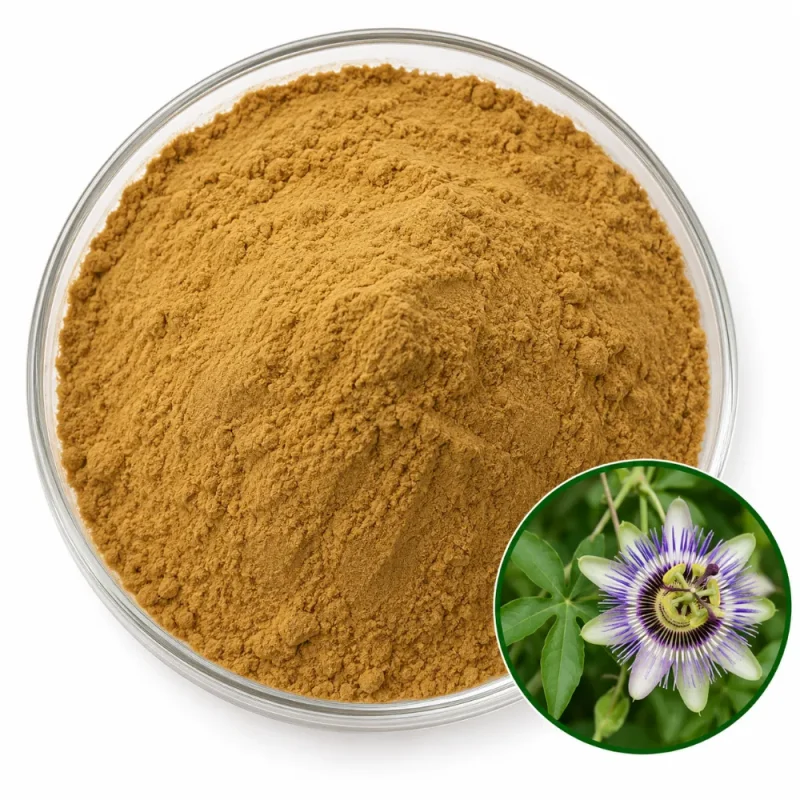
Passionflower Extract Powder

The aerial parts of Passiflora incarnata, the maypop vine native to the southeastern United States, are the source of this passionflower extract. Water extraction concentrates the soluble herb fraction, and the liquor is dried into a light brown powder that disperses in water. The fruit and the roots are not used.

A 10:1 ratio sets the concentration, no marker percentage is attached, and the powder is milled to 80 mesh. Vitexin-defined passionflower extract is a separate standardized product, and the plain dried herb is offered as a milled powder. This ratio extract carries no declared flavonoid figure.

Passiflora incarnata Identity & Plant Part

The botanical entity is Passiflora incarnata L., a perennial climbing vine of the Passifloraceae family. The part used is the aerial portion of the plant: leaves, stems and flowers cut above ground. Roots and fruit are not part of this ingredient, and the fruit pulp sold as passion fruit is a different species and a different material.

That species point is the main source of confusion. Passion fruit comes from Passiflora edulis, grown for its fruit, while the herbal drug tradition and the pharmacopoeial herb belong to P. incarnata. The herb carries flavonoid C-glycosides, vitexin and isoorientin among them, and these are the constituent family that standardized grades are built on.

Passionflower herb is also sold as a cut dried herb for infusions. That cut differs from a dispersible extract powder in particle size and in how it wets, so the two cannot replace each other in a formula without retesting.

Passionflower Extract vs Powder & Standardized Grades

FormWhat It IsChoose It When
10:1 Herb ExtractWater-extracted, concentrated and dried passionflower aerial partsA dispersible whole-herb extract is wanted without a marker
Passionflower Extract 4% Total Flavonoids as VitexinStandardized extract with a defined total flavonoid figure expressed as vitexinThe specification names a flavonoid figure
Passionflower Herb PowderDried, milled passionflower herb with no extractionWhole herb with fiber is needed at higher inclusion
Isoorientin 98%Isolated flavonoid C-glycoside compoundA single pure compound is required

The 10:1 ratio records how much passionflower herb went into the extract. It states no flavonoid figure, which is why a labelled flavonoid content belongs to the standardized grade. The flavonoid C-glycosides in the herb dissolve in water, so a water extract keeps them, but the proportion that reaches the dried powder is not fixed by the ratio.

The three siblings change the basis of the specification. The standardized extract adds a flavonoid figure with its method, the milled herb adds back the insoluble plant fiber, and isoorientin is a single compound with no herb matrix. Declared flavonoid content therefore points to the standardized extract, while a plain passionflower ingredient points here.

The color of passionflower extract follows extraction time and drying conditions, so it describes the lot physically and tells a buyer nothing about flavonoid content.

Typical Specifications

Specification ItemProduct Information
Latin NamePassiflora incarnata
Plant PartLeaf & Herb
ProcessingWater Extraction
Common NamePassionflower
Ingredient TypeRatio Extract
Extract Ratio10:1
AppearanceLight Brown powder
Solubility / DispersibilityWater Dispersible
Quality Parameters
Moisture (LOD)≤5.0%
Total Ash≤5.0%
Particle Size80 mesh
Heavy MetalsLead ≤2 ppm · Arsenic ≤1 ppm · Cadmium ≤1 ppm · Mercury ≤0.1 ppm
MicrobiologyTPC ≤1,000 cfu/g · Yeast & Mold ≤100 cfu/g · E. coli Negative · Salmonella Negative/25 g
Shelf Life24 months in unopened original packaging, cool and dry storage

Application Areas

Herb Blend Capsules

Passionflower extract fills into two-piece capsules alongside other herb extracts. The light brown powder blends visually with most botanical companions, so capsule blends rarely show color mottling, and the dispersible powder wets quickly inside the shell. Check fill weight early, since a fine herb extract packs more densely than milled herb.

Instant Herbal Drink Sticks

Single-serve sticks combine the extract with a flavored, dispersible carrier. Its mild herbal taste is easiest to cover with fruit or honey-style flavors, and the hazy light brown cup suits tea-like presentations better than clear beverage styles. Stick fills run most evenly when the extract and the carrier share a similar particle size.

Gummy and Chewable Formats

Pectin gummies can carry passionflower extract at low inclusion. The extract is added after the cooked mass cools below its setting temperature, which limits heat exposure, and berry or citrus flavors cover the green-herbal edge of the powder. Gummy lines keep the extract in a pre-blend with sugar, which prevents dusting.

Formulation Notes

The powder is light brown with a mild green-herbal aroma and a slightly bitter taste. In water it disperses to a hazy tan-brown liquid, with a little fine material settling on standing, and it does not form a clear solution.

Premix the extract with a flowing carrier such as microcrystalline cellulose before capsule filling, because a fine herb extract can bridge in a hopper. In drink powders, add it to the dry blend ahead of acids and flavors so the bitter note spreads evenly. After opening, reseal the liner at every draw, since a moisture-affected herb extract darkens and cakes. Weigh passionflower extract in a dry room, because the surface of the powder takes up humidity quickly. A darker, tackier surface is the first visible sign that a light brown pack has been left open too long.

Packaging & Commercial Supply

Essencefield supports product evaluation, formulation trials, commercial orders, and ongoing ingredient supply. Packaging, storage, and shipping arrangements are determined by product characteristics, order quantity, stability requirements, and destination-market needs.

Supply ItemGeneral Information
SampleAvailable upon request for formulation, testing, and supplier evaluation
Order Quantities100 g · 1 kg · 5 kg · 25 kg · 100 kg · 500 kg · Bulk
Sample Lead TimeTypically 5–7 days after sample confirmation
Production Lead TimeTypically 15–30 days after order and specification confirmation
PackagingSuitable protective inner packaging with bags, cartons, drums, or other appropriate outer packaging
StorageStore in tightly sealed, suitable protective packaging in a cool, dry environment. Protect from moisture, heat, and direct sunlight. Specific storage conditions follow the approved product specification.
DocumentationCOA · Product Specification · TDS · SDS · Applicable declarations (as applicable)

Final order quantities, lead times, packaging, documentation, and shipping arrangements are confirmed according to the selected product and commercial requirements.

Request Ingredient Specifications & Quote

Share your target specification, application, quantity, and documentation needs. We’ll help confirm suitable options, samples, and commercial supply details.