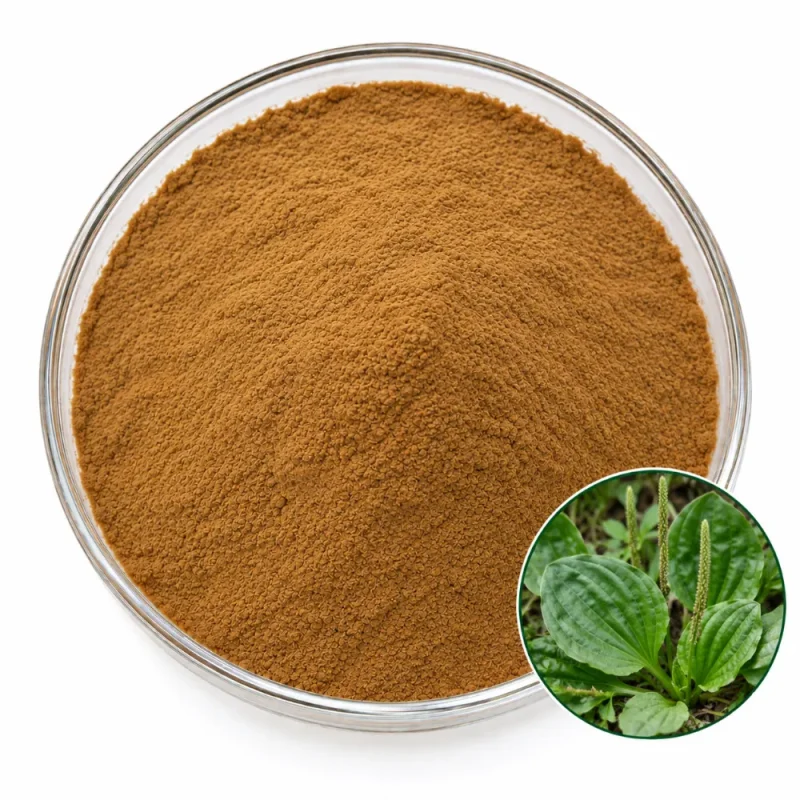
Plantain Leaf Extract Powder

Plantain leaf extract starts from the leaves of Plantago major, the broadleaf plantain of lawns and roadsides, with the flower spike and seed excluded. Water extraction concentrates the soluble leaf fraction, and the liquor is dried into a green powder that disperses in water.

The extract is supplied at a 10:1 ratio with no marker percentage and is milled to 80 mesh. This is the leafy herb and not the banana-like plantain fruit. Psyllium husk and seed products come from other Plantago species and are different materials.

Plantago major Leaf Source & Identity

The botanical entity is Plantago major L., broadleaf plantain of the Plantaginaceae, a low perennial with a rosette of oval leaves marked by strong parallel veins and a narrow green flower spike. The part used is the leaf. Seed, husk and flower spike are not part of this plantain leaf extract.

The word plantain has two meanings. The cooking plantain is a starchy banana of the genus Musa and has nothing to do with this herb, while ribwort is another Plantago species with narrow leaves. The leaf holds the iridoid aucubin, phenylethanoid glycosides such as plantamajoside, flavonoids and mucilage, named here only as families.

What 10:1 Means for Plantain Leaf

A 10:1 ratio on a plantain leaf extract describes concentration against the starting leaf and reports no iridoid or phenylethanoid figure. The mucilage and glycosides are polar, so a water process carries them across, and the dissolved powder shows a slight viscosity. A buyer who needs a declared marker must look at a defined grade, which is not listed for Plantago major. Plantain leaf extract is specified by Latin binomial, the leaf and the 10:1 ratio. The leaf of Plantago major is the only part in this entry, and seed or husk products, which depend on other Plantago species, follow entirely different specifications.

Typical Specifications

Specification ItemProduct Information
Latin NamePlantago major
Plant PartLeaf & Herb
ProcessingWater Extraction
Common NameBroadleaf Plantain Leaf
Ingredient TypeRatio Extract
Extract Ratio10:1
AppearanceGreen powder
Solubility / DispersibilityWater Dispersible
Quality Parameters
Moisture (LOD)≤5.0%
Total Ash≤5.0%
Particle Size80 mesh
Heavy MetalsLead ≤2 ppm · Arsenic ≤1 ppm · Cadmium ≤1 ppm · Mercury ≤0.1 ppm
MicrobiologyTPC ≤1,000 cfu/g · Yeast & Mold ≤100 cfu/g · E. coli Negative · Salmonella Negative/25 g
Shelf Life24 months in unopened original packaging, cool and dry storage

Application Areas

Green Capsule Fills

Plantain leaf extract fills into capsules as a green powder. The mucilage makes particles slightly cohesive, so a flow aid helps and the filling room is kept dry. Opaque shells protect the chlorophyll-derived color from light.

Mild Herbal Tea Blends

Instant tea-style powders use the leaf extract as a green-brown base with a gentle grassy note. It dissolves to a slightly viscous, hazy liquid. Mint, lemon and apple flavors suit it, and a carrier in the dry blend keeps each sachet at the same dose.

Chewable Tablet Blends

Chewable tablets on a sorbitol base carry the extract with mint or citrus flavor. The mucilage helps binding and hardness, but it can slow disintegration, so release is tested on the finished tablet rather than assumed.

Powder Sticks with Light Body

Sticks pair the extract with fruit flavors in barrier laminate. The mucilage thickens a drink slightly, so a short stir is needed for full dispersion, and a dry premix prevents lumps at the seal. The slight thickening is a natural result of the leaf mucilage.

Green-Tinted Gummies

Cooked gummies take plantain leaf extract late in the base, where its mucilage adds a little body. Green apple and pear flavors fit the tint, and a short storage trial confirms that heat and acid do not push the color toward olive.

Formulation Notes

Plantain leaf extract is a green powder with a faint, grassy, slightly salty aroma and a mild bitter, astringent taste. In water it forms a hazy green-brown liquid with a slight viscosity from the mucilage. Fine leaf fragments settle slowly.

Mucilage and glycosides make the powder hygroscopic. Keep the weighing area dry, reseal the liner after every draw and store the opened pack away from heat and light. Chlorophyll fades from green toward brown as a pack ages, and surface clumping is the first sign of moisture pickup.

Mix the leaf extract with a flow aid and screen it into the bulk. Mucilage wets slowly and forms lumps, so in drinks the powder is dry-blended with sugar before water is added and the mix is stirred during addition.

Packaging & Commercial Supply

Essencefield supports product evaluation, formulation trials, commercial orders, and ongoing ingredient supply. Packaging, storage, and shipping arrangements are determined by product characteristics, order quantity, stability requirements, and destination-market needs.

Supply ItemGeneral Information
SampleAvailable upon request for formulation, testing, and supplier evaluation
Order Quantities100 g · 1 kg · 5 kg · 25 kg · 100 kg · 500 kg · Bulk
Sample Lead TimeTypically 5–7 days after sample confirmation
Production Lead TimeTypically 15–30 days after order and specification confirmation
PackagingSuitable protective inner packaging with bags, cartons, drums, or other appropriate outer packaging
StorageStore in tightly sealed, suitable protective packaging in a cool, dry environment. Protect from moisture, heat, and direct sunlight. Specific storage conditions follow the approved product specification.
DocumentationCOA · Product Specification · TDS · SDS · Applicable declarations (as applicable)

Final order quantities, lead times, packaging, documentation, and shipping arrangements are confirmed according to the selected product and commercial requirements.

Request Ingredient Specifications & Quote

Share your target specification, application, quantity, and documentation needs. We’ll help confirm suitable options, samples, and commercial supply details.