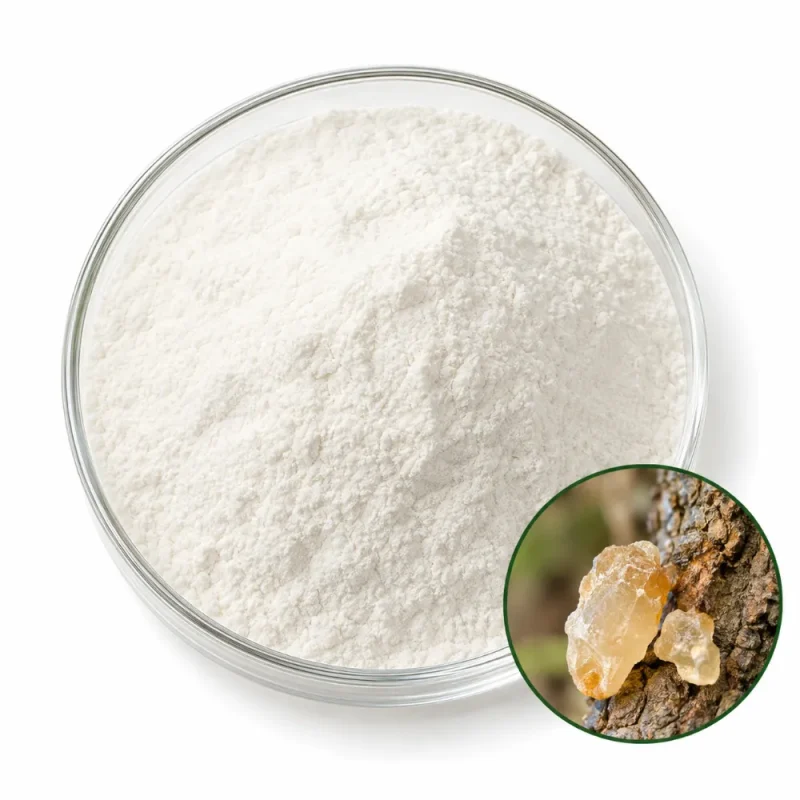
11-Keto-Beta-Boswellic Acid 98%

Frankincense resin from Boswellia serrata contains a family of pentacyclic triterpenoid acids, and 11-keto-beta-boswellic acid is the one that carries a ketone on ring C. It is isolated by ethanol extraction and purification as an off-white powder that is insoluble in water.

The Primary Grade is 98% 11-keto-beta-boswellic acid by HPLC, in Food / Dietary Supplement Grade. The figure describes this one acid, not total boswellic acids, which is the usual way frankincense extracts are specified. Related acids are listed as separate compounds.

11-Keto-Beta-Boswellic Acid Chemical Identity

11-Keto-beta-boswellic acid (C30H46O4, molecular weight 470.7) is an ursane-type pentacyclic triterpenoid acid. Its skeleton has five fused rings, a hydroxyl group at carbon 3, a carboxylic acid at carbon 24 and a ketone at carbon 11 conjugated with a double bond. The ketone is the structural difference that separates it from plain β-boswellic acid.

The natural source is the oleo-gum resin of Boswellia serrata Roxb. ex Colebr. (Burseraceae), the Indian frankincense tree; resin from other Boswellia species such as B. sacra is a different raw material with a different acid pattern. The acetylated analogue, 3-O-acetyl-11-keto-β-boswellic acid, is the more lipophilic relative and is a separate compound.

Buyers comparing neighbors can look at Boswellia serrata extract with 65–85% boswellic acids, Boswellia serrata extract powder and frankincense powder. None of these is a single-compound grade, and each describes a different position on the path from raw resin to isolated acid. The 11-keto-beta-boswellic acid in the table is identified by its own CAS number and InChIKey.

In specifications the abbreviation KBA is common, and it is easily confused with AKBA. Writing 11-keto-beta-boswellic acid in full, together with the CAS number 17019-92-0, avoids the mix-up and shows that the acetyl group is absent from this compound.
Typical Specifications

Specification ItemProduct Information
Natural SourceBoswellia serrata resin
Plant PartResin & Gum
ProcessingEthanol Extraction & Purification
Compound ClassTriterpenoids, Terpenoids
Chemical Name (IUPAC)(3R,4R,4aR,6aR,6bS,8aR,11R,12S,12aR,14aR,14bS)-3-hydroxy-4,6a,6b,8a,11,12,14b-heptamethyl-14-oxo-1,2,3,4a,5,6,7,8,9,10,11,12,12a,14a-tetradecahydropicene-4-carboxylic acid
CAS Number17019-92-0
Molecular FormulaC30H46O4
Molecular Weight470.7 g/mol
PubChem CID9847548
InChIKeyYIMHGPSYDOGBPI-YZCVQEKWSA-N
Purity98% (HPLC)
GradeFood / Dietary Supplement Grade
AppearanceOff-White powder
Solubility / DispersibilityInsoluble in Water
Quality Parameters
Moisture (LOD)≤5.0%
Total Ash≤5.0%
Heavy MetalsLead ≤2 ppm · Arsenic ≤1 ppm · Cadmium ≤1 ppm · Mercury ≤0.1 ppm
MicrobiologyTPC ≤1,000 cfu/g · Yeast & Mold ≤100 cfu/g · E. coli Negative · Salmonella Negative/25 g
Shelf Life24 months in unopened original packaging, cool and dry storage

11-Keto-Beta-Boswellic Acid Purity & Related Substances

The 98% grade is a single-compound value measured by HPLC, and it describes the peak of this acid as a share of all detected peaks. Water, ash and non-absorbing material are outside the number. Boswellia resin contains several close relatives: α- and β-boswellic acid, their 3-O-acetyl esters, the 11-keto acetyl analogue and several lesser acids. Because the α and β forms are isomers with the same formula, an HPLC method needs enough resolution to separate pairs that differ only in the position of one methyl group. A method that reports total boswellic acids lumps them together and cannot be used for this specification. Residual resin acids and volatile oils are removed during purification, after ethanol extraction, and no further route is described. Hydroxy acids of this type are stable when dry, but the ketone can react under strong reducing conditions, so the chromatogram of an aged lot is worth rechecking. The identity values in the table belong to the keto acid alone, not to the acetylated form.

Specification wording matters for this compound because the same plant yields many similar acids. 11-Keto-beta-boswellic acid 98% should be quoted with the CAS number 17019-92-0 and with the statement that the figure is a single peak by HPLC, not a sum. A certificate that gives only boswellic acids by titration or by UV is a different measurement and belongs to the extract specifications.

When 11-keto-beta-boswellic acid is compared across suppliers, the HPLC conditions should be compared as well as the percentage, since a short method can hide the acetylated analogue under the same peak.

11-Keto-Beta-Boswellic Acid Solubility & Delivery

The compound is insoluble in water, as expected for a large triterpenoid with one carboxylic acid and one hydroxyl group on a lipophilic five-ring core. It dissolves in ethanol, methanol and other organic solvents, and in alkaline water as the carboxylate salt, though alkaline conditions are rarely compatible with finished goods. Practical delivery approaches are oil-phase dispersions, co-solvent premixes, phospholipid or cyclodextrin complexes, surfactant systems and micronized powders that improve wetting. Each approach affects dissolution rate more than identity. The powder is dry, slightly waxy and electrostatic, and it can lump in humid rooms. Weighing in a controlled environment and closed transfer protect fill accuracy. Heat in the presence of acid should be limited, since the conjugated enone is the reactive part of the molecule. The compound has a faint resinous character that influences taste in liquids, so flavor selection and masking are part of the design.

Heat and acid should be limited in aqueous processing, since the conjugated enone is the reactive part of 11-keto-beta-boswellic acid. Dry, closed storage keeps the powder stable, and exposure to light and moisture is kept short during weighing. The compound has a faint resinous character that influences taste in liquids, so flavor selection and masking are part of the design.

Weighing and premixing follow from the small dose. A dilution of 11-keto-beta-boswellic acid in a free-flowing carrier is prepared in steps, checked for homogeneity and then added to the main blend. Cleaning between products uses solvent-compatible agents, since resinous residue of 11-keto-beta-boswellic acid does not rinse off with water alone.

Application Areas

Hard capsules with a flowing premix

The fine, slightly waxy powder bridges in narrow hoppers, so a premix with a free-flowing excipient helps fill accuracy. A cool, dry room limits caking before the shell is closed, and fill weights are sampled during the run.

Softgels and lipid-based fills

Because 11-keto-beta-boswellic acid is lipophilic, dispersing it in a lipid or phospholipid carrier gives better wetting than dry fills. The dispersion is stirred during encapsulation and the fill is sampled for uniformity at the start, middle and end of the run.

Tablets with wetting excipients

In tablets the insoluble powder benefits from a wetting agent or surfactant so that the matrix disintegrates quickly. Compression is tested for sticking, since the resinous powder can adhere to punches, and a lubricant level is chosen that does not slow disintegration.

Powder sticks and combination blends

Dry mixes stirred into water need a dispersant to keep the insoluble powder from floating. In blends with other boswellic acids, each component is assayed separately because HPLC percentages of different compounds do not add.

Packaging & Commercial Supply

Essencefield supports product evaluation, formulation trials, commercial orders, and ongoing ingredient supply. Packaging, storage, and shipping arrangements are determined by product characteristics, order quantity, stability requirements, and destination-market needs.

Supply ItemGeneral Information
SampleAvailable upon request for formulation, testing, and supplier evaluation
Order Quantities100 g · 1 kg · 5 kg · 25 kg · 100 kg · 500 kg · Bulk
Sample Lead TimeTypically 5–7 days after sample confirmation
Production Lead TimeTypically 15–30 days after order and specification confirmation
PackagingSuitable protective inner packaging with bags, cartons, drums, or other appropriate outer packaging
StorageStore in tightly sealed, suitable protective packaging in a cool, dry environment. Protect from moisture, heat, and direct sunlight. Specific storage conditions follow the approved product specification.
DocumentationCOA · Product Specification · TDS · SDS · Applicable declarations (as applicable)

Final order quantities, lead times, packaging, documentation, and shipping arrangements are confirmed according to the selected product and commercial requirements.

Request Ingredient Specifications & Quote

Share your target specification, application, quantity, and documentation needs. We’ll help confirm suitable options, samples, and commercial supply details.