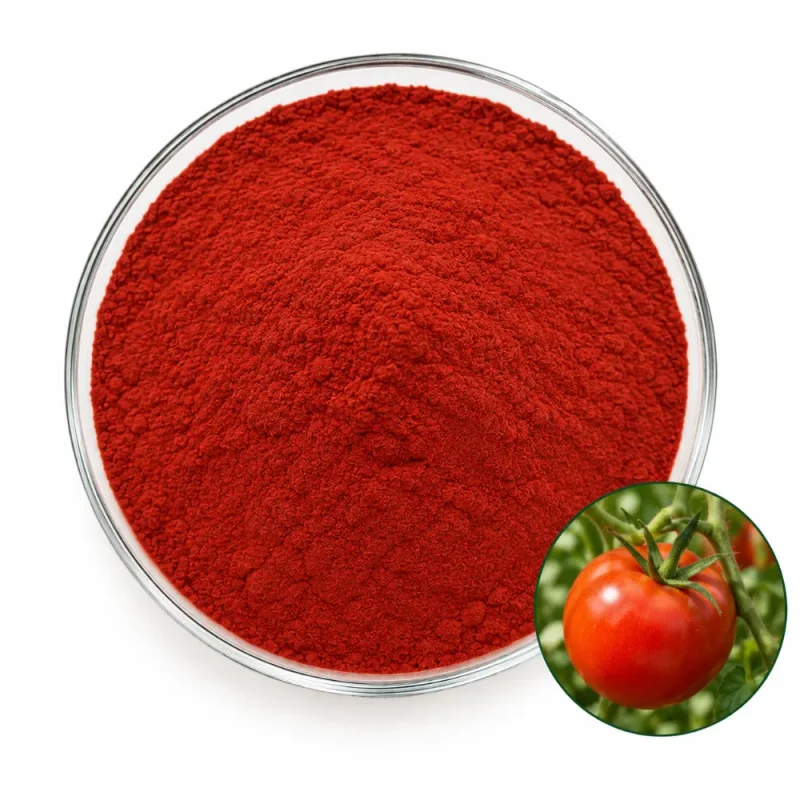
Lycopene Chemical Identity
Lycopene has the molecular formula C40H56 and a molecular weight of 536.9. The molecule is a straight chain of eleven conjugated double bonds, flanked by two open ends, and the long chromophore absorbs strongly in the blue-green range, so the pigment looks deep red. Because it is a pure hydrocarbon with no polar groups, it dissolves only in nonpolar solvents and lipids.
The natural source is the fruit of Solanum lycopersicum L., the tomato. The pigment is made in the fruit as it ripens and is mostly in the all-trans form, which is also the form that crystallizes most readily. Heat and light convert part of it to cis-isomers, and these differ in color and solubility. Tomato also holds two colorless relatives, phytoene and phytofluene, supplied here as Phytoene 95% and Phytofluene 95%, and the unextracted fruit is supplied as Tomato Powder. Those are separate ingredients with different chromophores.
Ripeness and cultivar set the lycopene level of the fruit, and the pigment accumulates as the tomato turns from green through orange to deep red. The skin and the pericarp hold more of it than the gel around the seeds. Lycopene is also made by some fungi and can be produced synthetically, so naming the botanical source and the part used tells a buyer which origin the crystals have. A formula should treat the pigment as an ingredient of defined identity and not as a generic tomato color.