Chlorogenic Acid 98%

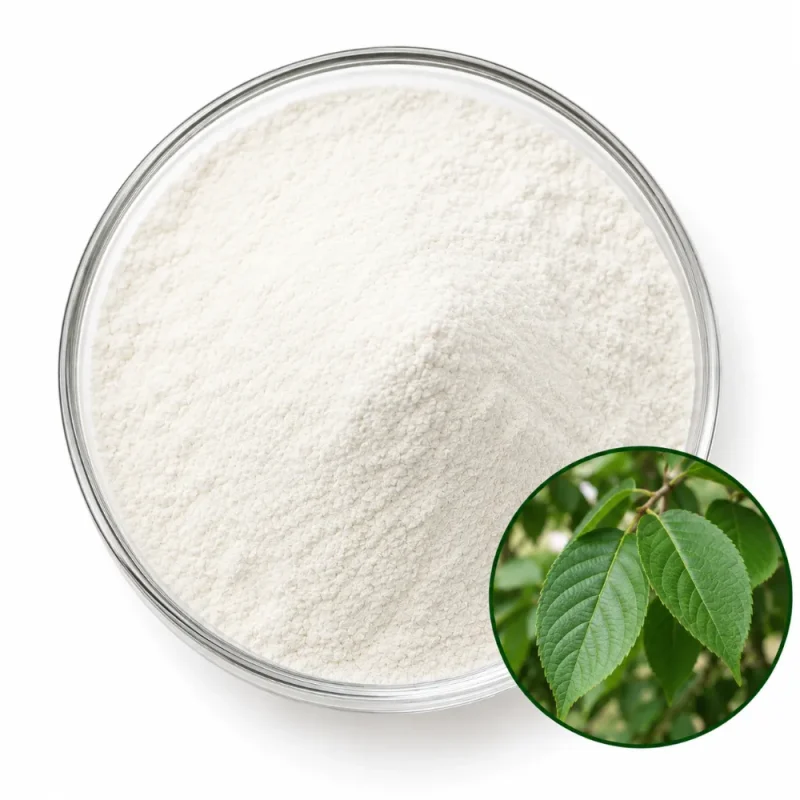
Caffeic acid joined to quinic acid by an ester bond gives chlorogenic acid, and this chlorogenic acid is isolated from the leaf of Eucommia ulmoides by ethanol extraction and purification. It is a water soluble hydroxycinnamic acid ester, supplied as an off-white powder, and one of the most widespread polyphenols in the plant kingdom.

The primary grade is 98% chlorogenic acid by HPLC, with a 95% grade also supplied, in Food / Dietary Supplement Grade. The leaf of the hardy rubber tree is the source here, not the green coffee bean, so the botanical origin is stated beside the name.

Chlorogenic Acid Chemical Identity

Chlorogenic acid has the molecular formula C16H18O9 and a molecular weight of 354.3. It joins caffeic acid to quinic acid through an ester bond, and the free carboxyl and several hydroxyl groups make the molecule polar and acidic. In common usage the name refers to 5-O-caffeoylquinic acid, although the numbering of quinic acid has changed over time and older papers use a different locant for the same compound.

That numbering history is a real source of confusion. Neochlorogenic acid and cryptochlorogenic acid are isomers with the caffeoyl group on other positions of the quinic ring, and they share the formula and molecular weight. The natural source here is Eucommia ulmoides Oliv., the hardy rubber tree, whose leaf is rich in this ester together with iridoids and flavonoids. Related forms from the same tree are supplied as Eucommia Leaf Extract 5–50% Chlorogenic Acid, the 10:1 Eucommia Leaf Extract Powder and the iridoid Aucubin 98%. Coffee beans are the best-known source of chlorogenic acid, but they are a different material with a different impurity profile.

Typical Specifications

Specification ItemProduct Information
Natural SourceEucommia ulmoides leaf
Plant PartLeaf & Herb
ProcessingEthanol Extraction & Purification
Compound ClassPolyphenols
Chemical Name (IUPAC)(1S,3R,4R,5R)-3-[(E)-3-(3,4-dihydroxyphenyl)prop-2-enoyl]oxy-1,4,5-trihydroxycyclohexane-1-carboxylic acid
CAS Number327-97-9
Molecular FormulaC16H18O9
Molecular Weight354.31
PubChem CID1794427
InChIKeyCWVRJTMFETXNAD-JUHZACGLSA-N
SMILESC1C(C(C(CC1(C(=O)O)O)OC(=O)C=CC2=CC(=C(C=C2)O)O)O)O
Purity98% (HPLC)
Available Grades95% · 98% (HPLC)
GradeFood / Dietary Supplement Grade
AppearanceOff-White powder
Solubility / DispersibilityWater Soluble
Quality Parameters
Moisture (LOD)≤5.0%
Total Ash≤5.0%
Heavy MetalsLead ≤2 ppm · Arsenic ≤1 ppm · Cadmium ≤1 ppm · Mercury ≤0.1 ppm
MicrobiologyTPC ≤1,000 cfu/g · Yeast & Mold ≤100 cfu/g · E. coli Negative · Salmonella Negative/25 g
Shelf Life24 months in unopened original packaging, cool and dry storage

Chlorogenic Acid Purity Grades & Impurities

GradeAssay & MethodWhere It Fits
95% Chlorogenic AcidHPLCDrink powders and blends
98% Chlorogenic AcidHPLCCapsules and reference-grade blends

The HPLC assay quantifies the chlorogenic acid peak against a reference standard, and the isomers are the central analytical problem. Neochlorogenic and cryptochlorogenic acids elute close to the main peak and absorb at the same wavelength, so a method that does not resolve them will overstate the content. A trace should show the three caffeoylquinic isomers as separate peaks, and the assay should state which one is being measured.

The related substances of a leaf-derived caffeoylquinic ester are the other caffeoylquinic acids, caffeic acid and quinic acid. Acyl migration moves the caffeoyl group around the quinic ring in warm, neutral or alkaline solution, so a lot that was handled hot can show a shifted isomer ratio. Hydrolysis releases free caffeic acid. The iridoids and flavonoids that accompany the ester in the leaf are removed by purification and appear only as traces at this grade.

The difference between the 95% and 98% grades is the share of such companions. The lower grade tolerates a little more isomer and caffeic acid, which is acceptable for blends and drink powders, while the higher grade is the cleaner reference-grade material. Moisture and ash are limited separately, and the powder should be stored dry, because the ester is hygroscopic enough to cake.

Handling of the reference standard affects the reported number. The standard is itself hygroscopic, so its water content changes the weight used to prepare the calibration curve, and two laboratories can report different contents for one lot if they treat the standard differently. A method that corrects the standard for water and resolves all three caffeoylquinic isomers gives the comparison that a buyer needs, and the report should state the isomer that was measured.

Chlorogenic Acid Solubility & Delivery

Chlorogenic acid dissolves readily in water and in aqueous ethanol, and the solution is slightly acidic. It is soluble in methanol and poorly soluble in nonpolar solvents. The molecule is polar, with a low logP, so it stays in the water phase and has little affinity for oil, and it passes through simple aqueous systems without any need for a co-solvent.

Stability governs the delivery design for chlorogenic acid. In solution the ester hydrolyzes and isomerizes with heat and with rising pH, and it browns by oxidation as the catechol ring reacts with oxygen and metal ions. Formulators keep drink bases mildly acidic, add a chelating agent where iron or copper is present, and avoid long hot holds. The powder is hygroscopic, so a desiccant in the pack and a quick close of the container protect flow and assay between uses.

Color in solution is a practical quality signal. Fresh solutions are pale yellow, and a brown or green tint develops as quinones and their condensation products form. Deionized water and clean stainless equipment are used for stock solutions that will be stored, because iron fittings and hard water deepen the color within hours, and a stock that has darkened is discarded and remade instead of being corrected with more acid.

Application Areas

Acidic Drink Powders

Chlorogenic acid dissolves clearly in water, so it fits drink powders and shots. Keep the base slightly acidic, add the powder at the end of mixing, and avoid prolonged heating, which shifts the isomer ratio and darkens the liquid.

Capsule and Tablet Fills

Capsules and tablets take 98% chlorogenic acid at low to moderate inclusion. The powder is hygroscopic, so a dry room, sealed packaging and a desiccant protect the fill, and a dry binder in tablets limits moisture pickup during storage.

Powder Stick Premixes

Sticks carry chlorogenic acid in dry premixes with a sweetener and an acid. The ester is mildly bitter and astringent, so fruit flavors and a small amount of sweetener round the taste, and the premix is sieved to avoid lumps from moisture.

Reference and Analytical Blends

Laboratories and quality teams use 98% chlorogenic acid to build calibration blends and to test methods. Each weighing is logged, and a retained sample is kept per lot so the isomer pattern can be compared when a new lot is received.

Packaging & Commercial Supply

Essencefield supports product evaluation, formulation trials, commercial orders, and ongoing ingredient supply. Packaging, storage, and shipping arrangements are determined by product characteristics, order quantity, stability requirements, and destination-market needs.

Supply ItemGeneral Information
SampleAvailable upon request for formulation, testing, and supplier evaluation
Order Quantities100 g · 1 kg · 5 kg · 25 kg · 100 kg · 500 kg · Bulk
Sample Lead TimeTypically 5–7 days after sample confirmation
Production Lead TimeTypically 15–30 days after order and specification confirmation
PackagingSuitable protective inner packaging with bags, cartons, drums, or other appropriate outer packaging
StorageStore in tightly sealed, suitable protective packaging in a cool, dry environment. Protect from moisture, heat, and direct sunlight. Specific storage conditions follow the approved product specification.
DocumentationCOA · Product Specification · TDS · SDS · Applicable declarations (as applicable)

Final order quantities, lead times, packaging, documentation, and shipping arrangements are confirmed according to the selected product and commercial requirements.

Request Ingredient Specifications & Quote

Share your target specification, application, quantity, and documentation needs. We’ll help confirm suitable options, samples, and commercial supply details.