Mulberry Fruit Polysaccharide Identity
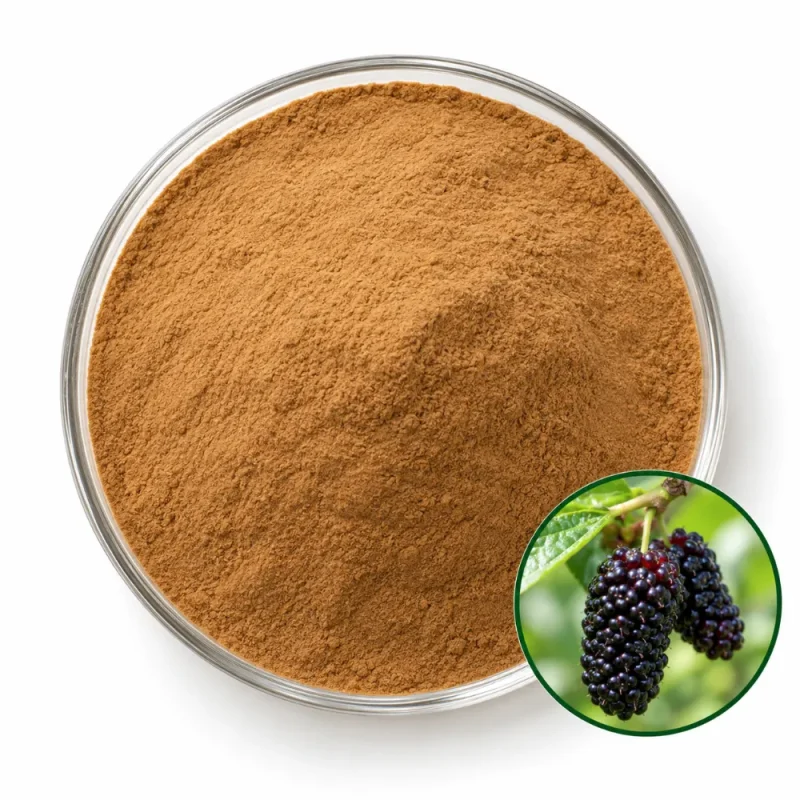
The source is the fruit of Morus alba L., white mulberry, a tree of the family Moraceae. The fruit is a soft, juicy multiple fruit that ripens from white or pink to deep purple. The fruit is the only plant part used here, and the leaf, twig and root bark of the same tree are separate raw materials with different chemistry. Black mulberry, Morus nigra, and paper mulberry, Broussonetia papyrifera, are different species.
Mulberry fruit is rich in free sugars, mainly glucose and fructose, along with organic acids, pectin and anthocyanins, chiefly cyanidin glycosides. Hot-water extraction pulls the polar part of this mix into solution, and ethanol precipitation keeps the large polymers while the small sugars and acids remain in the supernatant. Mulberry fruit polysaccharide is described as a pectin-like heteropolysaccharide with galacturonic acid in the backbone and arabinose and galactose in side chains.
Mulberry fruit is also notable for its softness and high water content, which makes fresh handling difficult. Fruit is frozen or dried soon after picking, and the quality of the polysaccharide fraction depends on how quickly the fruit was stabilized, since fermentation consumes sugars and changes the extract. Cultivars range from white to nearly black, and none is named for this product.
The pigment is the visible difference from other fruit fractions. Purification reduces it, and the finished powder keeps a purple-red tone from residual anthocyanins and condensed color compounds.
Related materials serve other questions. Mulberry Fruit Extract Powder keeps the whole water extract, Mulberry Twig Extract Powder comes from the twig, and Paper Mulberry Fruit Extract Powder comes from a different genus.