Botanical powders are made by cleaning, drying, milling and sieving identified plant material into defined grades, and every stage affects moisture, particle size, handling and consistency. The botanical powder manufacturing process is more than grinding dried herbs: raw-material preparation sets the condition of the starting material, drying reduces moisture, milling changes physical properties and sieving controls particle classification. Understanding these operations helps supplement manufacturers, food formulators and buyers evaluate specifications, compare grades and choose powders that perform consistently.
From Raw Plants to Finished Powder
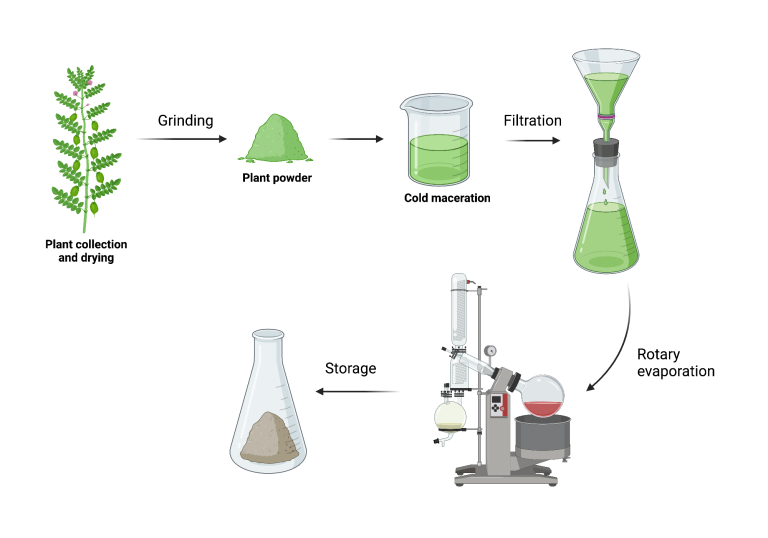
Whole botanical powders typically move from identification through cleaning and preparation, drying, milling, sieving and quality testing to packaging. Unlike extracts, mechanically milled powders keep much of the original plant matrix with no extraction or concentration step, which shapes their composition, physical behavior and formulation needs. For ingredient forms and applications, see Botanical Powders Explained.
Manufacturing Steps and Control Points
| Processing Stage | Main Purpose | Key Quality Considerations |
|---|---|---|
| Raw material preparation | Verify identity and prepare plant material | Species, plant part, foreign matter |
| Drying | Reduce moisture before grinding | Drying conditions, moisture endpoint |
| Milling | Reduce material to smaller particles | Particle size, heat generation |
| Sieving | Classify particles and remove oversized material | Sieve aperture, percentage passing |
| Quality testing | Verify agreed specifications | Identity, microbiology, physical properties, contaminants |
| Packaging | Protect the finished powder | Moisture protection, storage, traceability |
The exact sequence depends on species, plant part, equipment and application; some materials need extra cutting, microbial reduction or tighter particle classification.
Step 1: Preparing the Plant Material
Consistent production starts with correctly identified material. Species, growing conditions, harvest maturity and post-harvest handling all influence composition and processing behavior, which matters for repeat commercial supply.
Botanical Identity and Initial Preparation
Identify the ingredient by accepted scientific name and plant part: Morus alba L. leaf powder differs from mulberry fruit powder, and Taraxacum officinale root powder is not interchangeable with dandelion leaf material. USP General Chapter <563> describes identification through morphological, histological and chemical characteristics, which may involve visual examination, microscopy, chromatographic fingerprinting or other methods. Once identified, material may be sorted, cleaned, trimmed and cut — fibrous roots often need preliminary size reduction, while delicate leaves need gentler handling.
Harvest and Post-Harvest Handling
Material should be handled and held under conditions suited to the species and plant part, since delays, excess moisture and poor storage can lead to deterioration or contamination. The American Herbal Products Association’s GACP-GMP guidance covers identification, harvesting, post-harvest handling, cleaning and quality practices. Commercially, what matters is the harvested plant part, handling before drying and the link between incoming material and its source — the chain our Sourcing & Traceability page describes from source information and incoming lots to processing records and finished batches.
Foreign Matter and Cross-Contact Control
Agricultural material can contain soil, stones, unintended plant fragments or other foreign matter. Controls may include visual sorting, screening (separating by particle dimension), magnetic separation (capturing ferromagnetic contaminants) and metal detection (an additional safeguard against some metallic objects). Equipment cleaning, segregation and controlled changeovers reduce cross-contact. No single method removes every risk, so controls should follow the material, equipment and hazard assessment.
Step 2: Drying the Botanicals
Drying removes moisture before milling and sets up suitable conditions for processing and storage. Too much residual moisture causes clumping, inefficient grinding or deterioration; too much heat or exposure can alter pigments, aroma compounds and sensitive constituents. The aim is a defined endpoint that keeps the characteristics the finished ingredient needs.
Common Drying Methods
| Drying Method | Main Characteristics | Limitations |
|---|---|---|
| Air or shade drying | Uses ambient or controlled airflow | Slower and affected by environmental conditions |
| Hot-air drying | Uses heated circulating air | Excessive heat may affect sensitive compounds |
| Vacuum drying | Removes moisture under reduced pressure | Higher equipment complexity and cost |
| Freeze drying | Removes frozen water primarily through sublimation | Greater energy demand, cost, and processing time |
No method suits every botanical; the choice depends on plant structure, moisture behavior, thermal sensitivity and required quality. A review of drying methods for herbal plants in Materials Today: Proceedings examines how drying technologies affect essential oils, antioxidant characteristics, color and aroma, reinforcing that conditions should be chosen for the material.
Controlling Moisture Without Compromising Quality
Temperature, airflow, residence time and loading govern moisture removal and the material’s exposure. Thin leaves dry fairly quickly; dense roots need attention to cut size and internal moisture distribution; oil-rich seeds bring handling and oxidation concerns. The endpoint should follow the botanical and its specification, and a lower temperature does not automatically mean better quality — the right conditions depend on constituents, processing behavior and required characteristics.
Moisture Content, Water Activity, and Loss on Drying
Moisture content is the amount of water present. Water activity (aw) describes how available that water is, relevant to microbial growth potential and some stability characteristics; FDA’s Water Activity Technical Guide explains its relation to equilibrium vapor pressure and water binding, and two powders with similar moisture can differ in aw because their constituents bind water differently. Loss on drying (LOD) measures mass lost under specified conditions and, per USP General Chapter <731> Loss on Drying, can include volatiles other than water — relevant for aromatic botanicals. Compare moisture-related values only on clearly defined methods. Drying also does not guarantee pathogen elimination: low water availability restricts growth, but some organisms survive, so where further microbial reduction is needed it should come from a validated process.
Step 3: Milling the Dried Material
Milling applies impact, cutting, shear or a combination to reduce dried material to the required particle characteristics without unacceptable heat or excessive breakdown.
Choosing the Right Milling Method
| Milling Method | Main Mechanism | Processing Considerations |
|---|---|---|
| Hammer mill | Mechanical impact | Feed characteristics, equipment wear, heat generation |
| Pin mill | Impact and shear | Fine grinding, operating speed, temperature control |
| Cutting mill | Cutting and shearing | Fibrous materials and preliminary size reduction |
Equipment choice depends on hardness, fiber and oil content, feed size and target particle size. Dense roots may benefit from preliminary cutting, brittle leaves fracture readily under impact, and some materials may justify low-temperature grinding where heat, oil release or other issues arise — each confirmed by material-specific evaluation.
Managing Heat and Excessive Fines
Milling generates heat as energy passes into the material, which can affect aroma, color or sensitive constituents; mill configuration, feed rate, speed and cooling all influence exposure. Finer grinding raises surface area, which can affect moisture uptake, cohesion and handling — but finer does not always mean poorer flow. A study on sieved plant powders in Food Science and Biotechnology found particle-size fractionation changed physical, flow and hydration properties, with flowability shifting in different directions for different plants. The goal is a grade suited to the application, not the smallest achievable size.
Dust Collection and Safe Powder Handling
Milling releases airborne fines that need containment and dust collection, and combustible dust may require assessment — OSHA lists certain organic materials, including food powders and spices, as potential combustible dust hazards. Equipment design, housekeeping, ventilation and preventive maintenance limit powder accumulation, with controls matched to the specific material and environment.
Step 4: Sieving and Classifying the Powder
Sieving separates milled particles by screen opening, removing oversized particles or returning them for further milling where the approved procedure allows, to establish a defined physical grade.
Understanding Mesh Size
Under U.S. standard sieve designations, higher numbers mean smaller nominal openings:
| U.S. Standard Sieve | Nominal Opening |
|---|---|
| No. 60 | 250 µm |
| No. 80 | 180 µm |
| No. 100 | 150 µm |
ASTM E11-24 sets requirements for woven-wire test sieve cloth and test sieves. Mesh describes the nominal opening, not the diameter of every particle; an 80-mesh powder does not consist of 180 µm particles.
Why Mesh Size Alone Is Not Enough
A mesh designation is most useful with a defined passing requirement — the minimum percentage of a representative sample that must pass a stated sieve, with the sieve standard, procedure and limit determining compliance. Without these, two powders labeled with the same mesh may not be comparable, and ranges such as “80–100 mesh” do not define the full distribution. Where closer control is needed, particle size distribution (PSD) testing reports D10, D50 (median) and D90. Interpret them by method: laser diffraction usually reports volume-based distributions and sieve analysis mass fractions, so results from different methods should not be compared directly. Our guide to Botanical Powder Particle Size & Mesh Size covers specification in detail.
Managing Oversized Particles and Rework
Oversize returned for re-milling should be controlled to avoid extra mechanical exposure, unintended batch mixing or shifts in particle characteristics. Manufacturers should set handling procedures, keep lot records and verify that the final powder meets the agreed specification.
Quality Testing and Batch Verification
Process records explain how a batch was made; analytical results show whether its tested characteristics meet acceptance criteria. Reviewing both helps investigate unexpected changes in moisture, particle size or handling.
Connecting Processing Stages to Quality Checks
| Quality Requirement | Related Stage | Possible Verification |
|---|---|---|
| Botanical identity | Incoming material | Microscopy, chromatography, or suitable identity methods |
| Moisture or LOD | Drying and storage | Appropriate analytical determination |
| Particle size | Milling and sieving | Sieve analysis or PSD measurement |
| Microbiological quality | Material handling and applicable process controls | Microbial testing and process verification |
| Heavy metals | Raw material and contamination controls | Element-specific analytical testing |
| Pesticide residues | Agricultural sourcing | Relevant residue analysis |
| Physical properties | Finished powder | Appearance, density, flow, particle characteristics |
Methods and criteria should match the botanical, application, customer specification and applicable requirements — for example ICP-MS for elemental contaminants and suitable chromatographic methods for pesticides — and not every ingredient needs the same panel (see contaminant testing for botanical ingredients). Our Quality & Testing page covers identification, physical specifications, contamination testing and batch review.
Why Representative Sampling Matters
A result is only as useful as the sample is representative; variation in moisture, particle size, segregation or handling can affect uniformity, so sampling should reflect the material, batch configuration and analytical purpose. For applicable U.S. supplement operations, 21 CFR 111.80 sets requirements for representative samples. Buyers should check that results correspond to the supplied lot and that sampling suits the specified characteristics.
Microbial Testing and Process Control
Microbial testing evaluates the sample against criteria; a validated microbial reduction process aims to achieve a specified reduction through controlled treatment. Where treatment is needed it should suit the botanical and be supported by process verification. Drying alone should not be assumed to eliminate pathogens, and a good microbiological result does not replace preventive controls.
Understanding the COA and Batch Records
The approved specification sets parameters and acceptance criteria; the COA records results for an identified batch. Review identity, lot number, methods, limits and actual results, remembering that a COA does not replace process controls, representative sampling or source-to-batch traceability. The relevant provisions of 21 CFR Part 111 apply within their regulatory scope rather than setting identical worldwide testing rules. See How to Read a Botanical Extract COA.
Packaging and Storage After Processing
After release, powder should be packed to protect its specified characteristics, limiting moisture uptake, contamination and exposure that could affect sensitive constituents. Consider packaging compatibility, barrier performance, seal integrity, storage temperature, humidity and transport conditions.
Shelf Life and Storage Requirements
Shelf life should rest on product-specific evidence, not the drying method alone, because composition, residual moisture, water activity, packaging and storage all affect stability. Some commercially supplied leaf and root powders have published shelf lives of up to 24 months under specified packaging and storage conditions, but that is not a universal figure. The approved specification should state storage requirements, shelf-life information, packaging expectations and lot identification.
How Processing Affects Formulation Performance
Meeting identity requirements does not make a powder suitable for a given formula; particle size, density, flow and moisture govern mixing, filling, compression and dispersion.
Bulk Density, Tapped Density, and Powder Flow
Bulk density relates mass to unsettled volume including inter-particle space; tapped density is measured after a specified tapping procedure and indicates packing behavior. Both help assess volumetric filling and consolidation, and USP General Chapter <616> Bulk Density and Tapped Density of Powders gives standard procedures. Density alone does not predict behavior in every process, so capsule and sachet work may also include flow testing under relevant conditions.
Application-Specific Powder Performance
In capsules and tablets, density, flow, PSD and compactability affect feeding, filling, compression and weight consistency. In dry blends, differences in size, shape and density can cause segregation during mixing or transfer. In functional beverages, whole powders keep insoluble solids and usually disperse rather than dissolve, with particle size affecting wetting, sedimentation, redispersion and mouthfeel. The best powder is the one that meets the formula’s processing and performance needs, which is not necessarily the finest grade.
Comparing Leaf and Root Powder Specifications
Two of our products, Mulberry Leaf Powder and Dandelion Root Powder, show how published specifications differ by plant material and grade.
| Specification | Mulberry Leaf Powder | Dandelion Root Powder |
|---|---|---|
| Botanical Name | Morus alba L. | Taraxacum officinale F.H. Wigg. |
| Plant Part | Leaf | Root |
| Ingredient Form | Non-extracted whole-leaf powder | Non-extracted root powder |
| Published Particle Size | 80–100 mesh | 60–80 mesh |
| Published Moisture Limit | ≤5.0% | Not stated in the public product specification |
| Appearance | Green to yellow-green | Yellow-brown to brown |
| Water Behavior | Dispersible, not fully soluble | Dispersible, not fully soluble |
Source: Essencefield Botanicals published product specifications. Confirm current grades, limits and batch results through the applicable commercial documents.
What These Specifications Mean for Buyers
Mulberry leaf powder keeps the leaf matrix, including insoluble fiber and green pigments, and its published mesh and moisture figures are a starting point for assessing processing behavior. Dandelion root powder keeps the root matrix at 60–80 mesh, and its fibrous composition, earthy sensory profile and suspended solids may affect formulation. These figures do not reveal which mills or drying conditions were used, so confirm how each mesh grade is defined and test representative samples under the intended conditions.
Common Processing Problems
| Problem | Possible Causes | What to Check |
|---|---|---|
| Powder caking | Residual moisture, humidity exposure, cohesive fines | Moisture, water activity, packaging |
| Uneven particle size | Milling variation, screening problems | Process controls, sieve analysis |
| Poor powder flow | Cohesive particles, irregular shape, moisture | Density, PSD, flow testing |
| Color or aroma changes | Heat exposure, oxidation | Processing conditions, storage |
| Excessive dust | High fine-particle fraction, handling conditions | Particle distribution, dust controls |
| Batch variability | Raw material or processing differences | Specifications, source records, batch history |
Caking that develops after packaging, for example, may come from moisture absorbed in storage, so changing the milling grade would not necessarily fix it; inconsistent capsule filling may involve bulk density or cohesion rather than mesh. Good investigations link the observed problem to analytical results, handling conditions and processing records.
What Buyers Should Verify Before Bulk Ordering
- Botanical identity: scientific name, plant part, and whole-powder or extract format.
- Physical specifications: defined particle-size requirements, moisture or LOD and relevant powder properties.
- Quality documentation: product specification, suitable methods and batch-specific results.
- Sample performance: evaluation under representative formulation or manufacturing conditions.
- Commercial consistency: lot traceability, specification continuity and supply change controls.
When several grades are available, our Specification & Grade Matching service compares identity, particle characteristics, analytical requirements and formulation needs. A representative sample establishes initial suitability but does not replace verification of the commercial batch, and the evaluated sample and later supply should be linked through an agreed specification. For the move from lab evaluation to purchasing, our Sample & Bulk Supply service covers samples, trial quantities, documentation and bulk supply.
Request Botanical Powder Specifications or Samples
Good botanical powder depends on proper raw-material preparation, controlled drying, effective milling and reliable classification, backed by contamination controls, representative sampling, testing and protective packaging. Browse our Botanical Powders, then contact Essencefield Botanicals with your species, plant part, mesh requirement and application to request a specification, representative COA or sample.