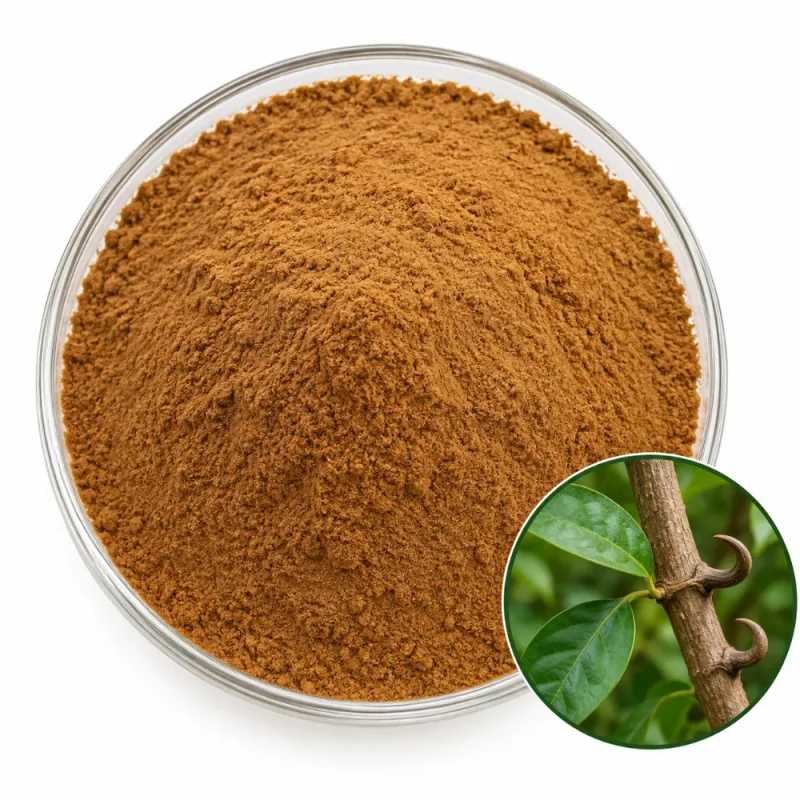
Cat’s Claw Extract Powder

Cat’s Claw extract starts from the bark of Uncaria tomentosa, a woody vine of the Amazon basin, with the leaves, roots and the whole vine excluded. Water extraction concentrates the soluble bark fraction, and the liquor is dried into a light brown powder that disperses in water.

The extract is supplied at a 10:1 ratio with no alkaloid percentage and is milled to 80 mesh. An alkaloid-defined Cat’s Claw extract is a separate standardized product, and a milled bark powder covers the unextracted material.

Uncaria tomentosa Identity & Plant Part

The botanical entity is Uncaria tomentosa (Willd. ex Schult.) DC., uña de gato, a climbing vine of the Rubiaceae whose paired thorns give it the claw name. The part used is the bark of the stem. Leaves, roots and whole-vine material are not part of this ingredient.

The identity point buyers meet most often is the second claw species. Uncaria guianensis is a different plant, sold under the same common name, and its alkaloid profile differs. Cat’s Claw bark carries oxindole alkaloids, polyphenols and glycosides, named only as constituent families. Alkaloid type matters in this species, which is why a bare extract name leaves the specification open. Bark is the part with the long record of trade under this name, and it is the part this extract is made from.

Cat’s Claw Extract vs Powder & Grades

FormWhat It IsChoose It When
10:1 Bark ExtractWater-extracted, concentrated and dried Cat’s Claw barkA whole-bark ratio extract without an alkaloid figure is wanted
Cat’s Claw Extract 3–4% Total Alkaloids / POA-standardized gradesBark extract standardized to an alkaloid rangeThe specification names an alkaloid figure
Cat’s Claw Bark PowderDried, milled Cat’s Claw bark with no extractionA bark powder with fiber is wanted at higher inclusion

The 10:1 ratio records how concentrated the extract is against the bark. It says nothing about oxindole alkaloids, so any labelled alkaloid figure belongs to the standardized grade. Alkaloid type matters in this species, and a ratio extract cannot answer it.

The siblings change the basis of the specification. The standardized extract adds a defined alkaloid range, the bark powder is milled plant material with its fiber, and this Cat’s Claw ratio extract names only the part and the ratio.

Typical Specifications

Specification ItemProduct Information
Latin NameUncaria tomentosa
Plant PartBark & Stem
ProcessingWater Extraction
Common NameCat’s Claw Bark
Ingredient TypeRatio Extract
Extract Ratio10:1
AppearanceLight brown powder
Solubility / DispersibilityWater Dispersible
Quality Parameters
Moisture (LOD)≤5.0%
Total Ash≤5.0%
Particle Size80 mesh
Heavy MetalsLead ≤2 ppm · Arsenic ≤1 ppm · Cadmium ≤1 ppm · Mercury ≤0.1 ppm
MicrobiologyTPC ≤1,000 cfu/g · Yeast & Mold ≤100 cfu/g · E. coli Negative · Salmonella Negative/25 g
Shelf Life24 months in unopened original packaging, cool and dry storage

Application Areas

Bark Extract Capsules

Cat’s Claw extract fills into two-piece capsules as a light brown powder that disperses in water. Run disintegration on the finished fill, since the extract disperses rather than dissolves. A flow aid in the premix keeps the fill weight steady because fine bark extracts tend to bridge in a hopper.

Compressed Tablets

The brown tint speckles white cores, so a coating step or a tinted base is common. A dry granulation route avoids extra moisture, which makes the Cat’s Claw extract tacky, and microcrystalline cellulose with a disintegrant carries the compression.

Powder Stick Blends

In single-serve sticks the extract pairs with earthy or cocoa-style bases that cover its woody, bitter note. It disperses to a hazy brown liquid and does not clear, so opaque, flavored mixes suit it better than clear ones.

Cocoa-Style Drink Mixes

Chocolate and malt bases hide the tannin edge of bark extracts better than citrus or mint does. Add the extract to the dry blend before the sweetener so the bark note spreads evenly through the mix.

Bark Tea-Style Mixes

Tea-style instant mixes use the extract as a dark, woody base, with cinnamon or clove flavors that suit the bark note. The liquid dissolves in part and stays hazy, so it is served as an opaque infusion rather than a clear tea.

Formulation Notes

Cat’s Claw extract is a light brown powder with a woody, slightly tannic aroma and a bitter, astringent taste. In water it disperses to a hazy brown liquid, and a fine deposit builds slowly at the base of the glass. The tannin-like bark phenolics add astringency, which sets the practical dose range in flavored products.

Blend the Cat’s Claw extract with a flowing carrier ahead of capsule filling, since bridging stops the hopper. In drink blends, add it to the dry mix early so the bark note spreads evenly. After opening, reseal the pack at every draw, because a water extract of bark takes up moisture, clumps and darkens at the surface.

Packaging & Commercial Supply

Essencefield supports product evaluation, formulation trials, commercial orders, and ongoing ingredient supply. Packaging, storage, and shipping arrangements are determined by product characteristics, order quantity, stability requirements, and destination-market needs.

Supply ItemGeneral Information
SampleAvailable upon request for formulation, testing, and supplier evaluation
Order Quantities100 g · 1 kg · 5 kg · 25 kg · 100 kg · 500 kg · Bulk
Sample Lead TimeTypically 5–7 days after sample confirmation
Production Lead TimeTypically 15–30 days after order and specification confirmation
PackagingSuitable protective inner packaging with bags, cartons, drums, or other appropriate outer packaging
StorageStore in tightly sealed, suitable protective packaging in a cool, dry environment. Protect from moisture, heat, and direct sunlight. Specific storage conditions follow the approved product specification.
DocumentationCOA · Product Specification · TDS · SDS · Applicable declarations (as applicable)

Final order quantities, lead times, packaging, documentation, and shipping arrangements are confirmed according to the selected product and commercial requirements.

Request Ingredient Specifications & Quote

Share your target specification, application, quantity, and documentation needs. We’ll help confirm suitable options, samples, and commercial supply details.