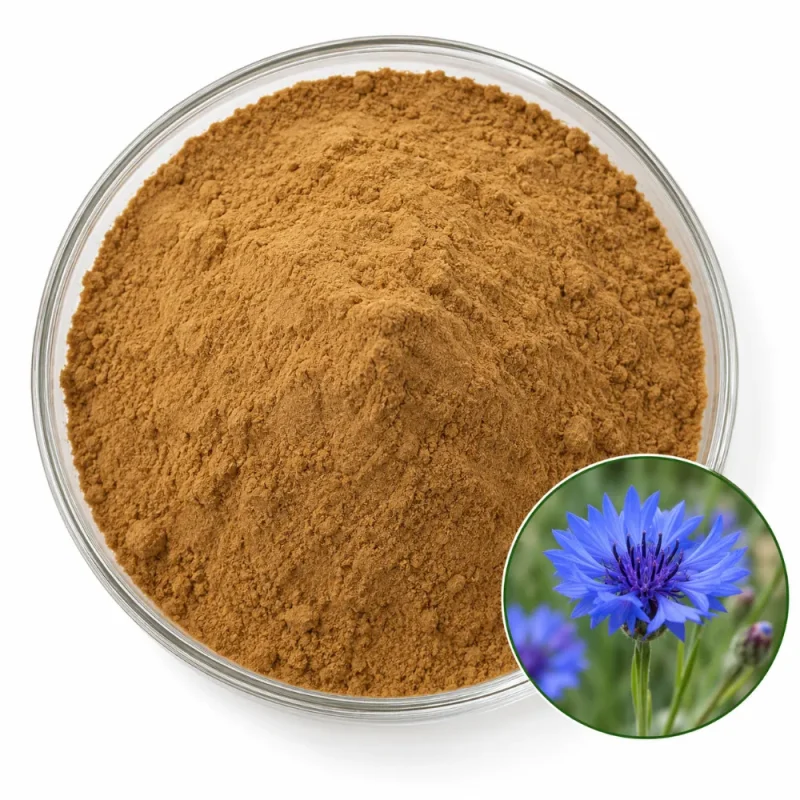
Cornflower Extract Powder

Cornflower extract starts from the flower of Centaurea cyanus, the blue-flowered annual of European cornfields, with the stems, leaves and roots excluded. Water extraction concentrates the soluble flower fraction, and the liquor is dried into a light yellow powder that disperses in water.

The extract is supplied at a 10:1 ratio with no marker percentage and is milled to 80 mesh. It is a plain flower extract, and the powder is light yellow as supplied, not blue, because the petal pigment is pH-sensitive.

Centaurea cyanus Identity & Plant Part

The botanical entity is Centaurea cyanus L., the cornflower or bachelor’s button, an annual of the Asteraceae with slender gray-green leaves and bright blue flower heads. The part used is the flower. Stems, leaves and roots are not part of this ingredient.

The blue of the petals comes from an anthocyanin pigment that shifts color with pH, so the dried flower looks blue while a water extract of it can look pale. Cornflower extract carries anthocyanins, flavonoids such as apigenin glycosides, sesquiterpene lactones and coumarins, named only as families. Other Centaurea species are different plants, and some blue-flowered species elsewhere share the cornflower name.

What 10:1 Means for Cornflower

A 10:1 cornflower extract is concentrated, but the color of the finished powder tells little about the pigment content of the flower. The petal pigment is sensitive to pH, light and heat, and the extract is a light yellow powder, so color is not a quality signal. The ratio describes concentration against the Centaurea cyanus flower and does not define anthocyanin or flavonoid content. A stated anthocyanin figure would call for a marker-based product. No powder or marker grade of the flower is listed beside it, so the ratio extract is the only form offered.

Typical Specifications

Specification ItemProduct Information
Latin NameCentaurea cyanus
Plant PartFlower
ProcessingWater Extraction
Common NameCornflower Blossom
Ingredient TypeRatio Extract
Extract Ratio10:1
AppearanceLight yellow powder
Solubility / DispersibilityWater Dispersible
Quality Parameters
Moisture (LOD)≤5.0%
Total Ash≤5.0%
Particle Size80 mesh
Heavy MetalsLead ≤2 ppm · Arsenic ≤1 ppm · Cadmium ≤1 ppm · Mercury ≤0.1 ppm
MicrobiologyTPC ≤1,000 cfu/g · Yeast & Mold ≤100 cfu/g · E. coli Negative · Salmonella Negative/25 g
Shelf Life24 months in unopened original packaging, cool and dry storage

Application Areas

Flower Extract Capsules

Cornflower extract suits two-piece capsules as a dispersible, light yellow powder. The flower fiber has been removed, so the fill is smoother than a milled flower powder would give. Weight checks during the first minutes of a run set the fill, and disintegration is checked on the finished capsule.

Floral Tea-Style Mixes

Instant tea-style mixes use the extract as a floral, honey-like base. Chamomile, lavender and rose notes blend well. The cup is a hazy pale yellow, and dry blending with a carrier keeps the dose even between sachets.

Gummy Floral Bases

Gummies carry the extract with elderflower, lemon and peach flavors that fit its soft floral note. Add it to the cooked base late. The pale yellow tint is easy to hide, but acidity can change the pigment, so finished color is checked after cooling.

Tablet Compression Blends

The extract compresses with microcrystalline cellulose and a disintegrant, and its pale tint needs no heavy coating. Dry granulation prevents surface lumps on the cornflower granules, and a light coat improves swallow feel. A short dwell time at the press gives harder, less friable floral tablets.

Stirred Drink Sachets

Sachets for stirred drinks carry the extract with citrus and berry flavors. Its pH-sensitive pigment can shift the cup toward pink in acidic drinks and toward green in alkaline ones, so pH is fixed before the final sensory check.

Formulation Notes

Cornflower extract is a light yellow powder with a faint, sweet, hay-like floral aroma and a mild, slightly bitter taste. In water it forms a pale, hazy yellow liquid, and floral fines settle slowly. Because the petal pigment responds to pH, cup color can drift in acidic or alkaline systems.

Weigh the extract in a dry room, since floral extracts attract humidity and form lumps in the scoop. Reseal the pack after every draw and keep it from direct light, which fades the sensitive pigment fraction. Premix the Centaurea cyanus extract with a flowing carrier for capsule runs to avoid bridging.

Packaging & Commercial Supply

Essencefield supports product evaluation, formulation trials, commercial orders, and ongoing ingredient supply. Packaging, storage, and shipping arrangements are determined by product characteristics, order quantity, stability requirements, and destination-market needs.

Supply ItemGeneral Information
SampleAvailable upon request for formulation, testing, and supplier evaluation
Order Quantities100 g · 1 kg · 5 kg · 25 kg · 100 kg · 500 kg · Bulk
Sample Lead TimeTypically 5–7 days after sample confirmation
Production Lead TimeTypically 15–30 days after order and specification confirmation
PackagingSuitable protective inner packaging with bags, cartons, drums, or other appropriate outer packaging
StorageStore in tightly sealed, suitable protective packaging in a cool, dry environment. Protect from moisture, heat, and direct sunlight. Specific storage conditions follow the approved product specification.
DocumentationCOA · Product Specification · TDS · SDS · Applicable declarations (as applicable)

Final order quantities, lead times, packaging, documentation, and shipping arrangements are confirmed according to the selected product and commercial requirements.

Request Ingredient Specifications & Quote

Share your target specification, application, quantity, and documentation needs. We’ll help confirm suitable options, samples, and commercial supply details.