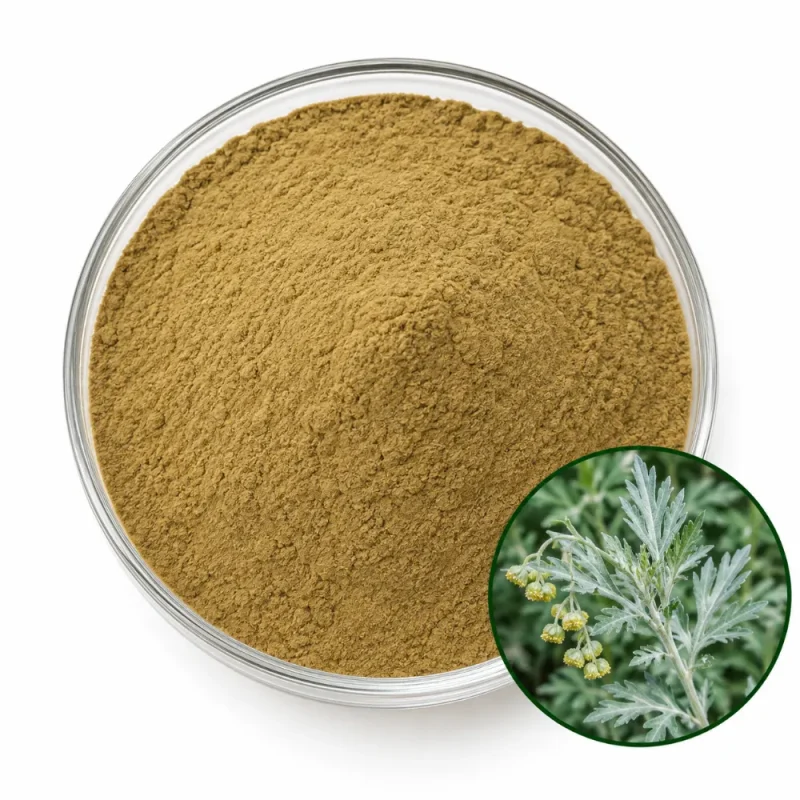
Wormwood Extract Powder

Wormwood extract is made from the aerial parts of Artemisia absinthium, the bitter herb of Europe, and not from sweet wormwood or mugwort. Water extraction concentrates the soluble herb fraction and the resulting liquor is dried to a light brown powder.

A 10:1 ratio defines this extract, supplied at 80 mesh and dispersing readily in water. This wormwood extract carries no absinthin or thujone figure, and there is no powder or standardized sibling of the same herb in the range to compare it with.

Artemisia absinthium Herb Identity & Part

The botanical entity is Artemisia absinthium L., a perennial shrubby herb of the daisy family, Asteraceae, with silvery, finely divided leaves and a strong bitter taste. The part used is the aerial portion, meaning leaves, flowering tops and thin stems, and the roots are not included in this wormwood extract. The genus Artemisia is large. Sweet wormwood, Artemisia annua, mugwort, Artemisia vulgaris, and the Chinese mugwort, Artemisia argyi, are different species with different chemistry, so the species name is the identity. Common wormwood is known for bitter sesquiterpene lactones such as absinthin, together with flavonoids, phenolic acids and an essential oil that carries thujone and is largely left out of a water extract.

Wormwood is strongly aromatic, and a freshly cut plant is easily recognized by its silvery leaves and sharp, resinous smell.

What 10:1 Means for Wormwood

The 10:1 ratio expresses how much dried herb goes into the extract and is not a content of any one compound. A water extract differs from the essential oil and from the alcoholic spirit historically made from the plant, and it concentrates bitter principles and phenolics while leaving most of the volatile oil behind. The range holds no wormwood powder and no standardized grade, so the ratio extract is the single form on offer. A buyer picks it when the formula names Artemisia absinthium and needs a dispersible, bitter botanical solid.

Typical Specifications

Specification ItemProduct Information
Latin NameArtemisia absinthium
Plant PartLeaf & Herb
ProcessingWater Extraction
Common NameWormwood, Absinthium, Common Wormwood
Ingredient TypeRatio Extract
Extract Ratio10:1
AppearanceLight Brown powder
Solubility / DispersibilityWater Dispersible
Quality Parameters
Moisture (LOD)≤5.0%
Total Ash≤5.0%
Particle Size80 mesh
Heavy MetalsLead ≤2 ppm · Arsenic ≤1 ppm · Cadmium ≤1 ppm · Mercury ≤0.1 ppm
MicrobiologyTPC ≤1,000 cfu/g · Yeast & Mold ≤100 cfu/g · E. coli Negative · Salmonella Negative/25 g
Shelf Life24 months in unopened original packaging, cool and dry storage

Application Areas

Bitter-Aperitif-Style Drink Mixes

Instant drink powders take the wormwood extract dry in tonic, ginger or grapefruit-style bases, where a pronounced bitterness is part of the concept. The cup is tan to brown and slightly hazy, and tonic-style flavors match the bitter profile.

Sealed-Shell Capsules

Wormwood is intensely bitter, so a closed capsule or a coated tablet keeps the taste away from the consumer. Room humidity is absorbed by the dry solid, and caked material does not return to a fine powder on sieving.

Herbal Tea Sticks

Powder sticks carry the extract with mint, anise or citrus flavors that cover part of the bitterness. Weight-based dosing keeps the bitterness consistent, since a bitter herb is judged on every stick. Dosing is judged by taste, so trial the stick at several levels.

Dark-Chocolate Bars

Bar lines weigh the extract into the dry blend ahead of the warm binder. Dark cocoa and coffee-style bases match the bitterness, and the fine powder spreads more evenly than milled herb. Cocoa fat softens the bitter edge and carries it across the palate.

Formulation Notes

The wormwood extract is a light brown powder with a faint herbal odor and an intensely bitter taste that lingers. In water it disperses into a tan, lightly hazy liquid, since polysaccharide fragments stay partly suspended while bitter lactones and sugars dissolve. The free-flowing powder responds quickly to humid surroundings, and caked material does not return to a fine powder on sieving.

Bitterness, not color, sets the dose in the finished product, so taste at the real inclusion level in the real matrix before approval. Sieve the powder before weighing, and fold it into a portion of the carrier ahead of the final mix. Between draws, reseal the liner against the powder and keep the drum on a dry pallet. Keep the drum apart from mild-tasting powders in storage, since a bitter, aromatic herb can taint neighbors in an open room. Keep batch records of dose, premix and sensory notes, since a taste that is acceptable at one level may not be at the next.

Packaging & Commercial Supply

Essencefield supports product evaluation, formulation trials, commercial orders, and ongoing ingredient supply. Packaging, storage, and shipping arrangements are determined by product characteristics, order quantity, stability requirements, and destination-market needs.

Supply ItemGeneral Information
SampleAvailable upon request for formulation, testing, and supplier evaluation
Order Quantities100 g · 1 kg · 5 kg · 25 kg · 100 kg · 500 kg · Bulk
Sample Lead TimeTypically 5–7 days after sample confirmation
Production Lead TimeTypically 15–30 days after order and specification confirmation
PackagingSuitable protective inner packaging with bags, cartons, drums, or other appropriate outer packaging
StorageStore in tightly sealed, suitable protective packaging in a cool, dry environment. Protect from moisture, heat, and direct sunlight. Specific storage conditions follow the approved product specification.
DocumentationCOA · Product Specification · TDS · SDS · Applicable declarations (as applicable)

Final order quantities, lead times, packaging, documentation, and shipping arrangements are confirmed according to the selected product and commercial requirements.

Request Ingredient Specifications & Quote

Share your target specification, application, quantity, and documentation needs. We’ll help confirm suitable options, samples, and commercial supply details.