Poria cocos Powder

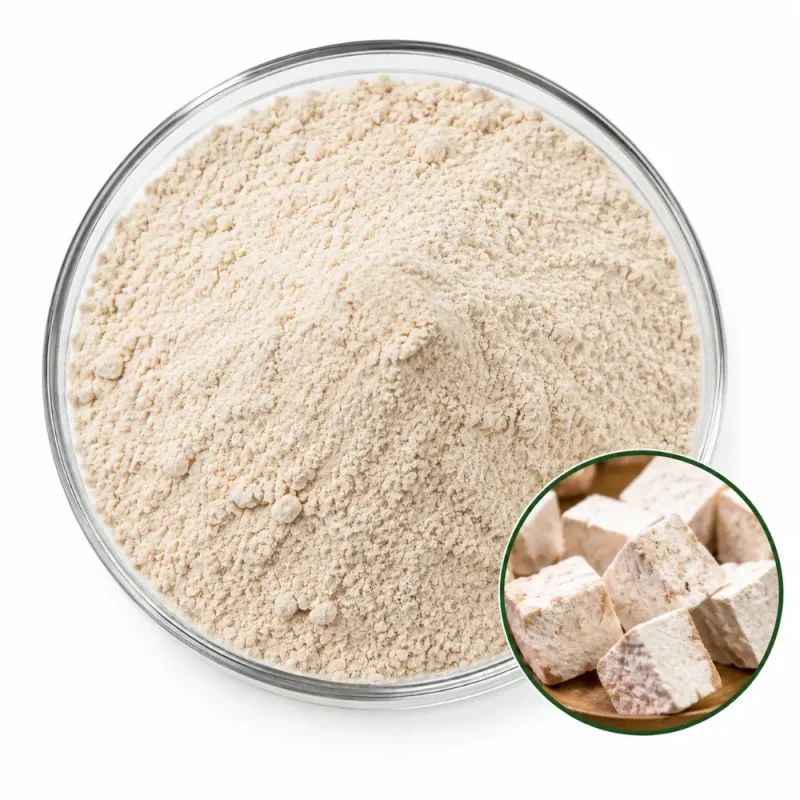
Poria cocos, the pale underground sclerotium known in Chinese herbal trade as fu ling, is dried and milled into this light yellow, nearly cream-colored powder with a bland, starchy character. The material is the compact mass of fungal tissue that grows around pine roots, so it is a mushroom-derived powder and not a plant root.

Poria cocos powder is supplied at 80 mesh, with 40, 60 and 100 mesh optional, and has a faint, earthy odor with a mild, slightly sweet, starchy taste. It is raw milled sclerotium rather than an extract, so inclusion rates are higher and the dense, fibrous character of the fungus is kept in the product.

Poria cocos Raw Material & Plant Part

The botanical name used in trade is Poria cocos F.A.Wolf, a wood-decay fungus of the family Polyporaceae in older sources. Current databases treat the name as a synonym of Wolfiporia cocos and place the fungus in the family Fomitopsidaceae, and labels may show either name. The raw material is the dried sclerotium, the hard, resting body that forms underground, which is peeled, sliced or cut and dried before milling.

The master data lists the part as fruiting body, but fu ling is a sclerotium, not the spore-bearing fruiting body of the fungus. That distinction defines the ingredient: the sclerotium is dense, starchy and nearly white, while true fruiting bodies of other polypore fungi are thin, leathery and differently flavored. The same fungus is traded as separate cuts, including the white inner part, the pinkish part close to the surface and the brown outer peel, and the white part is the one that gives the light-colored powder.

Poria is known for polysaccharides, mainly pachyman, a beta-glucan that dissolves very poorly in water, and for lanostane-type triterpene acids such as pachymic acid and dehydropachymic acid. The sclerotium also contains sterols and small amounts of other compounds. These are traits of the fungus and not levels for this powder.

Pachyman makes up much of the dry mass, which explains why the powder looks and feels like a fine starch yet does not gelatinize like one.
Poria cocos Powder vs Extract

FormWhat It IsChoose It When
Poria cocos PowderMilled dried sclerotium with its beta-glucan matrixWhole-sclerotium material in blends and capsules
Poria Cocos Extract PowderWater-extracted sclerotium with the insoluble matrix largely removedA more soluble format at a lower inclusion rate
Poria cocos Polysaccharide (Pachymaran) PowderPurified polysaccharide fractionA polysaccharide ingredient is wanted
Pachymic Acid 98%Purified single triterpene acid reference gradeAn isolated compound is needed

The sclerotium powder keeps the beta-glucan matrix, the triterpene acids and the sterols together at their natural, lower concentration. Inclusion rates are higher than for an extract, the powder is bland and neutral in color, and it only disperses in liquids because pachyman does not dissolve in water.

The extract powder concentrates the water-soluble fraction and is easier to dissolve. The polysaccharide powder isolates a defined carbohydrate fraction, and pachymic acid is a single triterpene acid that is soluble in organic solvents but not in water. Choose poria cocos powder when the whole dried sclerotium is the specification.

In sensory terms, the powder is the mildest of the forms, with almost no flavor. That neutrality is useful in dry blends, doughs and capsule fills, where it adds body without a competing taste.

Poria cocos powder is therefore the choice for blends in which a pale, bland body is wanted, and poria cocos extract powder is the choice for soluble formats. Neither form changes the species or the part on the label, and the sclerotium remains the defining raw material of poria cocos in every form.

Typical Specifications

Specification ItemProduct Information
Latin NamePoria cocos
Plant PartMushroom & Fungi
ProcessingMilled
Common NamePoria, fu ling, hoelen, tuckahoe
Raw MaterialDried sclerotium
Ingredient TypeMilled Powder
AppearanceLight Yellow powder (natural color of the dried material)
Odor & TasteFaint earthy odor; bland, slightly sweet, starchy taste
Solubility / DispersibilityWater Dispersible
Quality Parameters
Moisture (LOD)≤8.0%
Particle Size80 mesh (40 / 60 / 100 mesh optional)
Heavy MetalsLead ≤2 ppm · Arsenic ≤1 ppm · Cadmium ≤1 ppm · Mercury ≤0.1 ppm
MicrobiologyTPC ≤10,000 cfu/g · Yeast & Mold ≤1,000 cfu/g · E. coli Negative · Salmonella Negative/25 g
Shelf Life24 months in unopened original packaging, cool and dry storage

Application Areas

Herbal soup and congee mixes

Poria cocos powder is a traditional neutral-tasting addition to herbal soups, congee and rice porridges. It adds body without a strong flavor, and it pairs with yam, lotus seed or jujube, so the inclusion rate is set by texture and not by taste.

Dough, pastry and cake fillings

Pastries and traditional cakes use the powder as a pale, fine, starch-like component in doughs and fillings. It does not gelatinize, so it softens the crumb without making it gummy, and a fine mesh gives the smoothest result.

Capsule and tablet blends

Fills use the powder as a pale, bland diluent that blends invisibly with colored botanicals. It flows fairly well and compresses with a binder, so tablets of mixed herb powders often include it as a body-forming component.

Dry drink bases with neutral flavor

Powder sticks and drink bases use it for body in mildly sweet drinks with grain or nut powders. It does not dissolve, so a sediment forms on standing, and the stick is stirred before drinking.

Handling & Blending Notes

Poria cocos powder is dense, pale and fairly free-flowing, and it handles more easily than most fibrous herb powders. It still takes up moisture from the air slowly, and the beta-glucan matrix swells when it meets water, so open packs cake in humid rooms. Barrier bags, dry weighing areas and prompt resealing keep the flow good.

Fine particles dust at open scoops and hoppers, and static charge builds in dry rooms, so covered transfer and local extraction keep the dust out of the air. Because the powder is pale, it shows contamination easily and picks up color from equipment, so clean, dedicated tools are used and color carry-over from earlier runs is checked.

The powder stores well in sealed packs at a cool temperature, but yellowing and a musty note can appear after months of damp storage, so dryness is the main protection. Mesh follows the format, with 80 mesh for capsules and dry blends and 100 mesh for doughs and drink bases. Opened containers are resealed at once.

Poria cocos powder is kept in sealed liners inside cartons, in a cool and dry store. Because the powder is pale, discoloration is easy to see, and yellowing or a musty smell on opening is a reason to hold the lot. Powder from an opened pack is used within a short period.

Packaging & Commercial Supply

Essencefield supports product evaluation, formulation trials, commercial orders, and ongoing ingredient supply. Packaging, storage, and shipping arrangements are determined by product characteristics, order quantity, stability requirements, and destination-market needs.

Supply ItemGeneral Information
SampleAvailable upon request for formulation, testing, and supplier evaluation
Order Quantities100 g · 1 kg · 5 kg · 25 kg · 100 kg · 500 kg · Bulk
Sample Lead TimeTypically 5–7 days after sample confirmation
Production Lead TimeTypically 15–30 days after order and specification confirmation
PackagingSuitable protective inner packaging with bags, cartons, drums, or other appropriate outer packaging
StorageStore in tightly sealed, suitable protective packaging in a cool, dry environment. Protect from moisture, heat, and direct sunlight. Specific storage conditions follow the approved product specification.
DocumentationCOA · Product Specification · TDS · SDS · Applicable declarations (as applicable)

Final order quantities, lead times, packaging, documentation, and shipping arrangements are confirmed according to the selected product and commercial requirements.

Request Ingredient Specifications & Quote

Share your target specification, application, quantity, and documentation needs. We’ll help confirm suitable options, samples, and commercial supply details.