Ganoderma lucidum Polysaccharide Identity
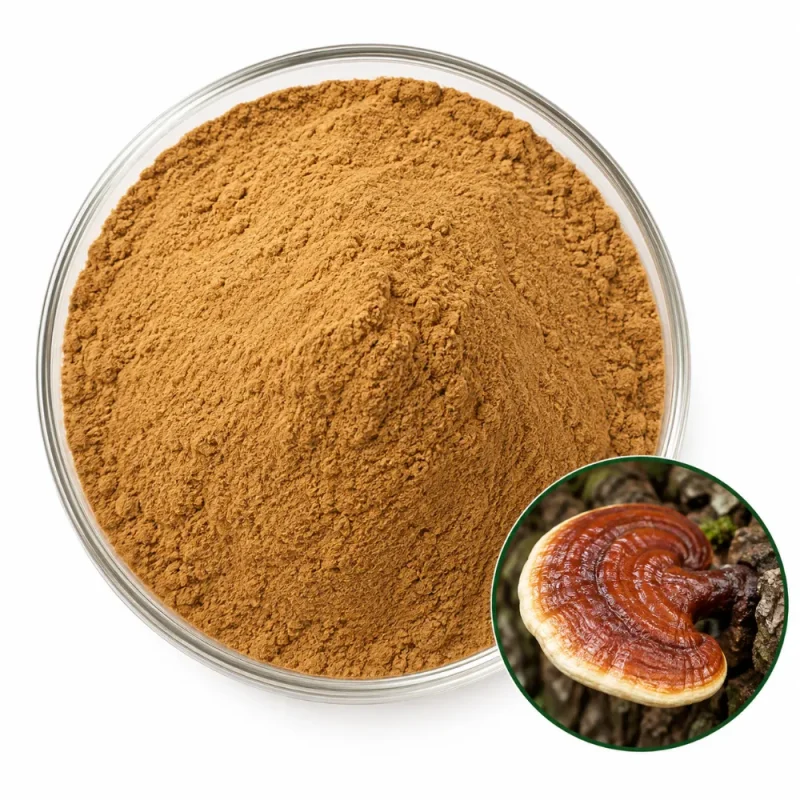
The source is the fruiting body of Ganoderma lucidum (Curtis) P.Karst., a bracket fungus of the family Polyporaceae known as reishi in Japanese and lingzhi in Chinese. The fruiting body is the visible, woody cap and stalk, and it differs from the spore powder and from grain-grown mycelium, which are separate materials. Taxonomic work treats cultivated East Asian lingzhi and the European G. lucidum as distinct species in some studies, and this ingredient is listed under Ganoderma lucidum.
The carbohydrate fraction of the fruiting body is dominated by glucans. Literature on the species describes β-glucans with a β-(1→3) backbone and β-(1→6) side branches, together with heteropolysaccharides that contain mannose, galactose and fucose, and some preparations carry a protein-bound portion. The woody structure is rich in insoluble chitin and cellulose-like fibers, so only a part of the carbohydrate is released by hot water. The extraction therefore concentrates the soluble polymers and leaves the insoluble matrix behind. What reaches the powder is a mixture of Ganoderma lucidum polysaccharides of different size and branching, not a single defined molecule. The same extract contains small amounts of protein, free sugars and minerals that purification reduces but does not remove completely.
The same mushroom is supplied in other forms. Reishi Mushroom Extract Powder is a 10:1 ratio extract with no content figure. Reishi Mushroom Powder is the milled fruiting body, and the Ganoderma lucidum Spore Powder is made from the spores. The polysaccharide powder is the choice when the water-soluble carbohydrate fraction is the defined ingredient.