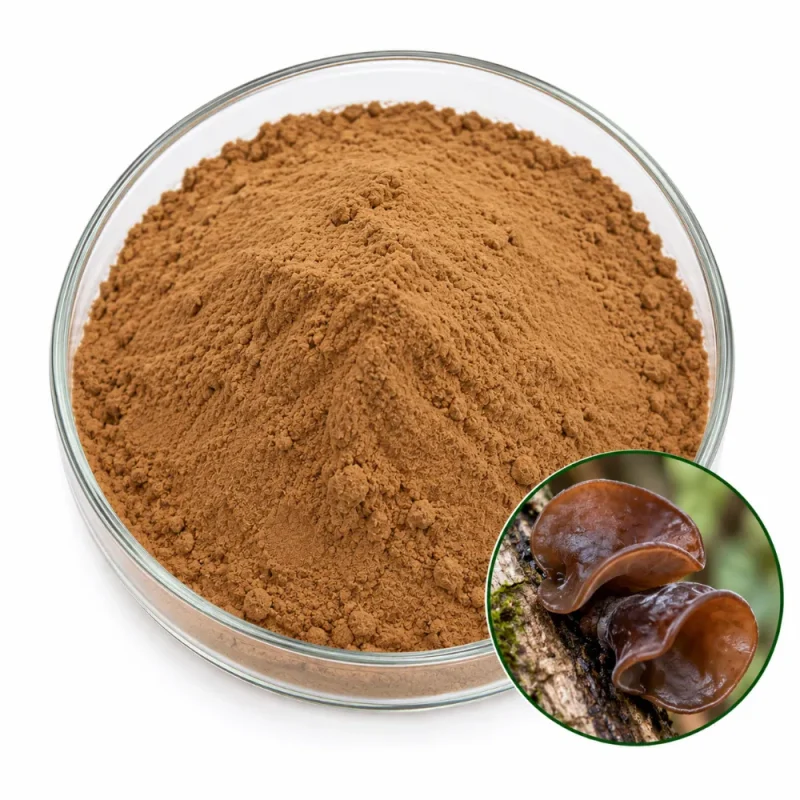
Auricularia heimuer Polysaccharide Powder

Hot-water extraction of the Auricularia heimuer fruiting body gives this polysaccharide powder, the acidic, water-holding fraction responsible for the jelly-like texture of black wood ear. It is purified, dried and milled to a fine light yellow powder that dissolves in water.

Polysaccharide content is ≥30% by UV-Vis (phenol–sulfuric, as glucose), moisture and total ash are each ≤5.0%, and the powder is milled to 80 mesh. It is supplied for dietary supplements, functional beverages and functional foods, with the percentage and the method stated together.

Auricularia heimuer Polysaccharide Identity

Auricularia heimuer polysaccharide powder is made from the fruiting body of Auricularia heimuer F.Wu, B.K.Cui & Y.C.Dai, the black wood ear that is cultivated on wood-based substrate. Auricularia heimuer fruiting body is the part used. The species was separated in 2014 from the European wood ear, Auricularia auricula-judae, to which Chinese cultivated black wood ear had been assigned before, so older literature may use the earlier name for the same crop.

The fruiting body is gelatinous when hydrated and leathery when dried, and it swells many times its dry weight in water. That behavior comes from acidic polysaccharides in the cell walls: chains containing mannose, glucuronic acid, xylose and glucose, with glucuronic acid giving the chain its charge. Glucans are also present. These polymers hold water and give the fruiting body its elastic crunch.

Hot-water extraction of Auricularia heimuer pulls these polymers into solution, and ethanol precipitation concentrates them. Chitin and cell-wall residue remain in the insoluble solid, and the dark melanin pigment of the fruiting body mostly stays behind or is removed during purification, which leaves the powder light in color.

Black wood ear is grown on logs or sawdust bags and picked when the ear is soft and fully expanded, then dried. Harvest stage influences wall thickness and polysaccharide content, and extraction always starts from dried, sorted fruiting body so that substrate and debris do not enter the powder.

No other Auricularia heimuer product is currently listed in the catalog, and this powder is the only form of the mushroom that Essencefield offers.
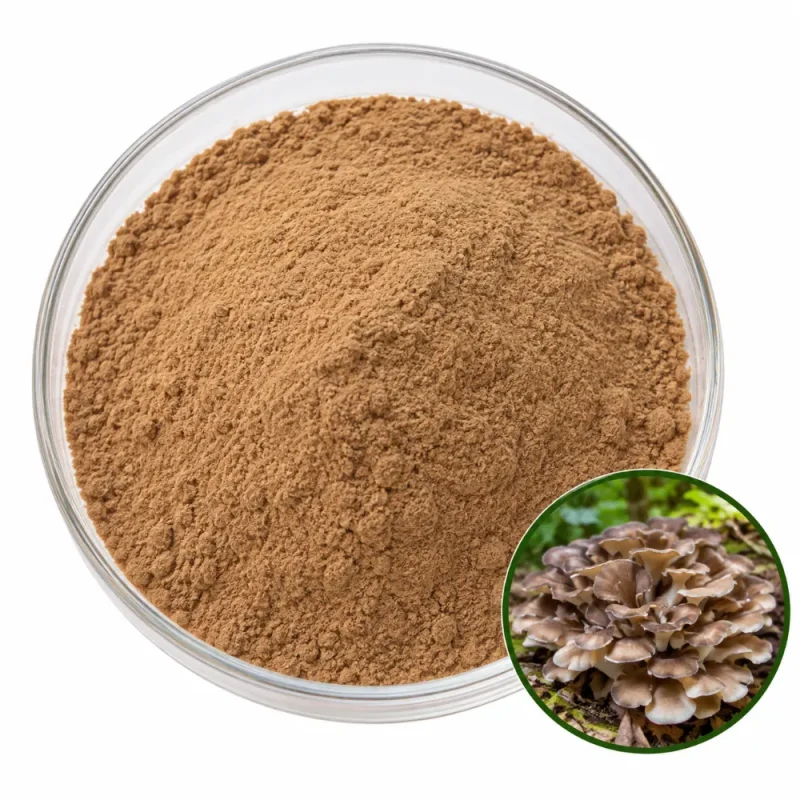
Polysaccharide Content & Test Method

The grade is defined by polysaccharides ≥30% by UV-Vis, so the number reports total carbohydrate whatever the chain type. Hot sulfuric acid hydrolyses the polymers, phenol turns the released sugars into a colored product, and absorbance is compared against glucose. The value is a glucose equivalent.

Uronic acid raises a specific issue for Auricularia heimuer. Glucuronic acid reacts differently from neutral sugars in the phenol–sulfuric method and gives a weaker color per unit mass, so an acidic polysaccharide read against a glucose curve can be underestimated. The figure is useful as a comparison between lots made the same way and is not an absolute measure of polymer mass.

The test also includes glycogen and any glucan along with the acidic polymers, so the percentage is not a β-glucan content and not a glucuronic acid content. Gravimetric precipitates would include protein, and enzymatic assays are not used for this grade. Viscous solutions are filtered and diluted before reading, which is why sample preparation is fixed for each batch.

Typical Specifications

Specification ItemProduct Information
Latin NameAuricularia heimuer
Plant PartMushroom & Fungi
ProcessingWater Extraction & Purification
Common NameBlack wood ear (Heimuer)
Ingredient TypePolysaccharide Extract
Polysaccharide TypeAcidic heteropolysaccharide (glucuronomannan-type)
ContentPolysaccharides ≥30% (UV-Vis, as glucose)
AppearanceLight Yellow powder
Solubility / DispersibilityWater Soluble
Quality Parameters
Moisture≤5.0% (LOD)
Total Ash≤5.0%
Particle Size80 mesh
Heavy MetalsLead ≤2 ppm · Arsenic ≤1 ppm · Cadmium ≤1 ppm · Mercury ≤0.1 ppm
MicrobiologyTPC ≤1,000 cfu/g · Yeast & Mold ≤100 cfu/g · E. coli Negative · Salmonella Negative/25 g
Shelf Life24 months in unopened original packaging, cool and dry storage

Auricularia heimuer Polysaccharide Solution Behavior

Auricularia heimuer polysaccharide is water soluble and gives noticeably more body than neutral glucans or fructans. The acidic chains are charged and hold water, so solutions turn viscous and slightly slippery as concentration rises, resembling the texture of the mushroom itself. The solution is pale yellow and may carry a little haze.

Dissolution is steadier when the powder is sifted into stirred water than when it is poured onto still water, where the first layer swells and slows the rest. Warm water helps. Viscosity continues to rise for several minutes after the powder seems to have dissolved, so a drink judged at once may feel thicker after standing.

Charge matters for Auricularia heimuer compatibility. The glucuronic acid groups bind calcium and other divalent cations and can interact with basic proteins, which may thicken or cloud mineral-fortified and dairy-based drinks. Neutral to mildly acidic water-based drinks are the stable case. Strong acid with heating shortens the chain and lowers viscosity.

Auricularia heimuer flavor is mild and faintly earthy. The powder is hygroscopic, so containers should be resealed after weighing. No viscosity values are stated for this grade.

Texture of Auricularia heimuer polysaccharide should be judged at the final serving temperature, since a viscous solution that feels slippery when warm can feel thicker when cold. The solution stays smooth in cold storage without forming lumps if the powder was fully dispersed before cooling, and one pass through a homogenizer removes small gel fragments.

Application Areas

Textured Instant Drinks

Auricularia heimuer polysaccharide gives a slippery body to instant drinks even at modest levels. Dissolve it in warm water with steady stirring, and judge viscosity after the drink has stood for ten minutes. The same drink feels thicker when cold, so tasting should follow the intended serving temperature.

Jelly and Pudding Bases

In jellies and puddings the acidic polymer adds water-holding and a soft, elastic mouthfeel next to agar or carrageenan. It forms only weak gels alone, so the gelling agent should be fixed first. Set time and texture are compared with a control batch after a day in the cold.

Capsule and Granule Fills

The purified powder fills capsules without the dark color and chewy fiber of milled wood ear. Dry granulation avoids the sticky surface formed on wetting, and desiccants protect stored capsules. Fill weight is checked at the start and end of each run so that the lighter powder does not drift.

Stick-Pack Mixes

Blends with sweetener or soluble fiber disperse the powder evenly so it hydrates without lumps. A barrier laminate keeps the hygroscopic powder from caking before use. Stirring before drinking redistributes any settled material in the cup.

Texture Aids in Sauce Mixes

Savory dry sauce mixes can include the powder for a little extra body after hot-water reconstitution. Salt has little effect on the neutral polymer, while strong acid thins it. Reconstitution in hot water should be tested at the intended solids level, because body builds quickly in a small volume.

Packaging & Commercial Supply

Essencefield supports product evaluation, formulation trials, commercial orders, and ongoing ingredient supply. Packaging, storage, and shipping arrangements are determined by product characteristics, order quantity, stability requirements, and destination-market needs.

Supply ItemGeneral Information
SampleAvailable upon request for formulation, testing, and supplier evaluation
Order Quantities100 g · 1 kg · 5 kg · 25 kg · 100 kg · 500 kg · Bulk
Sample Lead TimeTypically 5–7 days after sample confirmation
Production Lead TimeTypically 15–30 days after order and specification confirmation
PackagingSuitable protective inner packaging with bags, cartons, drums, or other appropriate outer packaging
StorageStore in tightly sealed, suitable protective packaging in a cool, dry environment. Protect from moisture, heat, and direct sunlight. Specific storage conditions follow the approved product specification.
DocumentationCOA · Product Specification · TDS · SDS · Applicable declarations (as applicable)

Final order quantities, lead times, packaging, documentation, and shipping arrangements are confirmed according to the selected product and commercial requirements.

Request Ingredient Specifications & Quote

Share your target specification, application, quantity, and documentation needs. We’ll help confirm suitable options, samples, and commercial supply details.