Sterculia lychnophora Polysaccharide Identity
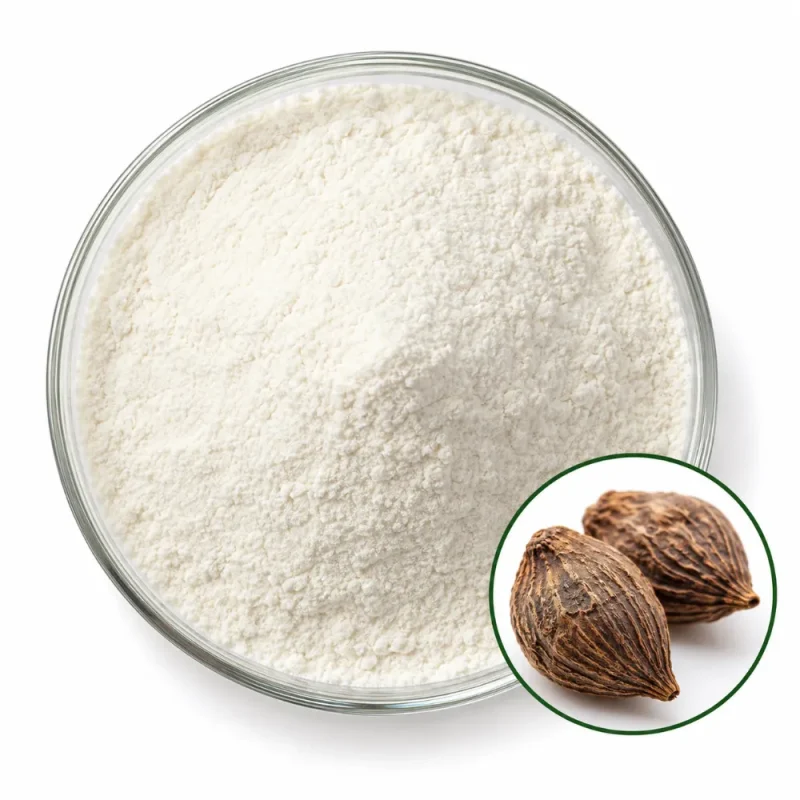
Sterculia lychnophora polysaccharide powder is made from the seed of Sterculia lychnophora Hance, known as pangdahai or malva nut, a tree of Southeast Asian forests. Sterculia lychnophora seed is the only part used. Current databases treat the name as a synonym of Scaphium affine, and the two names refer to the same plant.
The dried Sterculia lychnophora seed is wrinkled, brown and light, and it swells to many times its size within minutes of contact with water, forming a loose, sponge-like jelly. The swelling is done by the seed coat, whose cell walls hold a mucilage that can take up large amounts of water. The kernel inside is a different tissue and contributes much less of the swelling.
The mucilage is a pectin-like heteropolysaccharide built from galactose, arabinose, rhamnose and galacturonic acid, together with a calcium-sensitive, partly insoluble fraction often described as bassorin-type. The balance of water-soluble and swelling-only material controls whether the product dissolves or only disperses, which is why it is described as water dispersible.
The name causes confusion with other Sterculia products. Karaya gum comes from the bark exudate of Sterculia urens, a different material with a different use, and it is not part of this powder. Seeds are harvested when the fruit follicles split and are dried carefully so that the seed coat stays intact until extraction.
No other Sterculia lychnophora product is currently listed in the catalog, and this powder is the only form of the seed that Essencefield offers.