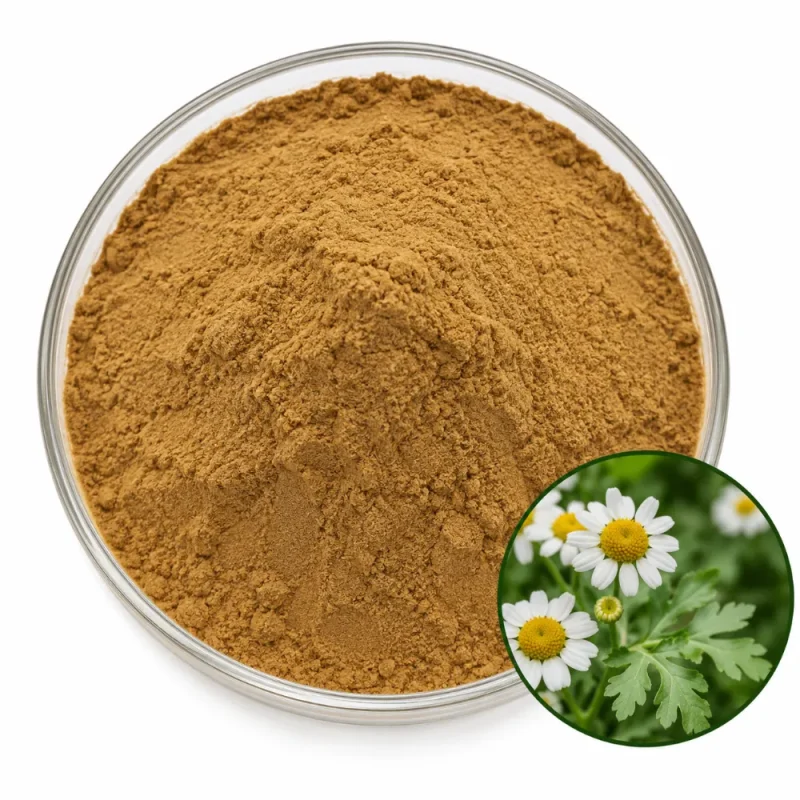
Feverfew Extract Powder

Feverfew extract starts from the aerial parts of Tanacetum parthenium, the daisy-like herb with feathery leaves and small white flowers, with the root excluded. Water extraction concentrates the soluble herb fraction, and the liquor is dried into a light brown powder that disperses in water.

The extract is supplied at a 10:1 ratio with no parthenolide percentage and is milled to 80 mesh. A parthenolide-defined feverfew extract, a milled herb powder and a purified parthenolide compound are separate products, so this is the plain whole-herb ratio option.

Tanacetum parthenium Identity & Plant Part

The botanical entity is Tanacetum parthenium (L.) Sch.Bip., feverfew, a short-lived aromatic perennial of the Asteraceae with divided, yellow-green leaves and button-shaped flower heads with white rays. It was long listed as Chrysanthemum parthenium. The part used is the aerial part. The root is not part of this ingredient.

Feverfew is easily confused with other daisy-like herbs, including tansy, Tanacetum vulgare, and with chamomile, which is why the botanical name matters. The herb carries parthenolide, a sesquiterpene lactone, along with volatile oil and flavonoids, named only as constituent families. Parthenolide is unstable to heat, acid and alkali, which shapes how an extract is made.

Feverfew is gathered as the flowering herb and dried before extraction, and the dried aerial parts are the starting material for the ratio extract.

Feverfew Extract vs Powder & Parthenolide

FormWhat It IsChoose It When
10:1 Herb ExtractWater-extracted, concentrated and dried feverfew herbA whole-herb ratio extract without a marker is wanted
Feverfew Extract 0.5–1% ParthenolideHerb extract standardized to a parthenolide rangeThe specification names a parthenolide figure
Feverfew Herb PowderDried, milled feverfew herb with no extractionA herb powder with fiber is wanted at higher inclusion
ParthenolidePurified sesquiterpene lactone compoundA single high-purity compound is the target

The 10:1 ratio expresses how far the feverfew herb has been concentrated. It does not report parthenolide. Because that lactone dissolves poorly in water, a water extract is a weak carrier of it, and the labelled figure belongs to the standardized grade or to the purified product.

The three siblings change the basis of the specification. The standardized extract adds a defined lactone range, the herb powder keeps fiber, and the purified compound removes the herb matrix. This Tanacetum parthenium ratio extract names only the part and the ratio.

Typical Specifications

Specification ItemProduct Information
Latin NameTanacetum parthenium
Plant PartLeaf & Herb
ProcessingWater Extraction
Common NameFeverfew Herb
Ingredient TypeRatio Extract
Extract Ratio10:1
AppearanceLight brown powder
Solubility / DispersibilityWater Dispersible
Quality Parameters
Moisture (LOD)≤5.0%
Total Ash≤5.0%
Particle Size80 mesh
Heavy MetalsLead ≤2 ppm · Arsenic ≤1 ppm · Cadmium ≤1 ppm · Mercury ≤0.1 ppm
MicrobiologyTPC ≤1,000 cfu/g · Yeast & Mold ≤100 cfu/g · E. coli Negative · Salmonella Negative/25 g
Shelf Life24 months in unopened original packaging, cool and dry storage

Application Areas

Herb Extract Capsules

Feverfew extract goes into two-piece capsules as a dispersible light brown powder. The feathery, aromatic herb gives a light, fine powder, so fill weights are confirmed in the first minutes of a run. Disintegration is tested on the finished capsule.

Coated Tablet Blends

Tablet excipients are microcrystalline cellulose and a disintegrant, chosen to keep the bitter powder inside a coated core. A film coat hides the brown tint and the pronounced bitter taste of the herb. Dry granulation keeps the Tanacetum parthenium powder from absorbing moisture before compression.

Tea-Style Instant Mixes

Instant tea-style powders use the extract as a bitter, camphor-like herbal base. Lemon, apple and mint flavors cover the edge. The cup is hazy tan, and a carrier in the dry blend keeps the dose uniform between sachets.

Powder Stick Premixes

Drink sticks combine the extract with strongly flavored, sweetened bases such as berry or cola. The bitter note limits the dose in lightly flavored drinks, so the range is tested in the final base. Dose is tested in the final flavored base before the stick format is fixed.

Gummy Base Blends

Gummies hide the herb’s bitterness in dark fruit flavors. Add the extract late in the cooked base to limit heat, and judge taste after the gel has set, because bitterness strengthens as the gummy cools.

Formulation Notes

Feverfew extract is a light brown powder with a faint, camphor-like and herbal aroma and a markedly bitter taste. In water it forms a hazy tan liquid, with a little sediment of herb fines on standing. Bitterness sets the sensory limit for feverfew and caps the dose that a flavored formula can carry.

Sesquiterpene lactones degrade with heat, strong acid and alkali, so feverfew blends avoid long hot holds and extreme pH. As an Asteraceae herb, feverfew is also relevant to allergy labeling rules in some markets. Keep weighing to a dry room, close the liner after every draw, and store the pack out of heat and direct light.

Feverfew extract is weighed in a dry room, and opened packs are kept closed between draws to limit moisture pickup.

Packaging & Commercial Supply

Essencefield supports product evaluation, formulation trials, commercial orders, and ongoing ingredient supply. Packaging, storage, and shipping arrangements are determined by product characteristics, order quantity, stability requirements, and destination-market needs.

Supply ItemGeneral Information
SampleAvailable upon request for formulation, testing, and supplier evaluation
Order Quantities100 g · 1 kg · 5 kg · 25 kg · 100 kg · 500 kg · Bulk
Sample Lead TimeTypically 5–7 days after sample confirmation
Production Lead TimeTypically 15–30 days after order and specification confirmation
PackagingSuitable protective inner packaging with bags, cartons, drums, or other appropriate outer packaging
StorageStore in tightly sealed, suitable protective packaging in a cool, dry environment. Protect from moisture, heat, and direct sunlight. Specific storage conditions follow the approved product specification.
DocumentationCOA · Product Specification · TDS · SDS · Applicable declarations (as applicable)

Final order quantities, lead times, packaging, documentation, and shipping arrangements are confirmed according to the selected product and commercial requirements.

Request Ingredient Specifications & Quote

Share your target specification, application, quantity, and documentation needs. We’ll help confirm suitable options, samples, and commercial supply details.