Lycopene

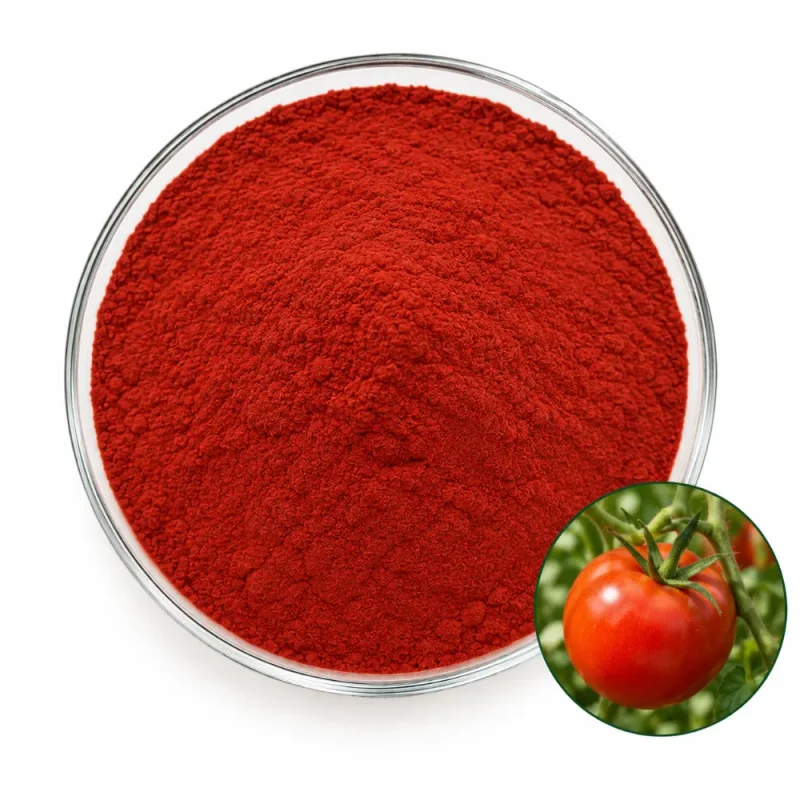
The red acyclic carotene of ripe tomato is the source of this lycopene, which is isolated from the fruit of Solanum lycopersicum by solvent extraction and purification. It has no end rings and no oxygen atoms, which sets it apart from the xanthophylls, and it is supplied as a dark red crystalline powder.

The primary grade is 90% lycopene by HPLC, in Food / Dietary Supplement Grade. The powder does not dissolve in water but dissolves in fat. As a carotenoid crystal it is graded by content, and its stability under light, heat and oxygen decides how it is stored and formulated.

Lycopene Chemical Identity

Lycopene has the molecular formula C40H56 and a molecular weight of 536.9. The molecule is a straight chain of eleven conjugated double bonds, flanked by two open ends, and the long chromophore absorbs strongly in the blue-green range, so the pigment looks deep red. Because it is a pure hydrocarbon with no polar groups, it dissolves only in nonpolar solvents and lipids.

The natural source is the fruit of Solanum lycopersicum L., the tomato. The pigment is made in the fruit as it ripens and is mostly in the all-trans form, which is also the form that crystallizes most readily. Heat and light convert part of it to cis-isomers, and these differ in color and solubility. Tomato also holds two colorless relatives, phytoene and phytofluene, supplied here as Phytoene 95% and Phytofluene 95%, and the unextracted fruit is supplied as Tomato Powder. Those are separate ingredients with different chromophores.

Ripeness and cultivar set the lycopene level of the fruit, and the pigment accumulates as the tomato turns from green through orange to deep red. The skin and the pericarp hold more of it than the gel around the seeds. Lycopene is also made by some fungi and can be produced synthetically, so naming the botanical source and the part used tells a buyer which origin the crystals have. A formula should treat the pigment as an ingredient of defined identity and not as a generic tomato color.

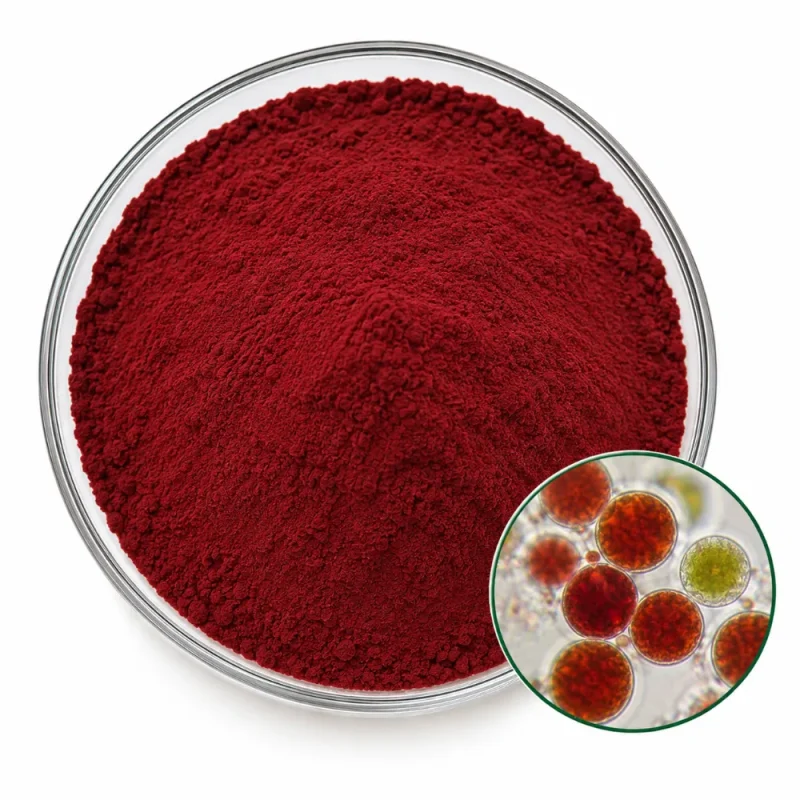
Typical Specifications

Specification ItemProduct Information
Natural SourceSolanum lycopersicum fruit
Plant PartFruit & Berry
ProcessingSolvent Extraction & Purification
Compound ClassCarotenoids
Chemical Name (IUPAC)(6E,8E,10E,12E,14E,16E,18E,20E,22E,24E,26E)-2,6,10,14,19,23,27,31-octamethyldotriaconta-2,6,8,10,12,14,16,18,20,22,24,26,30-tridecaene
CAS Number502-65-8
Molecular FormulaC40H56
Molecular Weight536.9
PubChem CID446925
InChIKeyOAIJSZIZWZSQBC-GYZMGTAESA-N
SMILESCC(=CCC/C(=C/C=C/C(=C/C=C/C(=C/C=C/C=C(/C=C/C=C(/C=C/C=C(/CCC=C(C)C)\C)\C)\C)/C)/C)/C)C
Purity90% (HPLC)
GradeFood / Dietary Supplement Grade
AppearanceDark Red powder
Solubility / DispersibilityInsoluble in Water
Quality Parameters
Moisture (LOD)≤5.0%
Total Ash≤5.0%
Heavy MetalsLead ≤2 ppm · Arsenic ≤1 ppm · Cadmium ≤1 ppm · Mercury ≤0.1 ppm
MicrobiologyTPC ≤1,000 cfu/g · Yeast & Mold ≤100 cfu/g · E. coli Negative · Salmonella Negative/25 g
Shelf Life24 months in unopened original packaging, cool and dry storage

Lycopene Purity Grades & Impurities

The 90% figure is an HPLC content against a lycopene reference, measured in a nonpolar solvent system because the molecule does not tolerate water. The method has to keep the sample dissolved and out of the light, since lycopene isomerizes and oxidizes in solution within minutes under bright lamps. A result that was prepared in the open, or in a solvent that gave a hazy solution, will read low.

The related substances are the other carotenoids of the tomato and the geometric isomers of lycopene itself. Beta-carotene, gamma-carotene and zeta-carotene appear as smaller peaks, and 5-cis lycopene is the most common cis-isomer in processed material. The colorless phytoene and phytofluene absorb in the ultraviolet and not in the visible band, so they need a different detection wavelength and are not counted by a visible-range lycopene assay. Oxidized lycopene fragments appear as the pigment ages.

Physical quality follows from the chemistry. A good crystalline lot is a deep red powder, and a lot that has faded toward orange or brown has lost chromophore even if the original HPLC content was high. Moisture and ash are limited separately in the table, and storage away from oxygen and light is the main protection of the grade.

Isomer balance is a quality feature that a single percentage hides. All-trans lycopene is the least soluble and the deepest red, whereas cis-isomers dissolve more easily in oil and look more orange. A lot with a high cis share can read the same HPLC content as an all-trans lot yet behave differently in an oil dispersion. Buyers who need a particular hue or dissolution profile ask for the isomer pattern of the chromatogram, not only for the total.

Lycopene Solubility & Delivery

Lycopene is insoluble in water and in most polar solvents, and it dissolves slowly in oils, chloroform and other nonpolar solvents. Even in warm oil, the solubility is low, and a solution that looks clear when hot may deposit crystals on cooling. The rigid, linear molecule is bulky and packs into tight crystals that resist wetting, so every practical delivery system is a dispersion.

Delivery approaches in principle are oil suspensions, emulsions, protective-matrix beadlets and complexes with proteins or cyclodextrins. Micronizing the crystals in oil raises color intensity and uptake into the matrix, while antioxidants and a nitrogen blanket slow oxidation. Copper and iron promote bleaching, so contact with metal surfaces and mineral premixes should be limited. In acidic or heated systems, color shifts toward orange as cis-isomers form, which is the usual first visible sign that a process is too severe.

Particle size is the lever that formulators control. Fine crystals present more surface to the oil and dissolve or disperse faster, while coarse crystals stay as visible red specks. Wet milling in a carrier oil under nitrogen gives a smooth, deep red paste, and the paste is then diluted into the bulk phase. Keep the batch temperature moderate during milling, because heat adds cis-isomers and shortens the working life of the dispersion.

Application Areas

Softgel Oil Fills

Softgels hold lycopene as a micronized suspension in oil with tocopherol. The fill is milled, degassed and encapsulated under nitrogen, and a light-proof pack matters because the deep red pigment bleaches quickly in daylight and the shell does not screen it.

Capsule Fills of the Crystalline Powder

Capsules take the 90% powder at a very small weight, so a two-step premix with a dry carrier is needed for uniform fill. The red crystals stain tooling and scoops, which calls for a dedicated line, a clean-down step and gloves for the operators.

Beadlet Feedstock for Dry Blends

Lycopene crystals are milled and spray-dried into a protective matrix to give dispersible beadlets. The crystal size sets the beadlet hue, and a sample from every lot is checked against a retained reference for color before beadlet production.

Color and Emulsion Systems

Emulsions for drinks and oil-phase colors use lycopene dispersed in a carrier with an emulsifier. Hue depends on particle size and on cis-isomer content, so an exposure trial at the intended processing temperature and under the intended shelf lighting precedes scale-up.

Packaging & Commercial Supply

Essencefield supports product evaluation, formulation trials, commercial orders, and ongoing ingredient supply. Packaging, storage, and shipping arrangements are determined by product characteristics, order quantity, stability requirements, and destination-market needs.

Supply ItemGeneral Information
SampleAvailable upon request for formulation, testing, and supplier evaluation
Order Quantities100 g · 1 kg · 5 kg · 25 kg · 100 kg · 500 kg · Bulk
Sample Lead TimeTypically 5–7 days after sample confirmation
Production Lead TimeTypically 15–30 days after order and specification confirmation
PackagingSuitable protective inner packaging with bags, cartons, drums, or other appropriate outer packaging
StorageStore in tightly sealed, suitable protective packaging in a cool, dry environment. Protect from moisture, heat, and direct sunlight. Specific storage conditions follow the approved product specification.
DocumentationCOA · Product Specification · TDS · SDS · Applicable declarations (as applicable)

Final order quantities, lead times, packaging, documentation, and shipping arrangements are confirmed according to the selected product and commercial requirements.

Request Ingredient Specifications & Quote

Share your target specification, application, quantity, and documentation needs. We’ll help confirm suitable options, samples, and commercial supply details.